
Hello, welcome, come aboard. You recall from our last post that we had loaded up Longo with enough food to last another day or two, and we had motored on down to one of my favourite places in world. From a sailing point of view, the weather hasn’t been particularly kind to us, but what we’ve lacked in wind we’ve picked up in mild days filled with sun. Those that have sailed the Turkish Coast will know of Gemiler Adasi or Camel Island and its rich history and unique anchorage opportunities. Warning: There are secrets herein that are not for kidlets.
Gemiler Adasi is a small bat shaped island (at least on the map) just a few short hours from Fethiye. Ian and I have now been here three times, once on our own and then twice to show off the island to family and friends. This time we were showing Ned this wonderful place and we were met by SV Soultrain and of course SV Chill came along.

2. Me and Ian on our first visit almost 18 months ago.
3. Ian with Charlie and Megan on our second trip last year
4. Ian and Ned this trip. They each speared a fish. We didn’t eat the lion fish (the red one which has nasty spines) but we did fry Ned’s catch and it was a delicious morsel.
5. Ray and Ali still look like they are loving their new floating life
6. Amanda and Trevor from SV Soultrain and Karon from SV Sea Dreamer.
Anchoring at Gemiler Adasi is very special. All boats Med moor (also known as lines ashore) to the island or the main land, which is just 200 metres across the channel. Med mooring means in addition to dropping the anchor you tie back two lines to rocks or bollards on the shore. The benefits of this configuration is that it offers stability from the swell and wind, and it keeps the boats neatly out of channels and thoroughfares. More importantly you have your very own little Med pool between your lines, where you can swim, snorkel and float about. Of course many folk will happily swim, kayak, SUP and dinghy right through your little haven, lifting your lines as they go. It’s a great way to meet people. Many sailors hate Med mooring, as it’s a bit of a nuisance to set up. Someone has to go to shore with extra-long lines and tie them to something solid enough to take on the job of holding your boat steady in a strong wind. On Longo this job is mine. Some brave souls dive off the back of their boats with lines over their shoulder and swim ashore. Others use SUPs. After watching many professional gulets, we have opted for me taking the dinghy to shore, complete with all the lines. I then secure the lines using chains to a rock, bollard of on rare occasions a tree stump (never a living tree) and then driving the dinghy back to Longo trailing the lines in the water. This often requires me to scramble over slippery and ragged rocks. I feel quite the adventure girl, with my handy multi-tool, flinging chains and ropes around. Meanwhile Ian drops the anchor on Longo and reverses back to meet me. This works for us as it gives me plenty of time to find a good solid spot to tie to without Longo hanging on the chain at the mercy of the wind. This is especially important as you are often in close proximity to other boats also tied back. This process also keeps the floating lines under control and away from Longo’s prop and as Grand Petit Bateau (GPB, Our tender) has a depth sounder so I can give Ian depth details via our walkie talkies, reducing the risks of Longo’s keel getting a good polish. It’s taken me a long time to get my technique down but the last couple of times have gone well. Let’s hope I’ve not now jinxed myself. During our most recent trip to Gemiler Adasi it was even easier as Ned came along with me. Having our Monkey Boy’s hands were very welcome especially when it means I don’t have to get wet getting in and out of GPB.
Back to why Med mooring at Gemiler Adasi is so special, other than having Ned along helping, of course! Gemiler Adasi has substantial ruins right down to the water’s edge and is the only place we’ve been where it is acceptable to tie back to those ruins. The same ruins where square riggers docked on their way to the crusades. Where we were positioned there were underwater ruins less than ten feet from the transom (back of the boat) with fish swimming among them and Ned spent an afternoon trying to spear a squid just off the side of the boat.
Our visit was very peaceful compared to the height of the season (June, July, August) where boats fill both sides of the channel and obnoxious pirate Gulets thread their noisy way between playing very bad 80’s or Turkish music (which is also probably 80’s music). To top this there is a jet boat that weaves among the anchoring boats pulling donuts of inebriated thrill seekers behind. There’s also the Pappa and Mumma in their little traditional boat offering to help with your lines for a small fee; they also sell homemade bread. The tourists are vomited out of these boats to swim and explore the island for an hour or two, then they are summoned back onboard by an almighty horn, and thus they leave us in solitude until the next boat arrives. Many hate this aspect of the island. I did the first time we were there. Now I see it as part of the atmosphere of the region. Of course, I’d still hate it if it wasn’t for the fact that the Gulets and other day boats all leave by mid-afternoon, and we are left we the solitude of an amazing location with stunning sunsets and sunrises.
All of this is marvellous and worth the visit but for me it’s the ruins on the island and their rich history that makes this place so special. I suppose given my previous posts that won’t surprise most of you. If nothing else gives away why these ruins are so special its English nickname will. You see this island is known as St Nick’s island. And yes, it’s that “Saint Nicholas”!
The island has ruins dating back to 4th – 6th CE and include five Greek churches and a 350 metre covered processional walkway. The walkway was built because the monks weren’t keen on getting cold and wet on their way to and from church. There are also over forty ecclesiastical buildings and fifty odd tombs, littered throughout the island.

2. An example of the pirate boats that bring their slaves (I mean tourists) to the island
3. Ian and Ned can’t resist a chance to get up close and personal with history
4. The ruins and historical aretfacts are so plentiful that many are left to the elements.
5. A section of the covered walkway. The walkway is decorated with a simple fish pattern or perhaps it is the ubiquitous Evil Eye you see everywhere in Türkiye and Greece (however that might be a bit pagan for the ol’ monks)
6. Another of the churches. This one has an painted icon still visible on the wall. It has been defaced but otherwise it is quite clear
There are records indicating that the island was used as a stopover for pilgrims on their way to the Holy Lands. I’ve just finished reading an excellent book, called the Order about the Knights of St John of Rhodes (Hospitallers). The Knights were pushed back to Malta where they successfully defended the island from the Ottoman hordes in 1565. This book suggests that the siege of Malta began as retaliation for the knights capturing the Suleiman the Magnificient*, the Ottoman ruler’s flag ship called the Sultana. This great sea battle was said to have occurred just of the coast of this little island and the reason the knights were successful was because they hid their fleet in the very same channel that our little boat was moored. The knights waited for the Ottoman fleet to pass by and attacked the smaller weaker boats at the back of the fleet leaving the Sultana’s flank unprotected and given her size she was unable to manoeuvre to protect herself with the enormous canons that she carried. Consequently, the Knight’s were able to take the Sulatan and her booty for their own.
If tales of knights, sea battles and such is not enough, I can take you back even further into history, to explain the origins of the English nickname for the island.
If I had been asked before coming to Tϋrkiye where St Nick came from I would have said one of the Nordic countries. The image in my head of old St Nick, is the one with the long beard and robes decked out with furs and a long wooden walking stick. Kind of like, Gandalf on a winter’s day. I didn’t realise how wrong I could be. St Nicholas and was of Greek decent, likely of dark or olive complexion but he probably had an impressive white beard when he died. He was born in the maritime city of Patara in Anatolia (part of the modern day Antalya Province, not far from the lovely town of Kas, Tϋrkiye). He is believed to have lived between 270CE and 343CE. Making him 73 years of age when he died which is very old for the time period. St Nick is also known as St Nick Of Myra (in Tϋrkiye) and St Nick of Bari of Italy (where most of his bones are located**) and more delightfully as Nicholas the Wonderworker!
Ol’ St Nick was a busy man. He is the patron saint of merchants, archers, repentant thieves, children, brewers, pawnbrokers, toymakers, unmarried people, students and, in one academic source, prostitutes. Second most importantly (after children not the prostitutes) he is also the patron saint of sailors. So if you are an unmarried cabin boy, with a profitable brewery on the side, who likes to whittle toys of other kidlets when not learning more about the economic benefits of expanding into money lending and pimping, then St Nick is your go to Saint for all your spiritual needs. Am I going on the naughty list for this?
Of course, you don’t become a Saint without delivering on the miracles and St Nick is said to have done his bit, though some of his “miracles” are less miraculous and more virtuous deeds. My favourite two stories are:
- There is painted and written evidence to suggest that St Nick saved three young girls from prostitution. Their father was so poor that he was unable to provide dowries and no alternative than to “sell” his daughters to pay his debts. St Nick felt that this was unacceptable. However, the proud father would not accept charity openly, so the crafty Saint crept up to the families house in the dead of night and threw through a window in a bag of coins sufficient to pay a dowry for the first daughter. Once she was married off, he did this twice more for her little sisters. The father of the girls caught St Nick in the act of providing the third bag of coins. And there you have it! The basis for the tradition of some crazy old mystical dude coming into your home in the dead of the night and giving your children presents.
- While the story of the three girls is delightful and it answers a question, I didn’t know I wanted to ask. The next story is just outright bizarrely cool. There is a tradition of painting St Nick standing over three small children who are standing in a cauldron over a hearty fire. The kidlets are looking up at St Nick with love and adoration. That’s because St Nick saved these kidlet’s from a fate worse than a fate worse than death! The story goes that St Nick happened upon a butcher who had few wares to sell due to a famine. He “obtained” three kidlets that he decided to pickle and cook, and then sell as bacon. St Nick was not impressed and apparently brought the kidlets back to life despite them having already been pickled and spirited them away before the butcher was aware of what was happening. Lover of kidlets and good quality ethically sourced bacon. My kind of Saint!
St Nick is one of the most revered and renowned Saints in Christendom. There is a great deal of evidence to show that St Nick’s relics (I.e. his bones) are the most well documented and are scattered across Europe. According to carbon dating those in Bari and the UK (I think) are most likely to be the actual bones of the Saint himself. More often than not Saintly relics have been shown to be medieval fakes.
I guess you’re wondering what all this talk of St Nick has to do with Gemiler Adasi. Or maybe you’ve already figured out and I don’t need to say he was said to have lived on the island. In addition, according to writings at the time, this was where he was also originally burried. There is a church hewn from solid stone on the highest point of the island (the big one in the first picutre above). To protect St NIck’s bones from desecration by the invaders, they were moved to Myra (now known as Demre), on the mainland south of Gemiler Island. In 1087 they were moved again to Bari in Italy where many of them still remian in the Basilica of San Nicola (this move was without the permission of the appropriate ecclesiastical bureaucrat responsible for them); subsequent to this some of the relics were taken to Venice during the first crusades.

2. This beautiful painting is Russian.
3. St Nick saving the pickled kidlets (I wonder if when they say “pickled” they mean in brine or that the toddlers were stonkered? If it was the second then St Nick may actually have evented the only hangover cure that may have actually worked!)
4. These three lovelies must have been very grateful to Saint Nik that their father was able to pay a dowry to their husband rather than the ladies being paid to service men.
There are paths all across the island you can follow that take you to most of the interesting places and there isn’t much you aren’t allowed to see or touch (except some fine mosaic floors in St Nick’s church at the top of the island and few places deemed unsafe). Gemiler Adasi in Spring is stunning, there are poppies and other wildflowers blooming everywhere throughout the ruins. There’s even a stray cat that lives on the island and plenty of bird song that livens the morning air. I’d like to think that at some point in my three visits I’ve touch a stone wall or walked a path that St Nick might have once touched or walked.
In future I would advocate leaving out Ol’ St Nick a nice strong Turkish coffee or maybe the ubiquitous chai and a slice of Turkish Delight or perhaps Baclava.
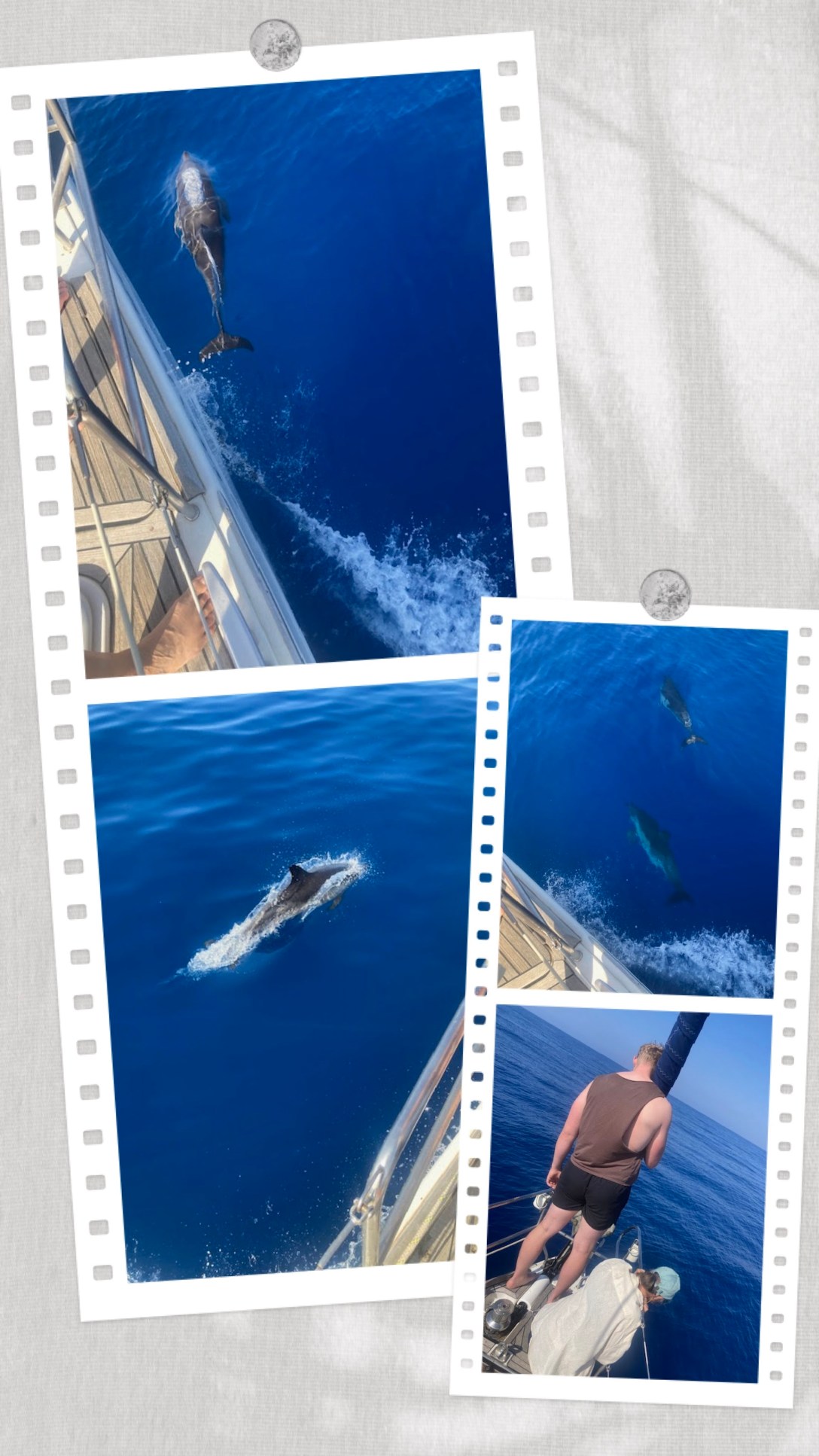
To put the cherry on top of our time at Gemiler Adasi, during our trip back to Fethiye, we were treated to the longest and most spectactular visit from St Nick, Patron Saint of Sailors, Guardians of the Big Blue Wobbly, aka dolphins, that we have ever seen. Two of these beautiful creatures joined our boat shortly after we hit the open sea and they stayed with us for a staggering half hour or so. During that time they cruised along our bow, darting off ahead to do back flips and skip along the swell. They were clearly playing and showing off. After every feat they would return to the boat and roll on their sides to look up at; you could all but hear the “did ya see that!” Finally they darted off. probably to hunt out a nearby school of fish.. Even their departure was impressive in its synchronicity and speed (probably twice as fast as our boat speed).

*If you doubt the smarts of dolphins I recommend you read “Hitchiker’s Guide to Galaxy” by Douglas Adams.
I normally leave you with fair winds and a dearth of sea monsters but today I think I will add the blessing of Saint Nicholas, the Patron Saint of sailors and children (for I like to think that we should all be young at heart).
*Suleiman’s full title: Suleiman the Magnificent, Sultan of the Ottomans, Commander of the Faithful, Shadow of God on Earth, Protector of the Holy Cities of Mecca, Medina and Jerusalem, Lord of Lords of the World East and West. I suspect his mother called him Sully when he was good and just Suleiman the Wicked when he was a naughty boy.
** the location of St Nick’s bones this has been confirmed through historical records.

 Sailing Longo Maï
Gre
LikeLiked by 1 person
What an adventure, so much wonderful history that we don’t learn about! And dolphins – I was skipping along the deck with you 👏👏👏👏
LikeLiked by 1 person
The dolphins are such a joy! They always leave me a little euphoric and hyped. I swear the emir “good will” vibes. 🐬🐬
LikeLike
A most entertaining and educational read!
Your pix are a bonus but one cannot help but feel “transported” when reading your anecdotes!
What a fantastic adventure!
LikeLiked by 1 person
Aww. Thanks Rowie! I’m so very glad you’re enjoying the blogs.
LikeLike