

Hello, welcome come aboard. You may recall our last post covered how we ran the Çanakkale Straits and zig-zagged through the Sea of Marmara finishing at the Kalamış & Fenerbahçe Marina, on the Asian side of Istanbul, which would be our home for two weeks.
During our first few days we met co-owners of the lovely boat next door. Owner No 1 was an excitable but polite lad. When Ian accepted his offer of a beer and tour of his boat, he discovered that Owner No 1 had no sailing experience and had hired himself a professional captain to teach him the ropes. Ian returned to tell me he was reasonably certain Owner No 1’s excitement was chemically induced but after a couple of beers both their interpretative dance skills improved and they got along just fine.
The next day we met Owner No 2 who was less excitable but also a newbie. He was there to have his first “solo sailing and docking” lesson. Owner No 2 earned the moniker “Captain Crashy”, as he made the action in “Speed 2” look sedate. Ian’s opinion of Captain Crashy was probably made a little too obvious when he issued the command, “all fenders to port!” Having gone through this stage just 12 months ago, I was somewhat surprised when over dinner that night Ian rather cheekily commented, that “for a nation of seafarers, it was outrageous that someone who hadn’t grown up sailing dinghies would be allowed to purchase a full size sailing yacht and that there should be a law against it!” Since I know how much Ian loves a bad dad jokes I laughed politely and didn’t remind him that we also fit in this category!
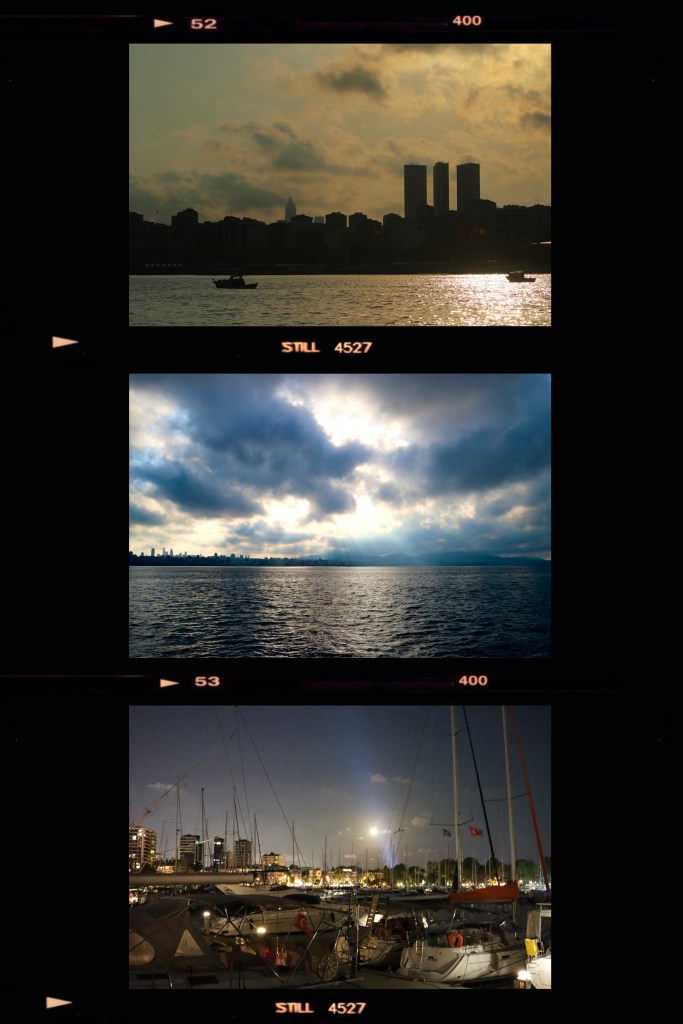
3 – Kalamış & Fenerbahçe Marina
Confident that both owners had eventually embraced the “slow and steady” method we felt it was safe enough to leave Longo and go exploring Kadiköy with Janine and Craig of SV Inelsamo.

The history of Kadiköy is quite impressive. Whether myth or fact the story goes like this: Back in 7th BCE King Nissos, ruler of Megara Greece, had an avaricious son called Byzas. The king, not liking the regicide twinkling in his son’s eye, went off to seek divine parental guidance from the Oracle of Delphi. (Sidebar: The Oracle of Delphi was the preternatural adviser to all the cool rulers. She was originally “belonged” to Galea (Mother Earth). That is until she was stolen away by Apollo.)
The Oracle told the old King to send the Prince on a quest to find the “the city of the blind” because this is where Byzas would earn his fame and fortune. Byzas decided that a bit of questing might be invigorating and if nothing came of it he could always return to pop off his old Dad later.
After a good long while adventuring with the obligatory fighting, pillaging and general mischief included, the Prince tired of the quest and decided to make camp on the Western shore of the Bosphorus Strait before heading back to see about his father. As the prince and his cronies looked across to the Eastern shore they saw, to their surprise, the Megara colony called Chalcedon. One of the Prince’s Generals laughingly said of the Chalcedonians “they must be blind! This shore is far superior, with its fertile farmlands and naturally defensible estuary. What were they thinking!” (the estuary is known as the Golden Horn).And so the Oracles prediction was fulfilled, Byzas, not blind to the virtues of the Western shore, made it his home; naming it Byzantium” after himself.
Shortly after, Byzas’s little settlement took off and other began to covet his is land. In 330 CE Emperor Constantine, the Emperor divided the Roman Empire into East and West. He took Byzantium for himself and being another shy and retiring type, renamed it Constantinople and called it his own and ruled the Eastern Roman Empire (or the Byzantine Empire) happily for quite a while.
During Mustafa Atatürk’s restructuring of modern Turkey in 1923, Constantinople was formally renamed Istanbul, which is what the locals had called it from time immemorial. Istanbul means “to the city”.
What became of the little settlement on the Eastern Shore of the Bosphorus Straits known as Chalcedon? It was an early centre for Christianity. The Council of Chalcedon was asked to deliberate on some pretty heavy Christological questions aiding in the foundations for many Christian ideologies that are still maintained today.
However it would have been a tad uncomfortable to be a Christian in Chalcedon at times since it was occupied by the Persians, Romans, Byzantines, Arabs, and the Ottomans. The crusaders had a good go too. Chalcedon remained “independently governed” until the mid-1400s when the Ottomans brought it officially within the boundaries of the great city-state of Constantinople and renamed the town “Kadiköy”. This means “the Village of the Judge” and honours its role in the birth of the great city that is now known as Istanbul.
The Kadiköy that greeted us was a leafy bayside suburb teaming with beautiful people lounging in trendy cafes or walking through verdant parks on their way to and from high rise apartments and vintage summer style mansions. At its heart is a transportation hub connecting East and West Istanbul by ferry, bus, taksi, dolmuş and the underground metro. Quayside hosts many market style stalls selling everything from flowers to doner kebabs and buskers in the afternoons. This area is a thriving mix of locals and tourists all politely mingling. The local commuters are remarkably tolerant of the visitors to their shores. I’ve noticed that even the most harried office worker struggles to wallow in their misery when they commute by ferry. I think it’s the dolphins playing around the ferries that does it.
Just behind the ferry terminal lies a traditional bazaar. The cobblestone lanes are crowded, mostly with locals shopping for Tursu (Turkish pickles), dried vegetables, lokum (Turkish delight) and other staples. The chatter of the pedestrians and hawkers compete with the inescapable buzz of mopeds being ridden by all and sundry through the crowds. We have become attuned to the practised daredevilry of these moped riders as they weave amongst traffic and pedestrians. Ian doesn’t miss a step as he pulls me (usually with camera in hand) out of the way.
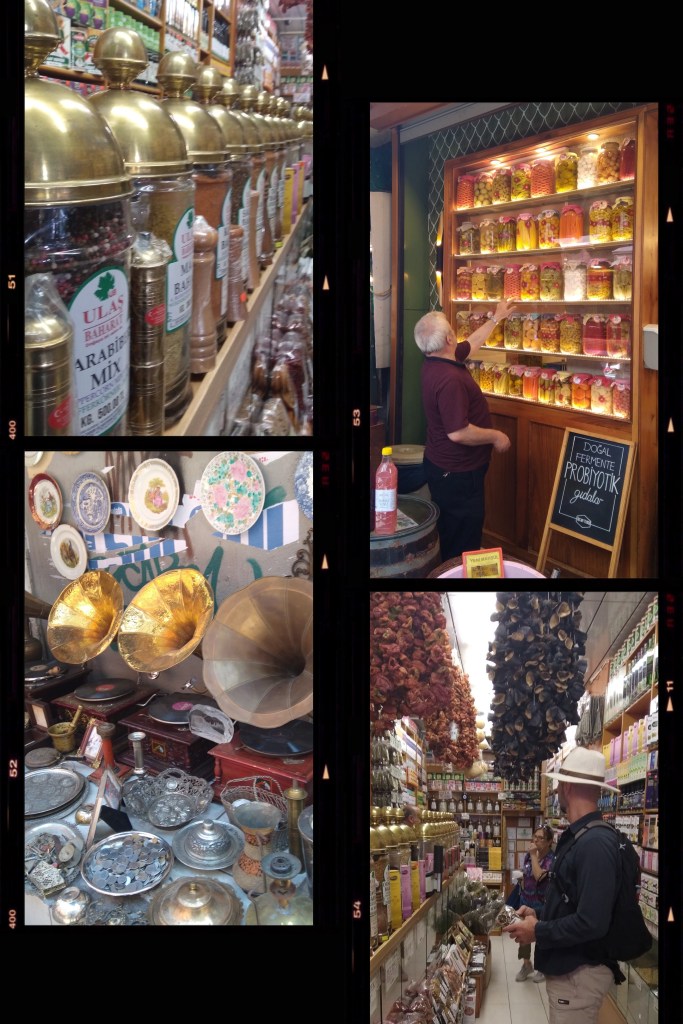
It was here that we found Yanyali Fehmi Lokantasi, a cafeteria style restaurant. These kinds of restaurants are common in Türkiye. They serve the hardy home-style meals and çay (tea) favoured by the locals. They’re almost always owned by families, serving their own take on traditional recipes. Thankfully, Yanyali had an English menu with their family history printed in the front. Without this we would never have known that Husyin from Bolu, the founding chef of the Yanyali restaurant, was once the Head Chef at the Topkapi Palace during the reign of the last Ottoman Sultan, Mehmed VI Vahideddin. Lofty ancestry indeed! Especially since the Sultan’s kitchen fed up to 4,000 royals and other officials daily. To achieve this, Husyin would have been in charge of 800 people and the kitchen sported no less than 20 chimneys.When the Sultan was expelled by the Grand National Assembly of Türkiye, Huysin was imprisoned by the British. (The British occupied Istanbul for a time toward the end of WW1.) on his release, he was hired by the founder of the restaurant, Fehmi Sönmnezler from Yanya. When we decided to take a seat outside this unassuming restaurant it was being run by Fehmi’s Great-Grandsons: Tansel Can and Ergin Sönmnezler.
Ian, overwhelmed by all the tasty choices (over 100 different dishes are made each day), decided he would enlist the assistance of a friendly waiter called Ergin. Using his go to question: “what’s your favourite?”. Having snaffled the best selection for himself, Ian bought the waiter back to our table to help the rest of us decide. In the end, we tried a variety of mains; lamb with onion, slowed cooked lamb, Begendi Kesap and zuchinni fritters.
When Ergin pried himself away from our table to serve someone else we realised our “waiter” was in fact the owner Ergin, the Great-Grandson of Fehmi, the original owner. Ergin returned as we chatted with him about his family history and the great food on offer. With much pride he told us that his Great-Grandfather had worked in the restaurant until he was 98 years old. (While it wasn’t spoken of directly, we came away with the impression that Ergin was also related to the chef, Huysin. Perhaps Huysin’s daughter married one of Fehmi’s sons?)
I guess our rapt attention to his stories impressed Ergin because he disappeared momentarily only to return with a number of delicious mezzes. Initially we all refused the dessert options, however Ergin, with an especially mischievous smile, insisted we try the house specialty. The origins of this desert is something of a mystery. Some suggest it dates back to the Byzantium era. Others argue it comes Arabian lands. According to Ergin it was speciality at the Topkapi Palace and something Huysin regularly made for the Sultan.

When he presented the dessert, he told us it contained a very special ingredient and challenged us to figure out what it was. It looked like white slime with a sprinkling of brown dust or dirt. It wasn’t a bad, smelly, get out the rubber gloves and disinfectant kind of slime. When I poked it wobbled just like the slime I made as a kid (cornflour and water); it was all shiny and blobby. It had the texture of blancmange and the flavour was surprisingly sweet. The kind of thing you’d feed to someone who’d just had their tonsils out. After our first taste, we all had a go at trying to figure out the secret ingredient. Even when Ergin told us it was called Tavuk Gögösü Pudingi, Ian, our linguistic gastronomer, wasn’t able to guess the secret ingredient.
Right! So guess, right about now you’re saying “Yeah, yeah, telling us what it is.” Well, it’s all in the name.
“Tavuk Gögösü Pudingi” translates to “Chicken Breast Pudding”.
You make the dessert by cooking chicken breasts for 6 hours, you shred and beat that smooth, mix it with sugar, rice-starch and milk (Ergin told us they use buffalo milk). Once it’s set, it’s sprinkled with cinnamon or nutmeg. Ergin was immensely pleased that we’d scoffed lot even after the big reveal. It was so delicious. I would have licked the plate but Ian wouldn’t let me!
At first we thought we’d only need a couple of days to see all that Kadiköy and Istanbul had to offer. It turned out that two weeks in Istanbul isn’t nearly enough! It’s a start but I’m not sure a lifetime would be “enough”.
Shortly, I will post Part II of our adventures until then fair winds and a dearth of sea monsters for your journey ahead.

 Sailing Longo Maï
[…] the lay of land, we planned our assault on Istanbul, we took time to first explore Kadiköy (see Part I). Then the following day we set off early to hit to the big attractions. The history of most of […]
LikeLike