Pilots and Masons, the wisemen of Constantinople – Part III of Istanbul.

Hello, welcome, come aboard. Today’s blog rounds out our adventures in Istanbul. It truly was a once in a lifetime adventure and somewhere I never envisaged myself visiting. We are now just beginning our adventures in Greece, which includes a visit from Ron, Marissa and our little Charlie Love. In the meantime, here is Part III of our adventures in Istanbul. I will also write about our adventures in the Marmara Sea including our visit to Gallipoli soon but first meet Taksim Square and Fener-Balat.

Taksim Square and Galata Tower: Ian had some very important boat job that required him to head down to a suburb that wouldn’t rank on the top 100 places to visit in Istanbul. Thankfully Janine and Craig of SV Inelsamo invited me to tag along on their visit to Taksim Square. So I ditched Ian’s adventure to nowhere and went off to explore with our friends. Janine and Craig had visited Taksim Square before and were the very best tour guides. We ferried across the Bosphorus, then hopped on the Füniküler* that takes you to the top of the hill. *Fun-nik-ul-er; now there’s a word, it clatters over your tongue like a mouth full of lego.

Taksim Square is on the European side of Istanbul and I wasreliably told that it was less touristy than where all the big icons are in old Town. It was still touristy, just less so. A little like comparing the Sunshine Coast with the Gold Coast. For non-Australians apologies for the local reference, please transpose two of your own holiday locations where one is sheer bloody madness and the other is just madness.

Taksim means “division” in Arabic. In times gone by all the water sources for the European side of Istanbul converged here before being funneled of to other parts of the city. Nowadays this impressive square is the heart of the local Istanbul life. The square is lovely but I think Janine and I really started to enjoy ourselves as we walked along İstiklal Caddesi (Independence Avenue), a long pedestrian shopping street, that begins at the Square and leads down the hill towards the Galata Tower and on to delightful laneways that end at the Golden Horn.

Independence Avenue is much like any big city mall. We recognised many shops, name brands and takeaway joints. The significent difference, from the malls in Australia, were the stately vintage buildings. It was still a public holiday so there was a chilled vibe to the pedestrians, local and tourists alike. Janine and I shopped while Craig patiently wandered ahead. It was such a lovely “normal” day. Shopping with friends, trying on clothes, stopping for a bite to eat. Normal from our old life, one of those normal things that you miss only when you return to it after a while.

Along the way we stopped to view the Galata Tower. The original tower was built during Byzantine period (527-565 CE). This poor building has had a somewhat traumatic existence! It was destroyed by fire and folk alike, rebuilt, repurposed, and forgotten by just about every occupier of Byzantium-Constantinople-Istanbul. It’s been a fortified watchtower, fire watch tower, prison, religious sanctuary and more recently a museum. In doing my research into the Tower’s history I came across this quirky little tid-bit, which is just too good not to share.

Hezârfen Ahmed Çelebi, (1609 – 1640) was an Ottoman scientist, inventor, chemist, astronomer, physician, Andalusi musician, and poet from Constantinople. According to one source* Hezârfen means “a thousand sciences” and the title was bestowed upon Ahmed as an acknowledgement of his wisdom. All this at the ripe old age of twenty-three. (Don’t you hate under-achievers!) Ahmed is credited, by at least one contemporary source, as having achieved sustained unpowered flight. He achieved this by strapping on a pair of wings and jumping off the Galata Tower. Remarkably he is said to have landed about 4 kilometres away, on the Asian side of the city. Making this the world’s first intercontinental flight, and the fourth sustained unpowered flight ever recorded. It’s said his inspiration came from the birds and Leonardo Da Vinci’s of course. *hezarfen-ahmet-celebi-the-first-man-to-fly

However being known for your wisdom in 1600 Constantinople was not… well… very wise. It seems that Sultan IV Murat decided our erstwhile genius was “somebody to be afraid of. Someone, who could get whatever he wants and therefore was somebody illicit”. Not wanting such greatest to overshadow him the Sultan gave Ahmed a bag of gold before sending into exile in Algeria where Ahmed died at the age of thirty-one.

Not to be outdone, Ahmed’s brother, Lagari Hasan Çelebi may have survived a flight on a seven winged rocket powered by gunpowder from Sarayburnu, the point below Topkapı Palace in Istanbul (1633). Lagari was obviously wiser than his brother as before launching his craft he joked with the Sultan Ahmet IV “Oh my Sultan! Be blessed, I am going to talk to Jesus!”. When Lagari landed in the sea he swam ashore and quipped “Oh my Sultan! Jesus sends his regards to you!”. For his efforts the Sultan gave him a bag of silver and the rank of Sipahi in the Ottoman army.
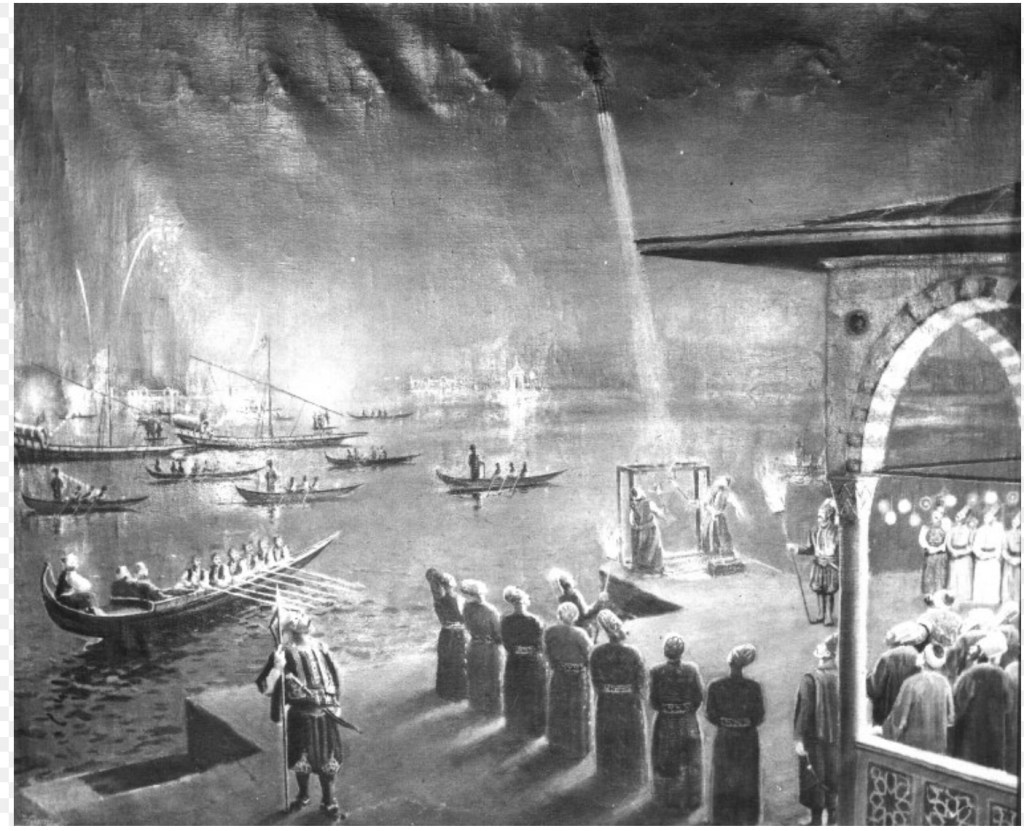
Courtesy of Wikipedia

I love a good conspiracy, and wonder if little brother, Lagari had a hand in his brother’s exile. There is after all no competition greater than that between siblings.

Unsurpringly Wikipedia suggests the authenticity of Evliya Çelebi, the Ottoman traveller who documented these events, may not have been reliable. To further erode the validity of an otherwise crackin’ good story in November 2009 Myth Busters tried to recreate Lagara’s flight. However, Evilyas account did not contain sufficient technical detail or the experiment to confirm or debunk claims. Myth Busters concluded that it would have been “extremely difficult” for a 17th-century figure, unequipped with modern steel alloys and welding, to land safely or even achieve thrust at all.

Eyüp and Fener-Balat Suburbs were our last grand adventure in Istanbul and it was one of my favorites for two reasons: it was somewhat unplanned and it was all about the ‘burbs. I’m being a tad cheeky saying this adventure was unplanned. Craig and Janine had a Plan A, Plan B and I think Plan C. These were based on the ferry timetables and our group desire for trekking. Plan B was taking the ferry up the Golden Horn (insert giggle here). There were some interesting sites along the Golden Horn, some beautiful and some downright curious. We left our ferry at the last stop in the municipality known as Eyüpsultanmet or Eyüp.
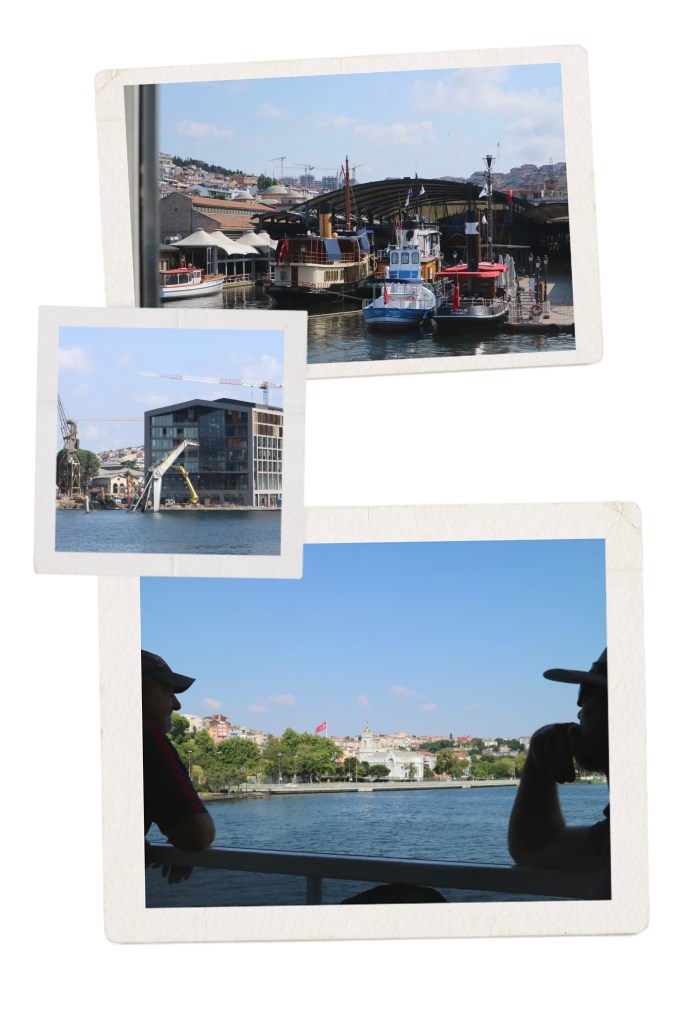
The crane is fully submerged up to its lifting arm. We aren’t sure if that’s intentional or whether someone had an oopsie.

Like the rest of the Istanbul habitation in the area dates back to the Byzantine era. There was a monastery (founded circa 480 CE), saints performing miracles (circa 518-565 CE and more in the 1200s ), some equally important civil wars, some seiges, a coup, attacks by crusaders, state meetings and visits by quite a few historical notables. So like the rest of Istanbul a place with a past and a character all of its own. The municipality has numerous churches and many more Mosques. The Eyüp Muslim cemetery is one of the oldest cemetries in Istanbul and which was very popular with sultans and other important dignitaries as the tomb of Ebu Eyyûb el-Ensarî (or in modern Turkish Eyüp Sultan). Ebu was close companion (sahaba) of Prophet Muhammad, he died during a raid against Constantinople and wanted to be buried as close as possible to the city walls.

The Eyüp we saw was a mix of old and new. More old than new with a definite working class feel to it. There was a lovely green park along the Golden Horn but it was overshadowed by major roads and shady backstreets. Not “drug lords, pimps and muggers” kind of shady. Though perhaps overnight? Who knows? Still the neighborhood had its charms at least in the daylight.
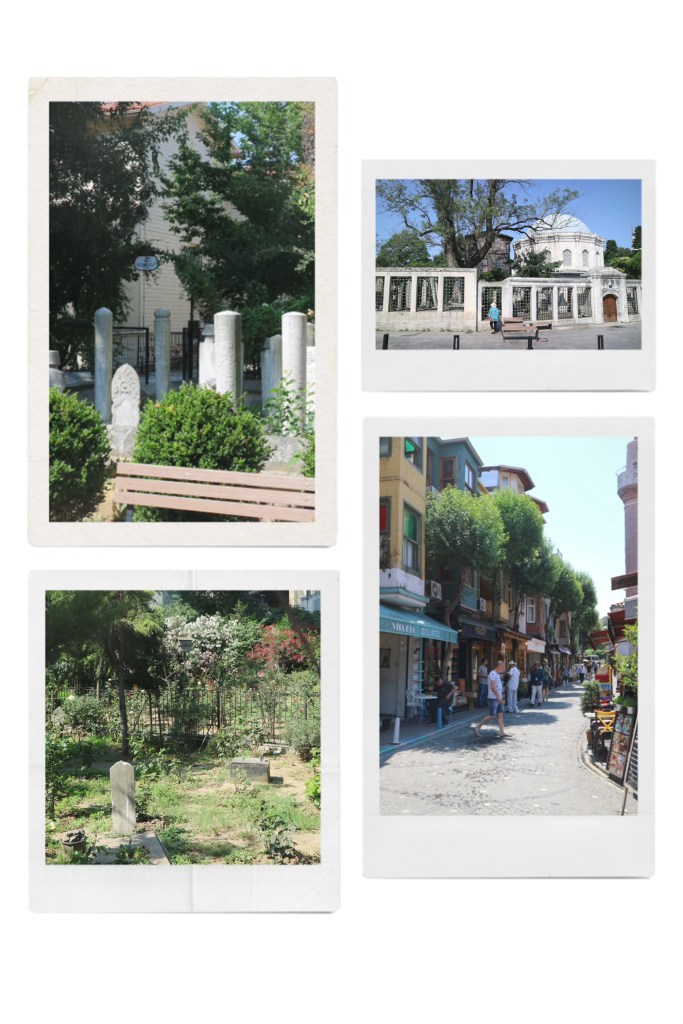
The white and grey pillars are grave markers.

We continued on our way and found ourselves in Fener-Balat. These were once the Jewish and the Greek quarters of Istanbul. In the mid 1500s Sultan Bayezid II offered citizenship to Jews and European Muslims fleeing the Inquisition in Spain and Africa, and the 1492 Alhambra Decree (forced expulsion of the Jewish population from Spain). Many of these refugees settled in Fener-Balat. However, Fener-Balat today is overwhelmingly Muslim, with most minority populations having left the district or were forced to leave as a result of the Armenian genocide and the Greek-Turkish “population exchange”.

These suburbs are an odd mix. The joyful sherbert hued buildings and the river create a pretty facade behind which lurks a dusty rabbit warren of mid-1800 and 1900 apartment buildings in varying states of disrepair. We came across the weekly pazari (fresh food market) in one back street. Going by the chatter that followed us through the market the locals were not accustomed to having tourist wander so far back in the suburb. They were friendly and curious though reserved. Other parts of the suburb are geared up for tourists with funky cafes, groovy shops and crazy curiosities.

Two notes:
1. The impressive red building is the Church of the Virgin Mary of the Mongols
2. I may have threatened Ian with the purchase of the sunflower ‘kini top and/or adoption the kitten. Ian was more concerned about the kitten than the top!

Throughout these suburbs there are remnants of the ancient Walls of Constantinople . These walls are some of the most substantial and long lasting defensive additions to Constantinople. The first walls were built by the Emperor Constantine. They are said to be “the last great fortification system of antiquity and one of the most complex and elaborate system ever built.” (wiki). Countless improvements, repairs and additions have been undertaken throughout history. While many of the ruins that remain date back to the Ottoman period, it is the double line of the Theodosian Walls built in the 1400s that are considered the penultimate defensive structures. At the height of their use these walls were impregnable. They withstood sieges by the Avar-Sassanian coalition, Arabs, Rus’, and Bulgars, among others. The introduction of gunpowder siege cannons being the only credible threat to the fortifications. The siege cannon used was 8m long and fired a 700kg projectile 2.5km, but it could achieve a maximum rate of fire of 3 rounds per day. Even this level of cannon technology was insufficient to capture the city on its own. Through a combined effort the walls were finally breached and Constantinople fell under the sheer weight of numbers of the Ottoman forces on 29 May 1453. (This willingness to accept incalculable deaths in order to achieve a goal is a recurring theme in Ottoman and Turkish history.)

The walls were largely maintained until the 1800s when the city outgrew its medieval boundaries, and sections were dismantled and repurposed. Despite lack of maintenance and wanton “recycling”, many parts of the walls are still standing today. In the 80’s a large-scale restoration program begun and the remnants are now mostly protected.

The segments of wall that we came across during our walk were well tended. They were “repaired” not “restored” using wooden frames to support crumbling parts of the structure. In other parts of Istanbul the walls are incorporated into more modern buildings. We saw numerous examples of modern houses being built on top of the ancient walls or have repurposed these walls as retaining walls.

It’s a little hard to see, but behind the scaffolding in the large picture remains of the Theodosian Wall have been removed so that the modern house behind can have a view of the Bosphorus.

It was a great day of adventuring, with lots of stops to eat, drink and be merry on the way. It ended with Ian attempting to drag us back to see his fireworks dealer. However, the heat and crowds of the Bazaar bested us and we headed back to our floating homes.

Not long after this we moved on to the satellite town of Yalova where we encountered the dreaded pterodactyl but that’s a story for our next post.

Fair winds and a dearth of sea monsters on your travels through life.

Kadiköy – You’d have to be blind not to love it (Istanbul Part I)

Hello, welcome come aboard. You may recall our last post covered how we ran the Çanakkale Straits and zig-zagged through the Sea of Marmara finishing at the Kalamış & Fenerbahçe Marina, on the Asian side of Istanbul, which would be our home for two weeks.

During our first few days we met co-owners of the lovely boat next door. Owner No 1 was an excitable but polite lad. When Ian accepted his offer of a beer and tour of his boat, he discovered that Owner No 1 had no sailing experience and had hired himself a professional captain to teach him the ropes. Ian returned to tell me he was reasonably certain Owner No 1’s excitement was chemically induced but after a couple of beers both their interpretative dance skills improved and they got along just fine.

The next day we met Owner No 2 who was less excitable but also a newbie. He was there to have his first “solo sailing and docking” lesson. Owner No 2 earned the moniker “Captain Crashy”, as he made the action in “Speed 2” look sedate. Ian’s opinion of Captain Crashy was probably made a little too obvious when he issued the command, “all fenders to port!” Having gone through this stage just 12 months ago, I was somewhat surprised when over dinner that night Ian rather cheekily commented, that “for a nation of seafarers, it was outrageous that someone who hadn’t grown up sailing dinghies would be allowed to purchase a full size sailing yacht and that there should be a law against it!” Since I know how much Ian loves a bad dad jokes I laughed politely and didn’t remind him that we also fit in this category!

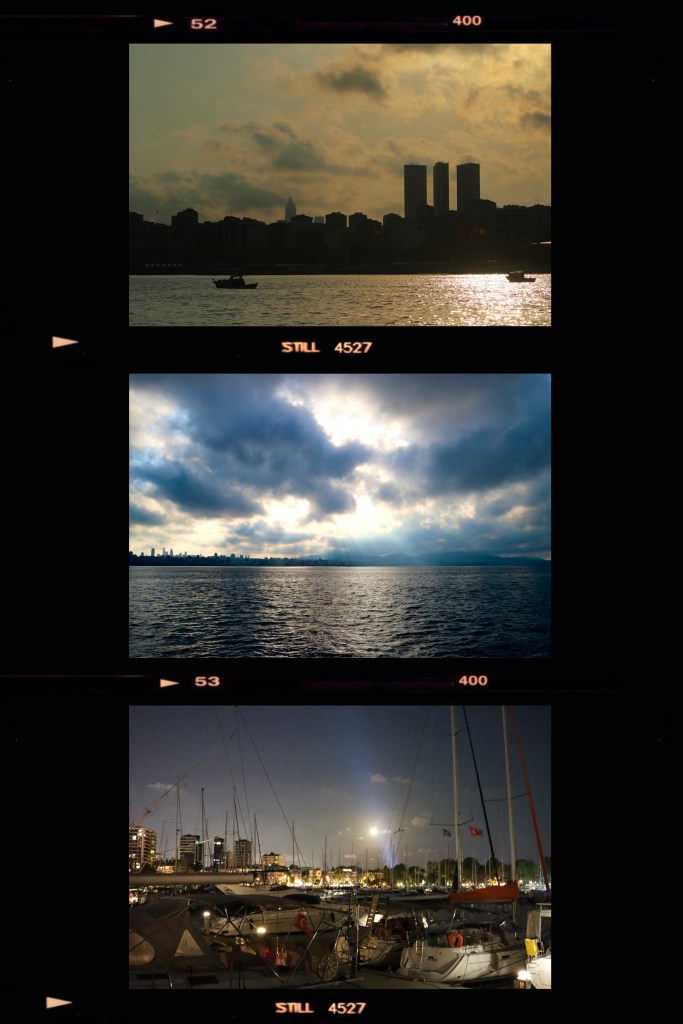
1 & 2 – Eastern Istanbul in the morning light
3 – Kalamış & Fenerbahçe Marina

Confident that both owners had eventually embraced the “slow and steady” method we felt it was safe enough to leave Longo and go exploring Kadiköy with Janine and Craig of SV Inelsamo.

Kadiköy in all its glory!

The history of Kadiköy is quite impressive. Whether myth or fact the story goes like this: Back in 7th BCE King Nissos, ruler of Megara Greece, had an avaricious son called Byzas. The king, not liking the regicide twinkling in his son’s eye, went off to seek divine parental guidance from the Oracle of Delphi. (Sidebar: The Oracle of Delphi was the preternatural adviser to all the cool rulers. She was originally “belonged” to Galea (Mother Earth). That is until she was stolen away by Apollo.)

The Oracle told the old King to send the Prince on a quest to find the “the city of the blind” because this is where Byzas would earn his fame and fortune. Byzas decided that a bit of questing might be invigorating and if nothing came of it he could always return to pop off his old Dad later.

After a good long while adventuring with the obligatory fighting, pillaging and general mischief included, the Prince tired of the quest and decided to make camp on the Western shore of the Bosphorus Strait before heading back to see about his father. As the prince and his cronies looked across to the Eastern shore they saw, to their surprise, the Megara colony called Chalcedon. One of the Prince’s Generals laughingly said of the Chalcedonians “they must be blind! This shore is far superior, with its fertile farmlands and naturally defensible estuary. What were they thinking!” (the estuary is known as the Golden Horn).And so the Oracles prediction was fulfilled, Byzas, not blind to the virtues of the Western shore, made it his home; naming it Byzantium” after himself.

Shortly after, Byzas’s little settlement took off and other began to covet his is land. In 330 CE Emperor Constantine, the Emperor divided the Roman Empire into East and West. He took Byzantium for himself and being another shy and retiring type, renamed it Constantinople and called it his own and ruled the Eastern Roman Empire (or the Byzantine Empire) happily for quite a while.

During Mustafa Atatürk’s restructuring of modern Turkey in 1923, Constantinople was formally renamed Istanbul, which is what the locals had called it from time immemorial. Istanbul means “to the city”.

What became of the little settlement on the Eastern Shore of the Bosphorus Straits known as Chalcedon? It was an early centre for Christianity. The Council of Chalcedon was asked to deliberate on some pretty heavy Christological questions aiding in the foundations for many Christian ideologies that are still maintained today.

However it would have been a tad uncomfortable to be a Christian in Chalcedon at times since it was occupied by the Persians, Romans, Byzantines, Arabs, and the Ottomans. The crusaders had a good go too. Chalcedon remained “independently governed” until the mid-1400s when the Ottomans brought it officially within the boundaries of the great city-state of Constantinople and renamed the town “Kadiköy”. This means “the Village of the Judge” and honours its role in the birth of the great city that is now known as Istanbul.

The Kadiköy that greeted us was a leafy bayside suburb teaming with beautiful people lounging in trendy cafes or walking through verdant parks on their way to and from high rise apartments and vintage summer style mansions. At its heart is a transportation hub connecting East and West Istanbul by ferry, bus, taksi, dolmuş and the underground metro. Quayside hosts many market style stalls selling everything from flowers to doner kebabs and buskers in the afternoons. This area is a thriving mix of locals and tourists all politely mingling. The local commuters are remarkably tolerant of the visitors to their shores. I’ve noticed that even the most harried office worker struggles to wallow in their misery when they commute by ferry. I think it’s the dolphins playing around the ferries that does it.

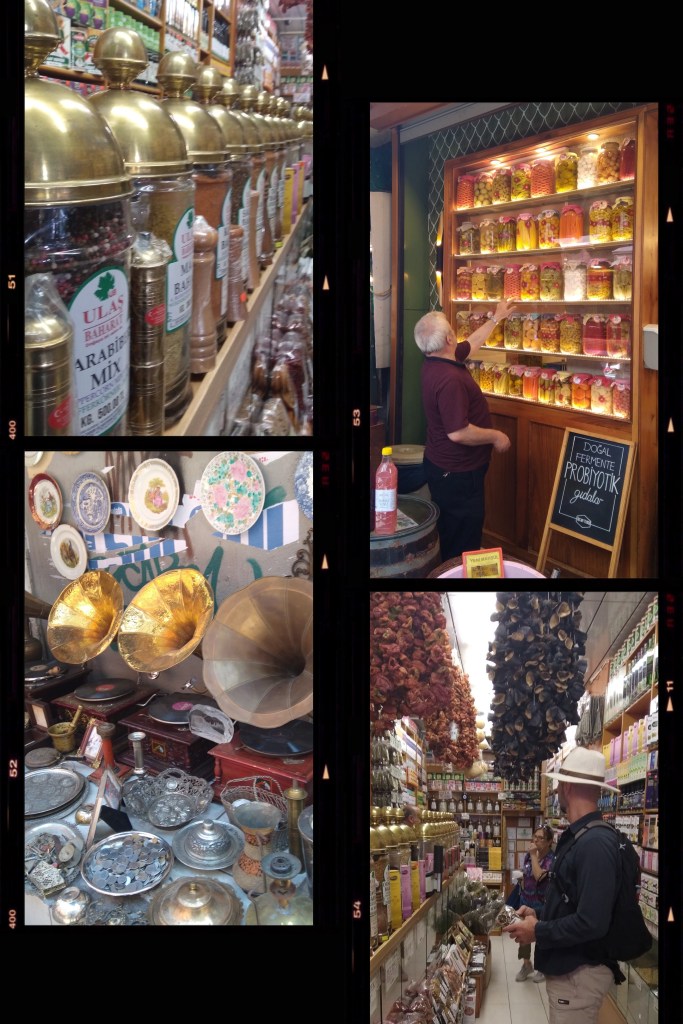
Just behind the ferry terminal lies a traditional bazaar. The cobblestone lanes are crowded, mostly with locals shopping for Tursu (Turkish pickles), dried vegetables, lokum (Turkish delight) and other staples. The chatter of the pedestrians and hawkers compete with the inescapable buzz of mopeds being ridden by all and sundry through the crowds. We have become attuned to the practised daredevilry of these moped riders as they weave amongst traffic and pedestrians. Ian doesn’t miss a step as he pulls me (usually with camera in hand) out of the way.

Ian loves the markets and always tries to use his Turkish skills when talking to the owners. For the most part the shopkeepers and other customers are pleased that he is willing to have a go.

It was here that we found Yanyali Fehmi Lokantasi, a cafeteria style restaurant. These kinds of restaurants are common in Türkiye. They serve the hardy home-style meals and çay (tea) favoured by the locals. They’re almost always owned by families, serving their own take on traditional recipes. Thankfully, Yanyali had an English menu with their family history printed in the front. Without this we would never have known that Husyin from Bolu, the founding chef of the Yanyali restaurant, was once the Head Chef at the Topkapi Palace during the reign of the last Ottoman Sultan, Mehmed VI Vahideddin. Lofty ancestry indeed! Especially since the Sultan’s kitchen fed up to 4,000 royals and other officials daily. To achieve this, Husyin would have been in charge of 800 people and the kitchen sported no less than 20 chimneys.When the Sultan was expelled by the Grand National Assembly of Türkiye, Huysin was imprisoned by the British. (The British occupied Istanbul for a time toward the end of WW1.) on his release, he was hired by the founder of the restaurant, Fehmi Sönmnezler from Yanya. When we decided to take a seat outside this unassuming restaurant it was being run by Fehmi’s Great-Grandsons: Tansel Can and Ergin Sönmnezler.

Ian, overwhelmed by all the tasty choices (over 100 different dishes are made each day), decided he would enlist the assistance of a friendly waiter called Ergin. Using his go to question: “what’s your favourite?”. Having snaffled the best selection for himself, Ian bought the waiter back to our table to help the rest of us decide. In the end, we tried a variety of mains; lamb with onion, slowed cooked lamb, Begendi Kesap and zuchinni fritters.

When Ergin pried himself away from our table to serve someone else we realised our “waiter” was in fact the owner Ergin, the Great-Grandson of Fehmi, the original owner. Ergin returned as we chatted with him about his family history and the great food on offer. With much pride he told us that his Great-Grandfather had worked in the restaurant until he was 98 years old. (While it wasn’t spoken of directly, we came away with the impression that Ergin was also related to the chef, Huysin. Perhaps Huysin’s daughter married one of Fehmi’s sons?)

I guess our rapt attention to his stories impressed Ergin because he disappeared momentarily only to return with a number of delicious mezzes. Initially we all refused the dessert options, however Ergin, with an especially mischievous smile, insisted we try the house specialty. The origins of this desert is something of a mystery. Some suggest it dates back to the Byzantium era. Others argue it comes Arabian lands. According to Ergin it was speciality at the Topkapi Palace and something Huysin regularly made for the Sultan.

Yanyali Fehmi Lokantasi

When he presented the dessert, he told us it contained a very special ingredient and challenged us to figure out what it was. It looked like white slime with a sprinkling of brown dust or dirt. It wasn’t a bad, smelly, get out the rubber gloves and disinfectant kind of slime. When I poked it wobbled just like the slime I made as a kid (cornflour and water); it was all shiny and blobby. It had the texture of blancmange and the flavour was surprisingly sweet. The kind of thing you’d feed to someone who’d just had their tonsils out. After our first taste, we all had a go at trying to figure out the secret ingredient. Even when Ergin told us it was called Tavuk Gögösü Pudingi, Ian, our linguistic gastronomer, wasn’t able to guess the secret ingredient.

Right! So guess, right about now you’re saying “Yeah, yeah, telling us what it is.” Well, it’s all in the name.

“Tavuk Gögösü Pudingi” translates to “Chicken Breast Pudding”.

You make the dessert by cooking chicken breasts for 6 hours, you shred and beat that smooth, mix it with sugar, rice-starch and milk (Ergin told us they use buffalo milk). Once it’s set, it’s sprinkled with cinnamon or nutmeg. Ergin was immensely pleased that we’d scoffed lot even after the big reveal. It was so delicious. I would have licked the plate but Ian wouldn’t let me!

At first we thought we’d only need a couple of days to see all that Kadiköy and Istanbul had to offer. It turned out that two weeks in Istanbul isn’t nearly enough! It’s a start but I’m not sure a lifetime would be “enough”.

Shortly, I will post Part II of our adventures until then fair winds and a dearth of sea monsters for your journey ahead.

The birth of an ancient sport: Yağli Güreş

Hello, welcome come aboard. We’ve been busy this week, preparing to head up to Bodrum to pick up our friends, Charlie and Megan. Bodrum is 167 nm away, Longo Mai has a conservative average speed of 5 or 6 knots thats between 27-33 hours of sailing. Unfortunately it’s not as simple as planning a car trip. The weather and safe anchorages play a large part in planning. We can’t leave Finike until after Thursday (06 Apr) and we need to be Bodrum Friday of the following week. Unfortunately the weather is finicky this time of year and while we have a day and a half of promised tailwind, it isn’t enough to get us all the way to Bodrum.

Especially as the following day’s forecast is predicting a head wind with gusts up to 30 knots. Over the last week the forecast has changed daily, and our plans have changed accordingly. Ian’s career was reliant on these environmental forces and his as relaxed as a Turkish dog resting in the middle of the road. (Trust me these dogs own the world and even the biggest trucks will swerve or stop and let them move in their good time.) He tells me if you plan early you’ll plan often. But he now takes it to the next level and is quite happy to wing it on the day. I’m not so lucky, its never been in my nature to be relaxed when there’s a deadline looming and I think it’s fair to say I’ve been a bit of a pork chop about it all. Thankfully Ian also weathers my moods well. Our friends are incredibly understanding and are now meeting us in the lovely town of Göcek. This is easily achievable for us and shouldn’t put too much of a dampener on our plans for their visit.

In the meantime we’ve also been taking advantage of the sunny day to mend the gel coat. This is a delicate grubby job with the sticky gel coat goop setting (going off) very quickly. The less excess goop the less sanding. Being new to this, Ian and I have a bit of sanding to do over the coming week.

We plan to leave Saturday and one of the last tasks will be to visit the Finike market in the morning before we leave. Just as it was in Brisbane, going to the market is a highlight of our week. There’s a restaurant on the way that makes a pretty good Menemen, which is like Shatsuka or Spanish eggs except the eggs are mixed in. Turkiye is predominantly Muslim country (officially non-secular) and as Finike is a conservative agricultural town, there’s no bacon or chorizo but the Menemen is always spicy and the ingredients are farm fresh making the flavours rich and flavoursome. The coffee is passable and my caffeine snobbery has been softened by necessity and now I’m just grateful its hot and passably drinkable.

After breakfast, we head down to the markets. Changing the route of our walk often; feeling like locals as we navigate the back streets. Next to the markets there’s a primary school and sports arena. Even on Saturday mornings there is the merry laughter and rambunctious shenanigans of kids at play during recess. Last Saturday we were lucky enough to see Yağli Güreş being practised at the sports arena.

Yağli Güreş is a popular sport in Turkiye. As a spectator’s sport its quite appealing. The wrestlers wear short leather trousers called “Kispet”, made of leather. The Kispet of adult wrestlers weigh a whooping 13 kilos. The only accessory the wrestlers, or pehlivan, team with their Kispet is a liberal dousing of olive oil. I guess there’s no surprise in me now telling you Yağli Güreş is known as oil wrestling.

The objective of oil wrestling, is not break your opponent but to to disable him. Therefore, unlike other wrestling sports the pehlivan can win by putting his hands down the other wrestler’s kispet and grasping the lower end of the pant’s leg and thereby prevent him from attacking. Yağli Güreş is serious business here in Turkiye with the National Champion winning 100,000USD, sponsorship and a very impressive gold belt.

The history of Yağli Güreş is as rich as you would expect given it dates back to 1000 BCE in Persia. The current rules date back to the Parthian Empire (238 BCE – 224 CE) and there is a strong tie to religion with the sport being conducted during Spring festivals. However, it didn’t become a sport in its own right until the reign of second Ottoman Sultan Orhan Gazi (1281-1362). Originally the matches could go on for days until someone won or died of exhaustion. It wasn’t until 1975 when someone with a little bit of common sense introduced a time limit.

This all very fascinating and impressive however I can’t help thinking how this wonderful sport really started. Maybe something like this.…

A troop of seasoned soldiers sit around a camp fire during a Spring Festival in some ancient city or other. They’re laughing and drinking as they boast about this battle or that fight. There’s a little more drinking and the crusty old veterans tease the junior soldiers about their lack of experience with their manly weapon. They all drink some more.

The camaraderie is high and spirits are flowing and everyone is happy until a procession of virginal maidens glide by, their hands in prayer and eyes cast down demurely. Their white shifts fluttering in the evening breeze, occasionally giving tantalising hints of the shapes beneath.

As the soldiers all quietened to watch the procession pass, Darius and Bahar, two of the younger fighters try to impress the ladies. Their mates egg them on as they all keep drinking. Their taunts and catcalls are sufficiently loud enough that the last virgin pauses and looks up with innocent doe eyes and blushes.

Darius and Bahar decide a wrestling match will prove their masculinity and prowess to this willowy maiden; ensuring her heart and more importantly her body is given freely and wantonly to the victor. So turning to their buddies, the two soldiers say “here hold our drinks” before throwing themselves at each other.

Their inebriation loosens their skills while heightening their emotions and soon the wrestlers forget the triviality of their purpose and begin to battle in earnest. Laughs become growling sneers. Curses become threats as a crowd grows around them. Their comrades and other spectators begin to wager on the outcome as more spirits flow lubricating the cheers and jeers.

Anoush, their wisened and grizzled sergeant, sitting at the next camp fire see ing the potential for a disastrous outcome, grabs a nearby jug and strides over to dump it’s contents over the two wrestling men. Except, alas, the jug isn’t full of water but olive oil. Slipping and sliding and unable to get a purchase on each other Darius and Bahar stop, gasping and spitting oil. Their surprise turns to humour and they begin laughing again.

Just as it looks like they’re about to clasp forearms and put aside their differences, someone in the crowd shouts out that Darius was the winner and he wants his bet paid out. Across the way there is a retort that Bahar was the winner “as any blind man can see”. Anoush, Darius and Bahar watch the mood of the crowd turn ugly. Anoush realising this could turn even nastier with the outcome worse than just the wrestlers getting mean and hurting each other, thinks quick and turns to Darius and Bahar and with a shrug, nods for them to continue.

The men struggle for a while as they figure out just how they’re going to win if they can’t get a good grasp. The crowd mood lightens as the fighters fumble along. Eventually, Bahar puts his hand down Darius’s pants grabbing the leg end and lifts him off the ground to dump him unceremoniously into a nearby pond. Anoush declares Darius the winner to the raucous laughter of the crowd. All threats and curses are forgotten as bets are paid out. Finally everyone toasts the wrestlers and plies them with more drink. There you have it Yağli Güreş is born!

Sometime later, Darius remembers the lovely maiden who had unwittingly incited the spectacle. He looks around thinking he’s in with a good chance. However she and her sisters have moved on (becoming bored long before Anoush intervened with the olive oil). Later Darius learns the maidens went on to the chieftain’s tent; which of course, is where all the money and power lies.

Fair winds and a dearth of sea monsters for your week ahead.

(Thanks to: Wikipedia, All about Türkiye, and A Sports with Religious Rituals from Hıdırellez Cult: “ Kırkpınar Oil Wrestling)

PS: I asked Ian what to call this weeks’s post and he suggested: “Lubed Up and Ready for Fun” or “it’s not romantic unless your eyes meet” (and that second one I’ve had to wave the politically correctness wand over) That’ll teach me for trying to include him in the creative process!

Three Streets Back – Finike

Hello, welcome, come aboard. Weather in Finike has been a bit hit and miss the last few days. Reminds me of Melbourne, pouring rain on minute, sunny the next. Wednesday, however, was a slice of perfections. The skies were blue and the sun shone out long enough for Ian to drag me out for a walk “three streets back”. We often find ourselves in the industrial backstreets hunting for a Widget or Whose-it for some boat project or other. However, sometimes our adventures don’t include looking for unicorn-widgets or Fix-It Wizards.

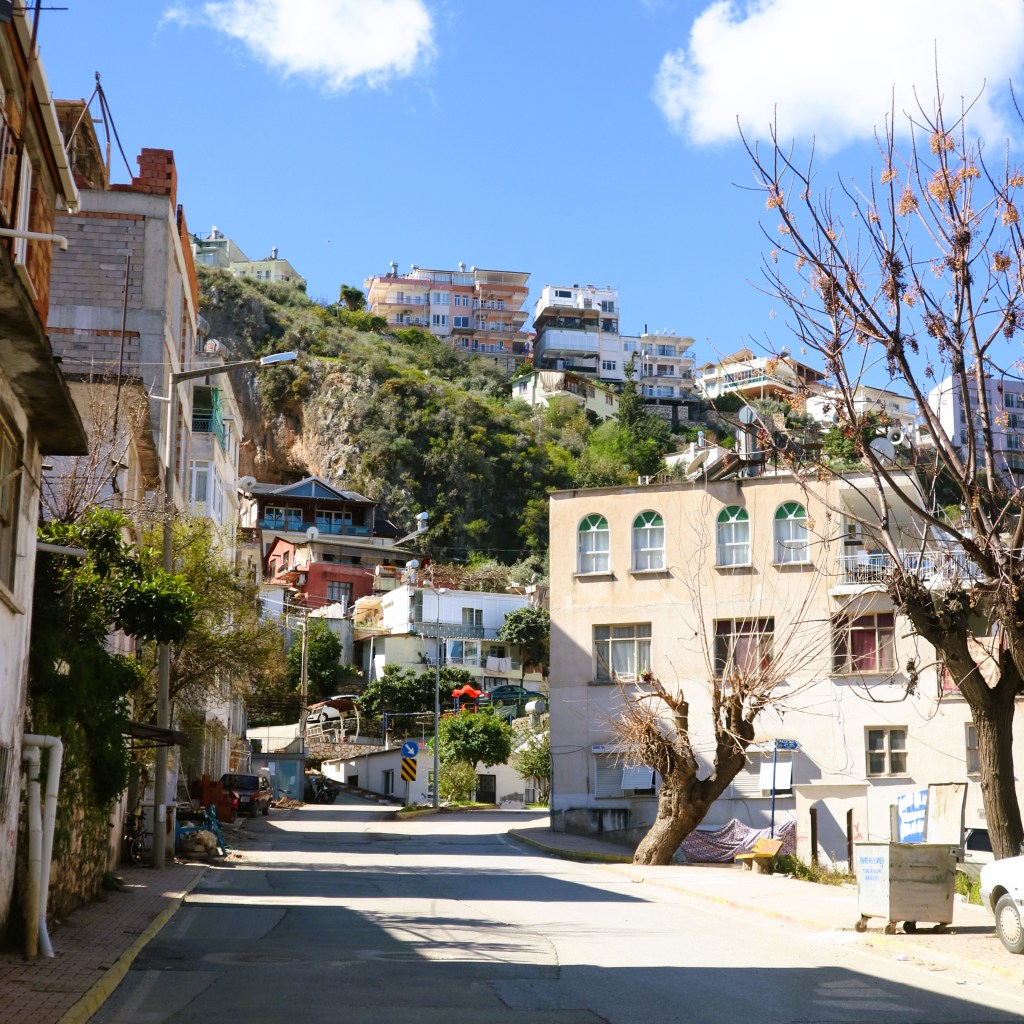
Wednesday was one of these “just because” adventures as we decided to walk up into the hilly suburbs behind the main streets of town. It wasn’t until we walked climbed the hillside (and I did a bit of research) that we began to appreciate the size of our “little town”.

The town has a population of around 12,000 people and the region boast almost 50,000, give or take the most recent births and deaths. I think this probably a conservative number at the moment given with the influx of those displaced by the earthquake and the war in Ucrania.

The agricultural foundation of the area dates back to at least 5 BCE when the region was known as  Phoenious. We were both surprised by the view looking back down toward the town and the acres and acres of greenhouses lay beyond the suburban spread. Agriculture and tourism are the main sources of income in the region, with oranges and other citrus fruit making up the largest crops. However, tomatoes, lettuce and all the good green, red and gold stuff are grown in enormous green houses. Of course the prime real estate along the coast is dotted with hotels and resorts, however even these compete with the farms.

At one time the area was ruled by the Byzantines, the Anatolian Seljuk State, the Tekeoğulları Principality and the Ottomans. You do not see much in the way of ancient history in Finike but it is on the Lycian Way so if you travel a short way in any direction, you’ll eventually trip over some ruin or archaeological wonder.

The ‘Battle of the Masts’, one of the major battles of antiquity, took place just off the coast of Finike in 655 ADE. This was the first decisive victory of the Arab fleet (200 ships) againstthe Byzantine fleet (500 ships). The Arab leader went on to Constantinople which, surprisingly enough, was named after his opponent Constantius’ Dad (or Grandfather, I can’t quite work it out which) Constantine the Great.

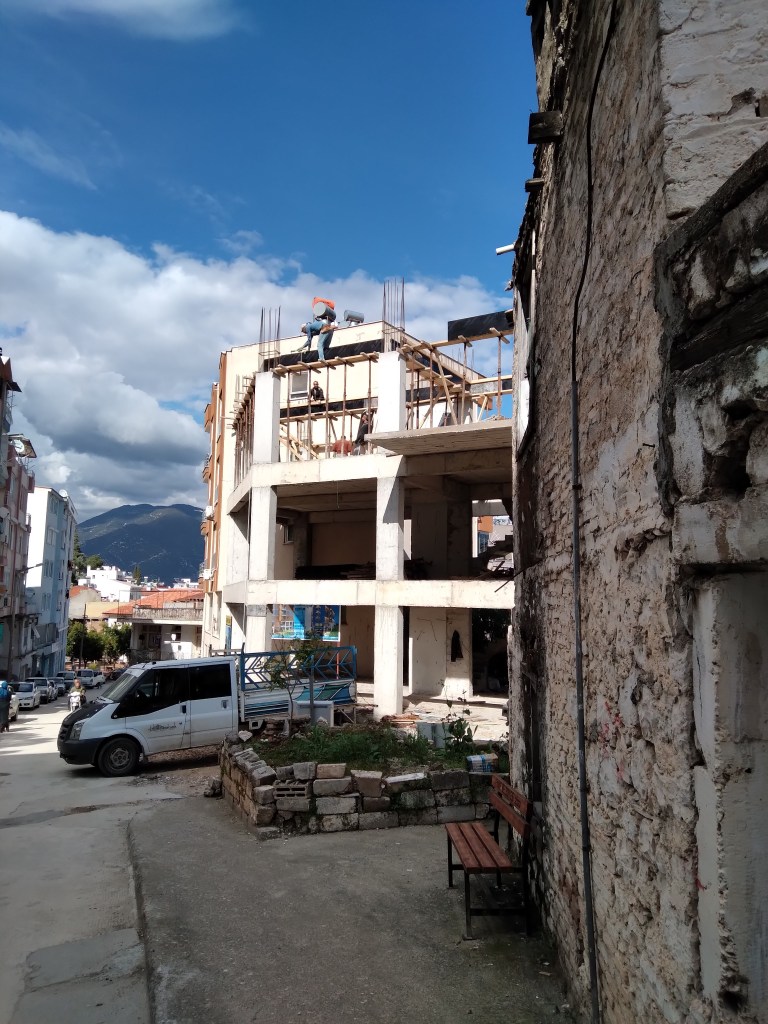
In more recent times, last Wednesday, we saw endless amounts development work going on. On some streets a new house or apartment block was being built. On other streets we saw road works, and sewage and other utilities being installed or upgraded. Occasionally all this work competed for space.

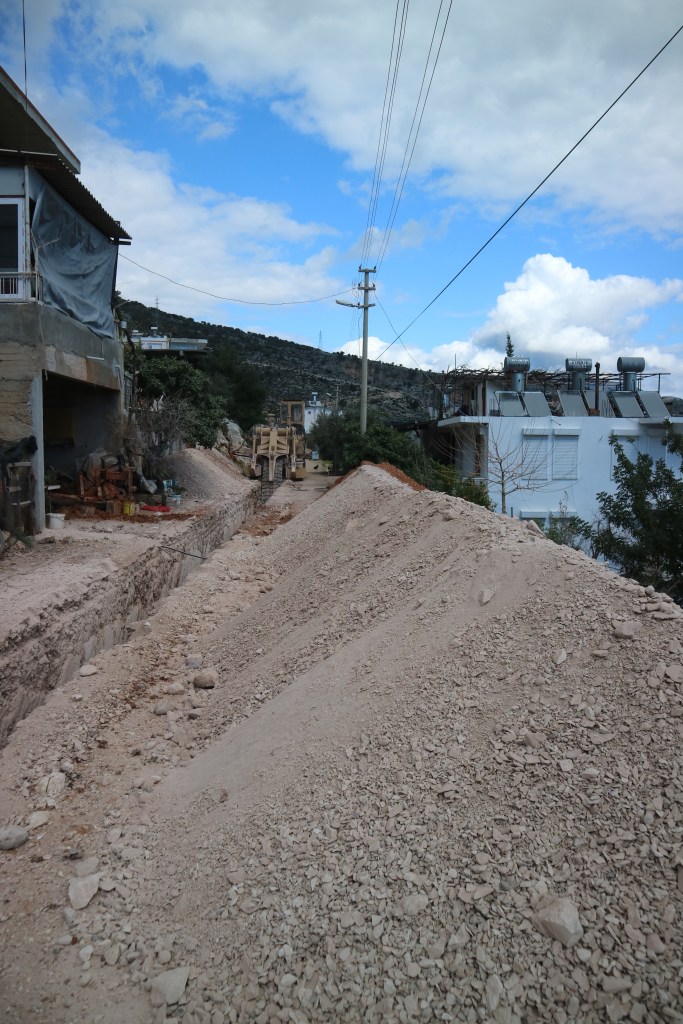
As you can see safety comes third

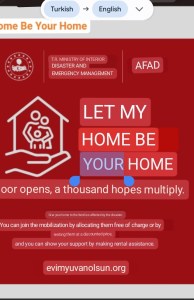
Yet, there is also decay and abandonment at every turn. There are half built buildings where folk a living on the lower floors while the upper floors are still bare steel and concrete. The Ministry of the Interior has a program called “Let My Home Be Your Home” that supports those who have lost their homes in the recent earthquakes. This would explain why so many of the partially completed residence are being occupied.

Ian also wisely suggested that the economy, the cost of money, politics will be having an impact on the construction and abandonment we see. I’m sure what he was saying is terribly clever, and the result of hours of inter-web research but I confess I was distracted by the lovely flowers.

For those that don’t know us well please don’t take my wanton sexist imagery as anything other than fact. Ian is dead keen on world economics, politics and such. I am not and count myself lucky that he worries about such things on my behalf.

There’s always a gaggle of kids’ about, playing games or riding bikes (the teenagers all ride mopeds). The younglings are watched by a distracted Mother or attentive Grandmother. The braver kids often say hello in English, pleased to be trying out their language skills. There’s always a wizened gentlemen or two sitting in the sun, a cigarette in hand and a çay beside them. No doubt they’re solving the world’s problems, if only we’d all listen! We always greet them with a sturdy Turkish “Merhaba” (hello). (çay – pronounced chai, a strong black tea made from Camellia)

To date I’ve been reluctant to intrude on folks time to ask for a photo but these two were happy to pose for a portrait.

We didn’t see many cats and dogs on this walk, however there were plenty of hens and more than a few confused roosters still calling out the sun despite it being lunchtime. We also heard the distinctive bleats and tinkling bells of a goat herd on a nearby hill. Beehives are also a distinctive feature of the landscape.

On one particular street we came by a rather special little creature. The street had a long deep ditch running the length of the road. I presume they are putting in cables or sewage pipes. The ditch was about 10 feet deep, at least 50 metres long and a few feet across. At one end was the ditch digging machine, and along the sides were large mound of dirt. Our side had enough room for us to walk pass, but the other side was quite tight for space. It was here that we came upon a tortoise. His shell no more than a hand span and in the way that all of these particular reptiles he looked ancient and wise. Unfortunately the little fellow wasn’t out for a stroll but was valiantly trying to cross over to the relative safety of our side of the road

No doubt he had designs on the shady garden behind us but tortoises can’t jump. (I know this because I checked on the inter-web: see http://www.tortoiseowner.com), so he was having some difficulties. As dirt skittered from beneath his feet into the ditch, I swear I saw him look plaintively at us as if to say “A hand here might be good. If you wouldn’t mind.” At which point, I may have squealed and danced about in useless panic. Thankfully, Ian, who is always better in a crisis, leapt to the rescue. Putting himself at grave risk of falling into the hole, he used the ditch digger as a bridge collected the beleaguered tortoise. He then returned to our side, and gently deposited the little reptile beneath a geranium bush.

I didn’t see if the tortoise gave Ian a nod of thanks so I made sure to give him a sloppy kiss as reward for his bravery.

As we went on our way, I pondered upon what the tortoise thought about his rescue. Ian, whose quick wit is faster than his leap into action, proclaimed it would have been something like, “Whilst upon my journies I came upon the Pit of Despair. And, whence I thought all was lost, the hand of the great All Mighty God came down upon thine shell and raised me up, as if upon golden wings, and carried me over the Pit to my salvation! For thine is the power O’ Great One.

So from the Mighty God and his adoring fan we say goodbye and… fair winds and a dearth of sea monsters for your coming week.