Jobs Done: Time for Feasts and Skydiving Spelunkers!

It’s that time of the season when everyone is working on their plans for Summer season. Boat jobs and projects are being finalised with a feverish anticipation of fair winds and warm waters. Ian, with a little help from me, has achieved so much this Winter that our boat now feels even more like home. A big part of this is the new canvas work which converts our cockpit into a cosy sunroom in Winter and a welcome shady respite from the sun in Summer.

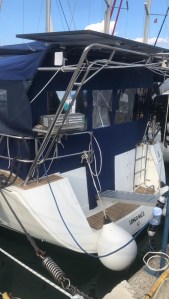
Another major upgrade is our new tender (or dinghy). This is an essential bit of kit that impacts everything from mundane tasks, like provisioning to exploring adventures. Our old tender, which I affectionally named Baby Boat, was a little under-powered with only a 5hp engine. It was just too slow and not suitable for more than short trips to shore. It was also a bit too small, having just enough room for us and few shopping bags. Now that we haven’t yet sunk our boat and have somewhat proven our sailing skills we have plenty of friends and family planning visits. And, Baby Boat definitely isn’t up to the job.

Ian was able to source a new tender in Istanbul and could have it delivered but we had to wait 3 months. We couldn’t find the engine we wanted anywhere in Turkey. We talked to Customs about importing it but their advice was ‘get in your boat take it to Greece, bring it back and don’t say anything’. Which is exactly what we did. We had one delivered from Athens to the tiny Greek Island of Kostellorizo where we picked it up.

Our new tender is bigger (Highfields 310) and has a whopping 20hp outboard. We thought 10hp would be OK but 15hp would be better and only a few more kg. But then, the 20hp weighed the same as the 15hp and no one has ever complained about having too much power. From my perspective the best thing about the outboard is the electric start. I had an annoying habit of letting go of the string thingy on Baby Boat’s outboard which would result in bruises in lady places. Anyway, we’ve been running the new engine in at ½ throttle. Even then it’s still quite quick and I got little bit of a fright thinking about how fast our new toy will be able to go at full speed. For ‘safety’ Ian added foot holds to the floor for those “just in case” moments when the wind in our hair becomes a battering ram trying to push us out of the boat! They’ve since been tested and Ian has confirmed it’s possible to get air in the dinghy (he hasn’t had the prop out of the water, yet!).

Given the engine size and how far we can now travel from Longo Maï we decided to register our dinghy. This is just in case the pesky Coast Guard pulls us up as the dinghy is, in all fairness, well beyond the limits of the  definition of a ‘tender’. When registering or naming tenders, it’s not uncommon for them to be called something simple like “tender to Longo Maï” however Ian left naming ours up to me. Consequently our new tender is Internationally registered as “Grand Petit Bateau” (or Big Baby Boat). Photos to follow in upcoming posts.

Now that all these jobs have been done the only job remaining is the last minute ‘minor’ task of upgrading to lithium batteries. So Ian is now looking towards next Winter’s project list while we’re also preparing for our first visitors, Megs and Charlie, who arrive on 15 April. We’ll be sailing up to Bodrum to collect them and then spending a couple of weeks cruising along the coast to Göcek. We can’t wait to share this wonderful adventure with them.  

Since we can’t start our journey up to Bodrum until we visit our dentist next week we are filling in our days as best we can.  Ian has taken to improving his cooking skills with a monstrous roast lamb feast for twelve. He then doubled down on this with a smoked brisket extravaganza. Both were cooked using ‘old school’ charcoal inside a 44gal drum heater. Some said it couldn’t be done; well, Ian learned from the masters. For years good friends of ours, Charlie and Rowie, slaved for hours making delicious smoked meals all the while thinking Ian was just drinking all their booze. Turns out he could multi-task.

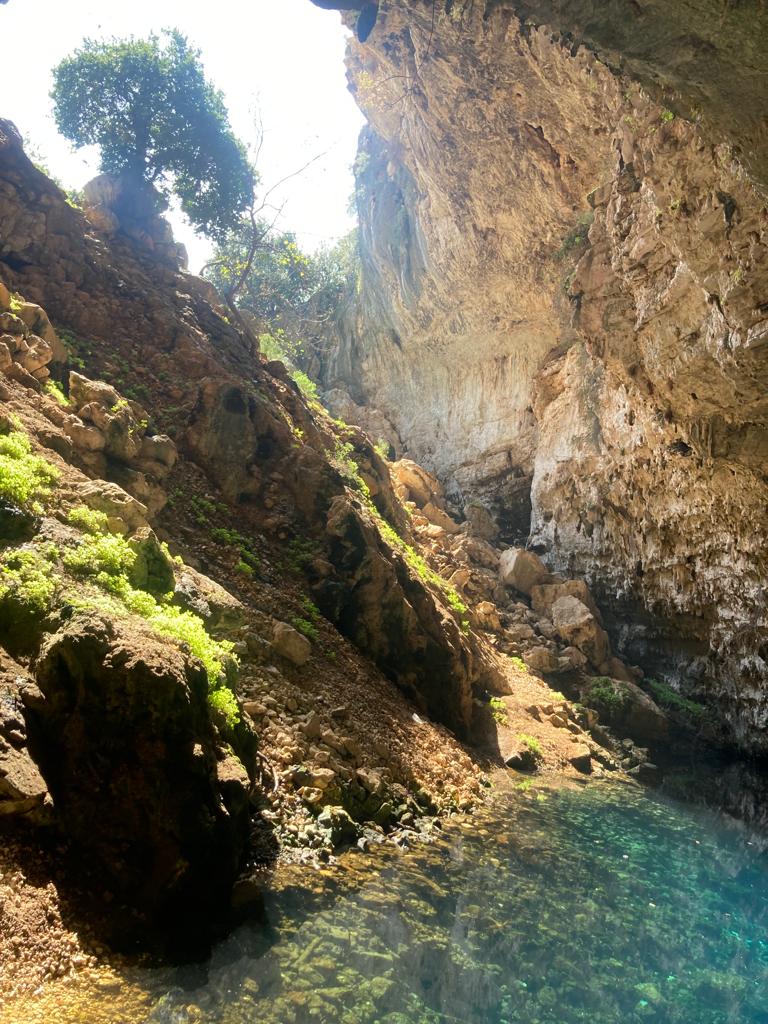
To loose the calories our most recent walking adventure was to find the elusive Finike Suluin Mağarasi (which translates to Finike Water Cave). The cave is a 25 minute walk from the marina and as with many noteworthy places in Tϋrkiye, there is no infrastructure protecting the site. The only protection is an one understated sign in Turkish on the side of the road, and an imposing overgrown hill with a non-existent path through the rocks, brambles and swarms of bees leading to the site.

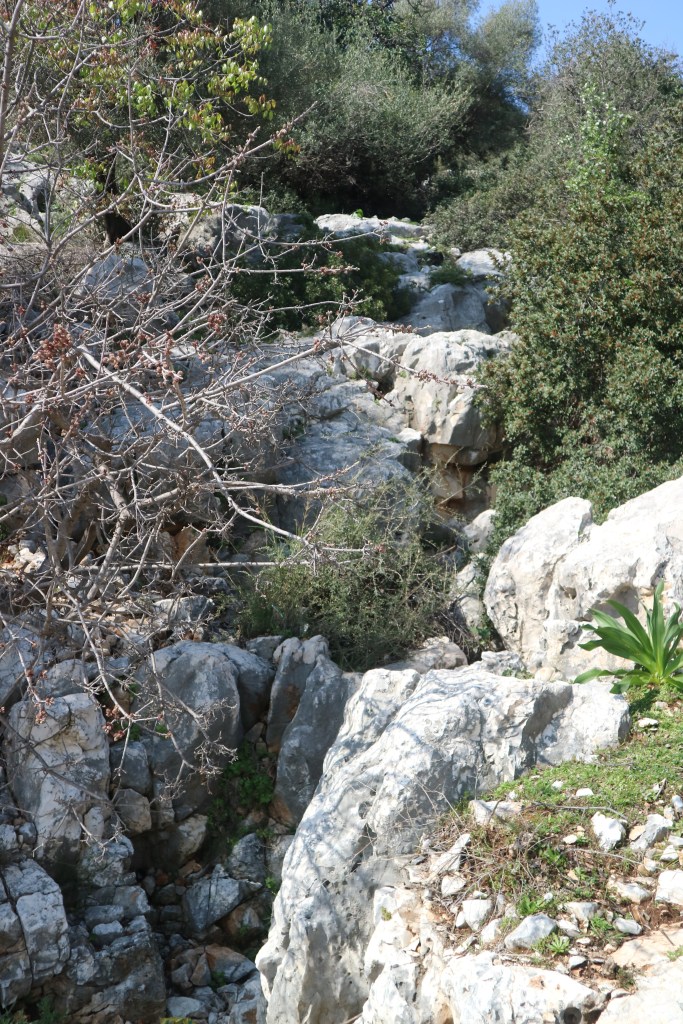
The cave is impressive, with a large turquoise pool at the bottom and sunshine reflecting off the walls. It’s possible to venture all the way down to the pool. There are bats nesting in the walls above and their chittering is reminiscent of cicadas in Summer. Between this noise and the twittering of the little birds in the area I found the cave quite calming.
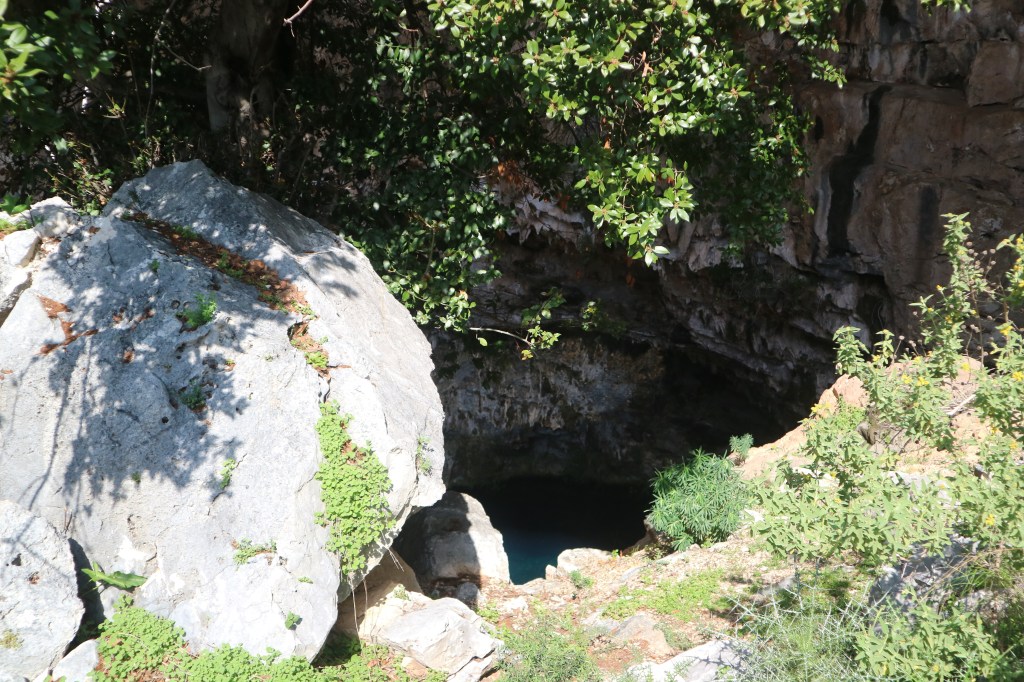
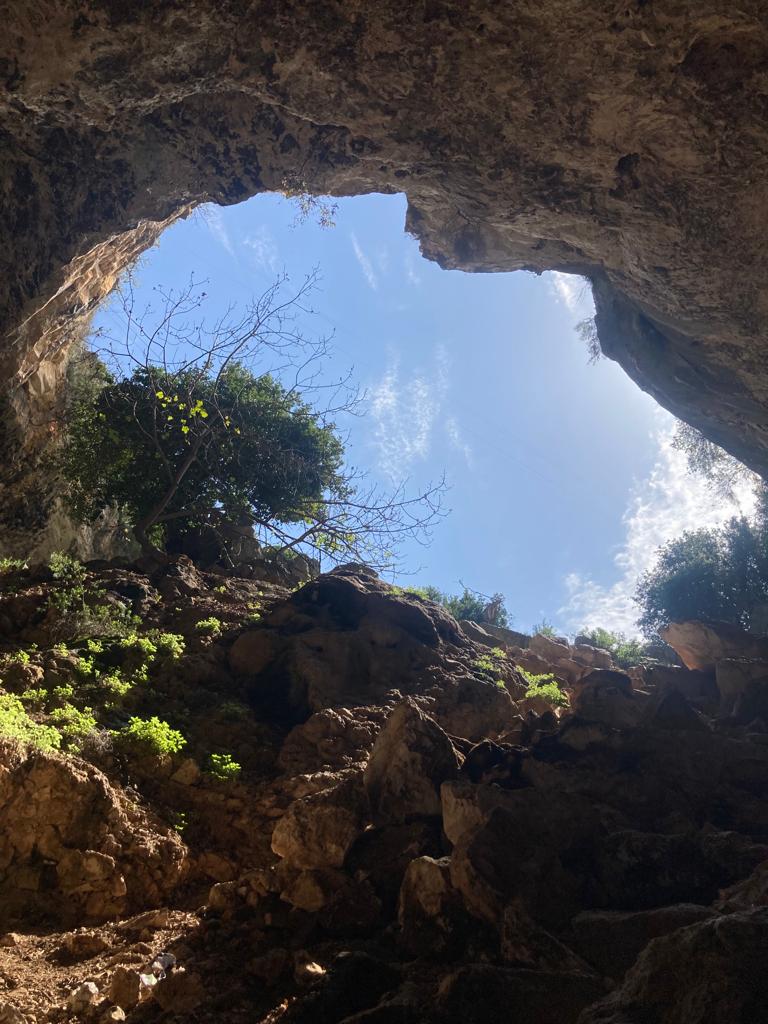
A BBC report from 2010 and many of the tourist blogs list the Suluin Mağarasi as the deepest diving cave in Asia. However, it doesn’t appear on any English lists of caves I could find.

The cave is more than 122 metres deep and while the surface is fresh water, divers encounter saltwater at 15 metres. This is unsurprising given the ocean is just across the road. The water is very acidic and often there is a smell of hydrogen sulphide (rotten eggs smell). It’s probably not advisable to drink or swim here  especially given the cauldron of bats residing above for thousands of years. Despite the threat of bat guano, in 1995 an American diving excursion formally recorded the depth of the cave. Unfortunately, two German divers died during this expedition. Dripstones were also identified underwater which indicates the cave was once dry for some depth. Bones and ceramic shards were another find during the dive.

An archaeological survey of the cave site was undertaken by a local university in 2010. It discovered the remains of stone buildings near the entrance of the cave which date back to the Holocene period (circa 9701 BCE). They also found late Neolithic-early Chalcolithic Age ceramic shards (7000 – 5000 BCE), and flint and obsidian arrowheads. Carbon dating of bone needles showed it was occupied in 6000BCE (Neolithic).

When researching the cave, I had to use Google Translate and of all the mistranslation I saw my favourite references how the American dive team did not skydive into the cave. Ian says it probably meant they did not use air for the dive but instead used Nitrox (a mixture of Nitrogen and Oxygen used for deeper dives).

Fair winds and a dearth of sea monsters for the week ahead.

* I just love old fashioned words, often you can tell their meaning without thought or reference to a dictionary. I could have called myself clumsy, a stumblebum or a clodhopper but bungersome says it all really.

Thanks to: BBC (http://news.bbc.co.uk/2/hi/science/nature/8650104.stm), Wikipedia (Vikipedi), Hurriyet Turkey (https://www.hurriyet.com.tr/yerel-haberler/antalya/suluin-magarasi-concorde-sigacak-kadar-ucsuz-b-40518502) and Taşkiran, H, Suluin Cave – A Cave Settlement in the Western Taurus, 01 Jun 2020 (https://aktuelarkeoloji.com.tr/kategori/guncel-kazilar/suluin-magarasi)
Yanartaş and Olympos – Mythological Beasts and Pirates

One of the touristy things that has been on our “to do” list since coming to Finike was to visit Yanartaş and the ruins of Olympos. So when the topic came up with our friends Mike and Mandy of SY Kirrikie, we decided that the time was right, especially as our days in Finike are dwindling fast and its always lovely to share experiences with other folk. Note to readers – this is a long post, you might want to make a cuppa and a snack.

Mike and Mandy of SY Kirrikie

The hour drive North to Yanartaş was a thrill with Mike at the wheel and Ian navigating. Mandy and I tried not squeal as our rental car tore down the winding road, dodging trucks and cars hither and tither! Much to Mandy and my surprise we arrived safely at the base of Yanartaş. (We had to hurry. The flames had been burning for thousands of years so they must be due to run out of gas soon. You’d hate to be the person who dawdled and arrived just after they ran out.)

The entrance to Yanartaş National Park

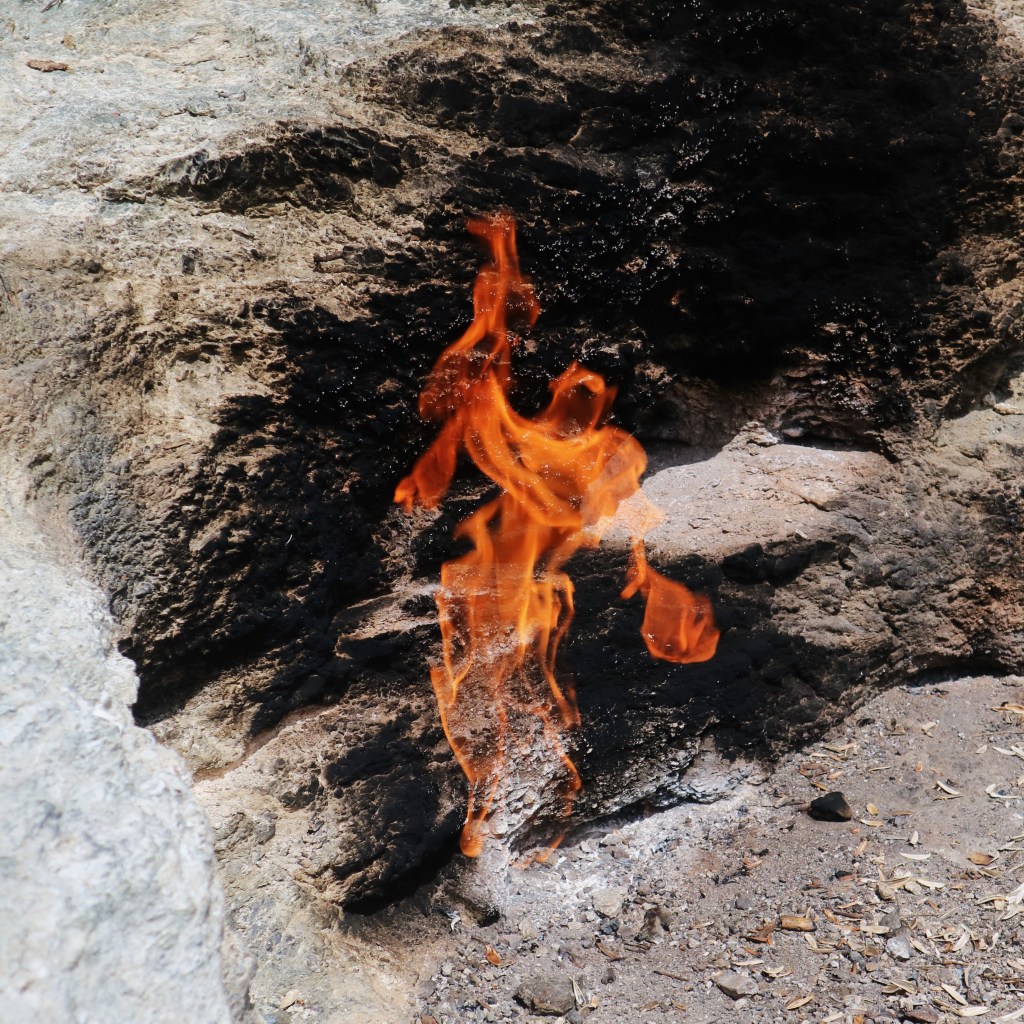
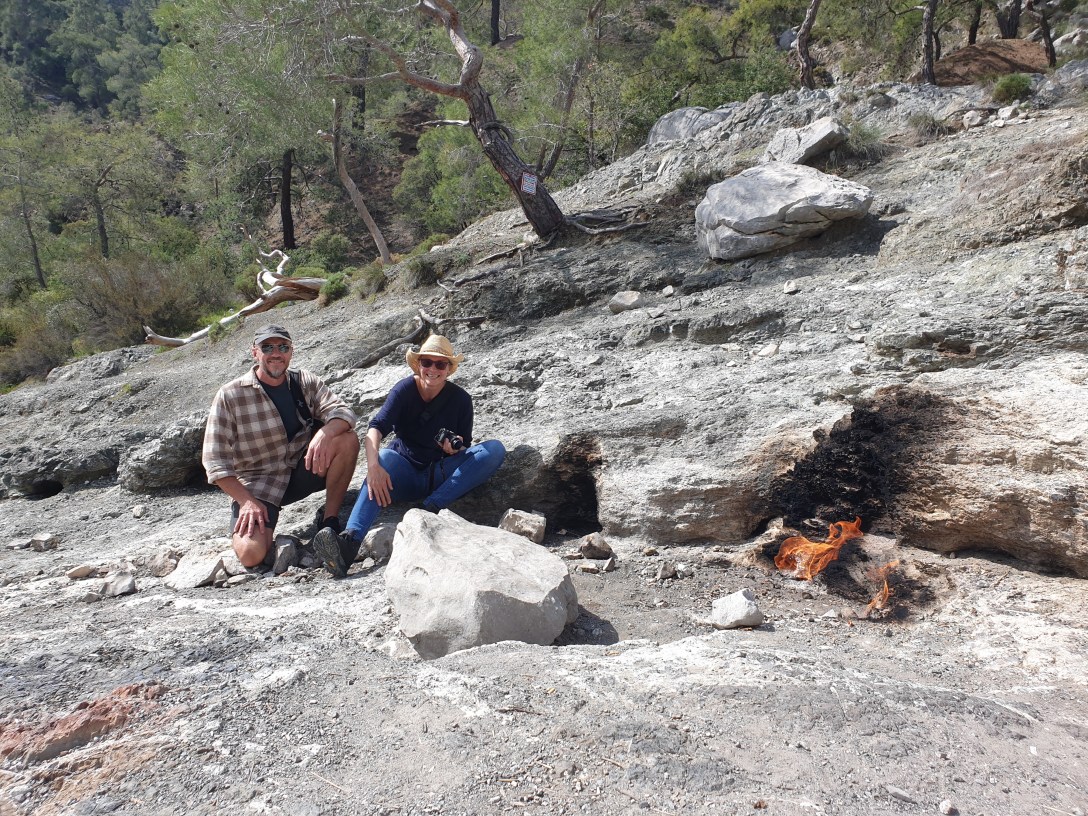
Yanartaş would be just like any other national park if it wasn’t for the natural fires that have been burning upon the mountain

These fires are the largest venting of abiogenic methane on the Earth’s terrestrial surface. They have been burning for over 2500 years, with historical records of the eternal flames stretching back several millennia. The flames breach the surface of the Earth through cracks in the volcanic rock. The original fire was much more powerful however as earthquakes changed the landscape the fire diffused into the smaller flames that can be seen today. the original flame was said to be used a navigation beacon by sailors. (Wikipedia)

I’m no scientist but google tells me this is mostly carbon, nitrogen and oxygen. the g13 CH4 is a reference to methane.
And am I the only one curious about the Foundation?

As you can imagine the site of a mighty flame spewing forth from the ground would have been awe inspiring. Unsurprisingly a temple was built at the site to honour the Greek God of Blacksmiths, Hephaestus. The legend goes that Hera cast Hephaestus, her own son, from Mount Olympos because he was an ugly cripple. Seems that ‘ his Mum didn’t think he was handsome’. Our hero took up blacksmithing to pass away his time on Earth, becoming the go to guy for the other Gods when they needed weapons or jewellery. Hephaestus apparently held something of a grudge against his mother and so made her a throne. This seems like a funny way to get back at someone until you discover the throne is actually a trap that catches Hera in its dastardly clutches. Eventually Zeus scolds his son for being a naughty boy and makes him release his Mother, and then rewards Hephaestus by honouring him with the position of God of Blacksmiths.

Unfortunately most of remaining ruins at the site date back to the Byzantine Period when a basilica was built over the temple. However there are still some Greek inscriptions and remains of the altar lurking among the ruins.

Hephaestus story is pretty cool however the local legends area is even more thrilling and steeped in controversy. The story goes that Prince Hippones of Ephyra killed his brother, Belleros, then changed his name to Bellerophontes (eater of Belleros) but for this post we’ll just call him Harry. When their father, the King, discovers Harry crime he exiles him. Harry takes refuge with the King of Argos, who is none too pleased to have the brother murdering lad in his realm. However, custom prevents him from killing someone who has taken refuge in his kingdom. Instead, the King of Argos decides to pass the young buck along to the King of Lycia. The King of Lycia, must have muttered some choice words about the other rulers inability to deal with their own problems. However he has his own issues to deal with so he hatched a cunning plan to punish Harry and solve one of his own nagging problems. You see there was a rather irritating monster, called the Chimera, who has been terrorising folk on mount Olympos. The King of Lycia decided that Harry is just the man to kill the Chimera. I guess the King thinks he’s on to a good thing here since at least one of his problems will be gone at the end of the day.

This depiction of the Chimera greets you at the entrance to Yanartaş. I’ve read a number of different descriptions and seen quite a few paintings and this is hands down my favourite Chimera.

Harry flies to Mount Olympos on his horse, Pegassos, and a mighty battle between him and the Chimera ensues. Finally our anti-hero, Harry spears the monster and inters it within the mountain where it remains to this day bellowing flames through the cracks of its prison. It seems that Harry feat of heroism is sufficient for everyone to forgive (or forget) his act of fratricide and honour him by arranging a race from the mountain to the city of Olympos. The athletes carry flaming torches set alight using Chimera’s breath and this, according to Anatolian legend, is the first Olympic Games and the Olympic Torch is the symbol of the Chimera flame.

There are plenty more pictures of this amazing place in the Gallery (which I will be releasing shortly). However Ian was keen for me to point out that Tϋrkiye takes care of its workers. He interpreted this sign as “after a day of toil blacksmithing or cutting stone the workers sit down and “suck on VB.” Personally, I think that if Tϋrkiye was really taking care of its workers it wouldn’t be giving them VB.

After our climb up to see the Chimera burping flames, we travelled down to the holiday town of Çirali for lunch. This little village is one of those places that lives for Summer and then dies away to become a peaceful ghost town the rest of the year. (The Ç in Çirali is pronounced Ch)

We were visited by a rather spirited tortoise who came by to pay homage to the O’ Mighty Tortoise God’. Unfortunately he was so excited that he moved too fast for me to get a photo. After lunch we headed on down to the end of the beach to see the ancient City of Olympus.

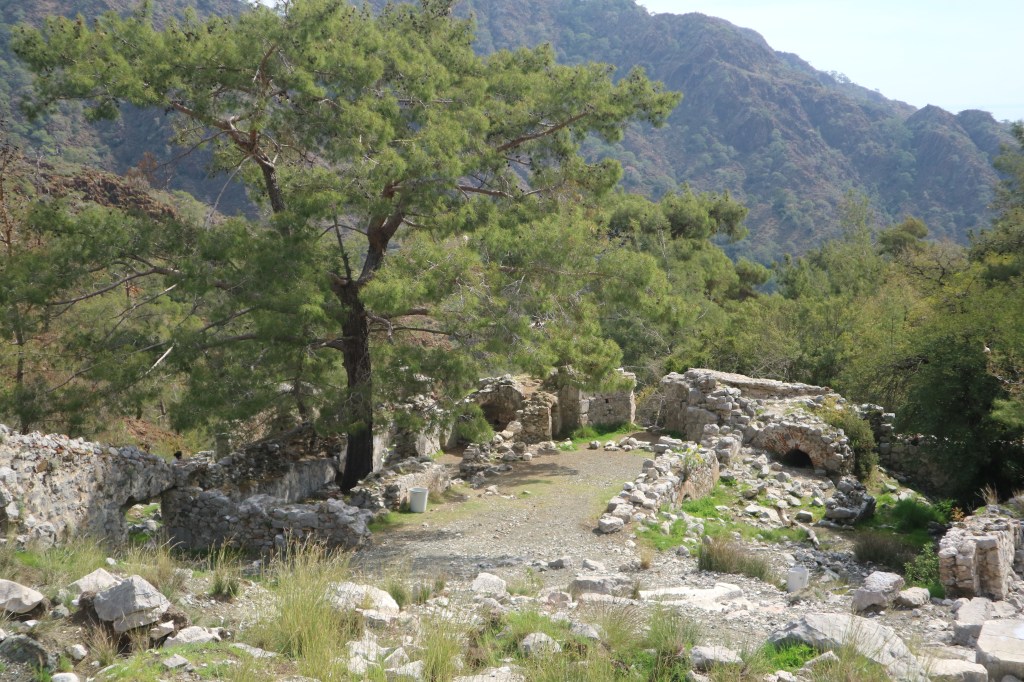
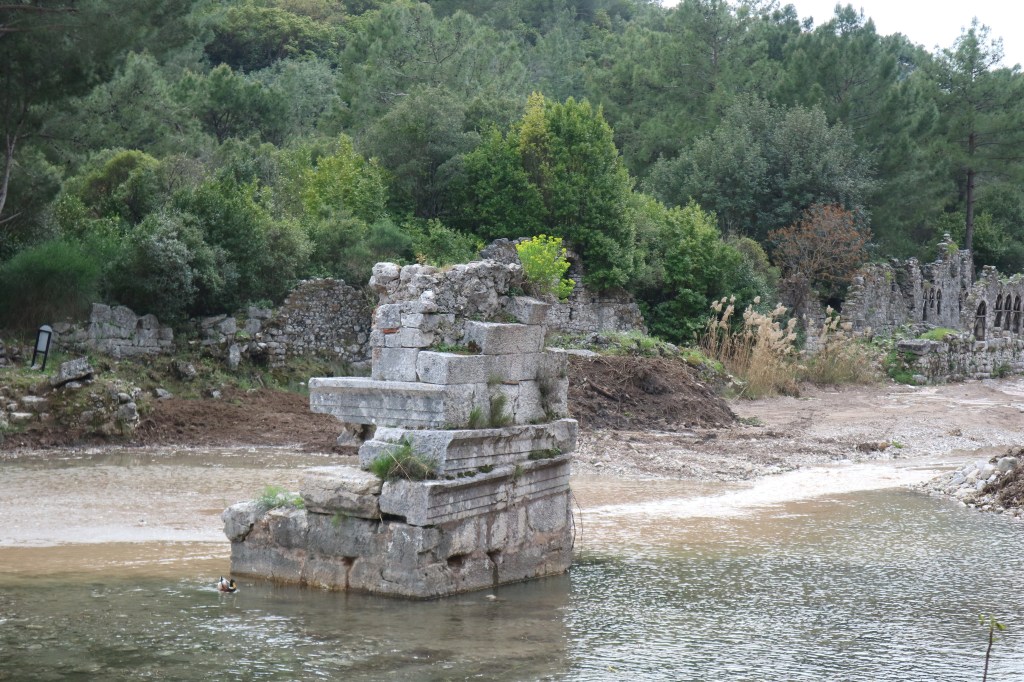
Unlike many of the ruins that we have visited the City of Olympos is managed and during our visit ongoing works were being done to take care of the site.

Habitation of the site dates back to about 800 BCE when a Doric colony (an ancient Greek ethnic group) made it their home, though it didn’t become a “city of import” until 200 BCE when it was recorded as having three votes in the Lycian League, as noted by the Greek geographer and historian Strabo (64 or 63 BCE – c. 24 CE). Coins from the Lycian League were also found at the site.

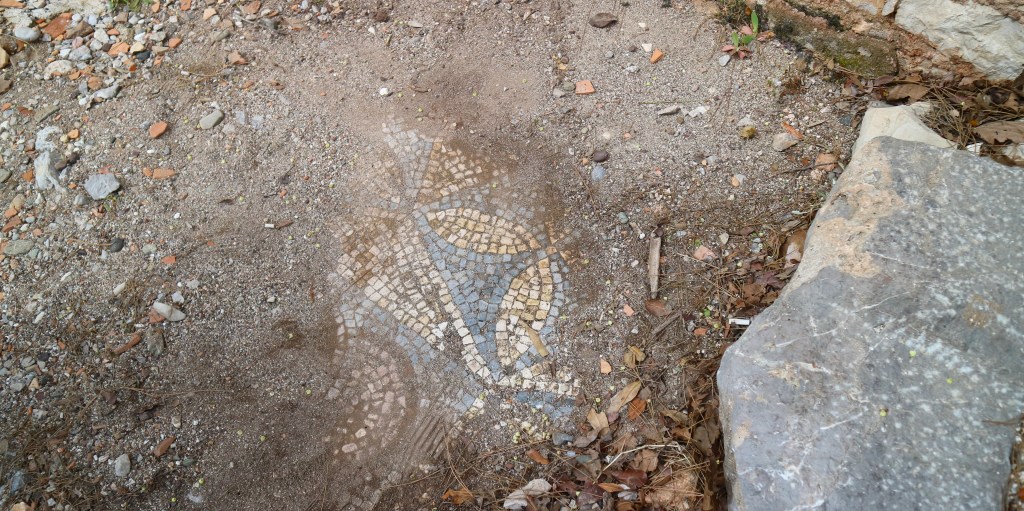
The mosaic is at the entrance to the two tombs, literally beneath our feet.

It seems the city was a thriving community with ties to the settlement on Yanartaş. And, around circa 100 BCE a Cicilian pirate called Zeniketes took over the city.

The Cicilian pirates are named after the region and were tolerated by the Romans for a long while as they supplied cheap slaves. When researching Zeniketes I came upon this interesting little side story. In 75 BCE another Cicilian pirate captured and held Julius Ceasar hostage on Farmakonisi (a Greek Island in the Agean Sea) for 38 days. According to Plutarch, Julius Caesar was incensed by the amount of his ransom insisting it be increased and then he negotiated on behalf of the pirates to have it paid. Once he was released, Caesar raised his own naval force (he didn’t hold a military office at the time) and returned to the island to apprehend the pirates. When it looked like the State wasn’t going to punish the pirates appropriately, Caesar had his men crucify the pirates. (Courtesy of http://www.britannica.com)

The historian Plutarch in his work, The Life of Pompey, explained the challenges faced by the Roman General, Pompey the Great when he decided to finally put an end to Cicilian pirates:

Their flutes and stringed instruments and drinking bouts along every coast, their seizures of persons in high command, and their ransoming of captured cities, were a disgrace to the Roman supremacy. For, you see, the ships of the pirates numbered more than a thousand, and the cities captured by them four hundred. (75 CE) (Courtesy of National Geographic UK)

Back to the City of Olympos and Zeniketes, the Cicilian pirate. He ruled over Olympos and the area that stretched from the Bay of Gelidonya to the western coast of Antalya (approx. 100 km of coast). There is evidence that Zeniketes was a worshipper of Hephaestus and would probably have made the journey up to see the eternal flames. His rule ended in 77 BCE when he set himself, his family and his crew alight rather than succumb to Roman rule. According to archaeologists the site thrived after his reign.

Christianity came to town around 300 CE when Methodius was named the first bishop of the Lycian region. Methodius was martyred in 312 CE for defending Christianity during one of the many persecutions. The only definitive text remaining that is attributed to Methodius is a treatise on the virtues of Christian virginity. So I’m guessing Olympos was not a fun place to be during his time. (Wikipedia)

The city of Olympos remained in one form or another throughout ancient history and into the middle ages with the Venetians, Genoese and Rhodians all having fortresses and settlements along this coastline. It was abandoned sometime before the arrival of the Ottomans in 1500 CE. The cities demise being attributed to war, earthquakes and plague. (https://www.allaboutturkey.com/olympos.html)

We capped off our day with a coffee at a beach side restaurant, before making the trip back up the hillside and then safely home. Thank you to Mandy and Mike for making this such a wonderful day and for sharing your photos.

Fair winds and a dearth of sea monsters for your week ahead.

Three Streets Back – Finike

Hello, welcome, come aboard. Weather in Finike has been a bit hit and miss the last few days. Reminds me of Melbourne, pouring rain on minute, sunny the next. Wednesday, however, was a slice of perfections. The skies were blue and the sun shone out long enough for Ian to drag me out for a walk “three streets back”. We often find ourselves in the industrial backstreets hunting for a Widget or Whose-it for some boat project or other. However, sometimes our adventures don’t include looking for unicorn-widgets or Fix-It Wizards.

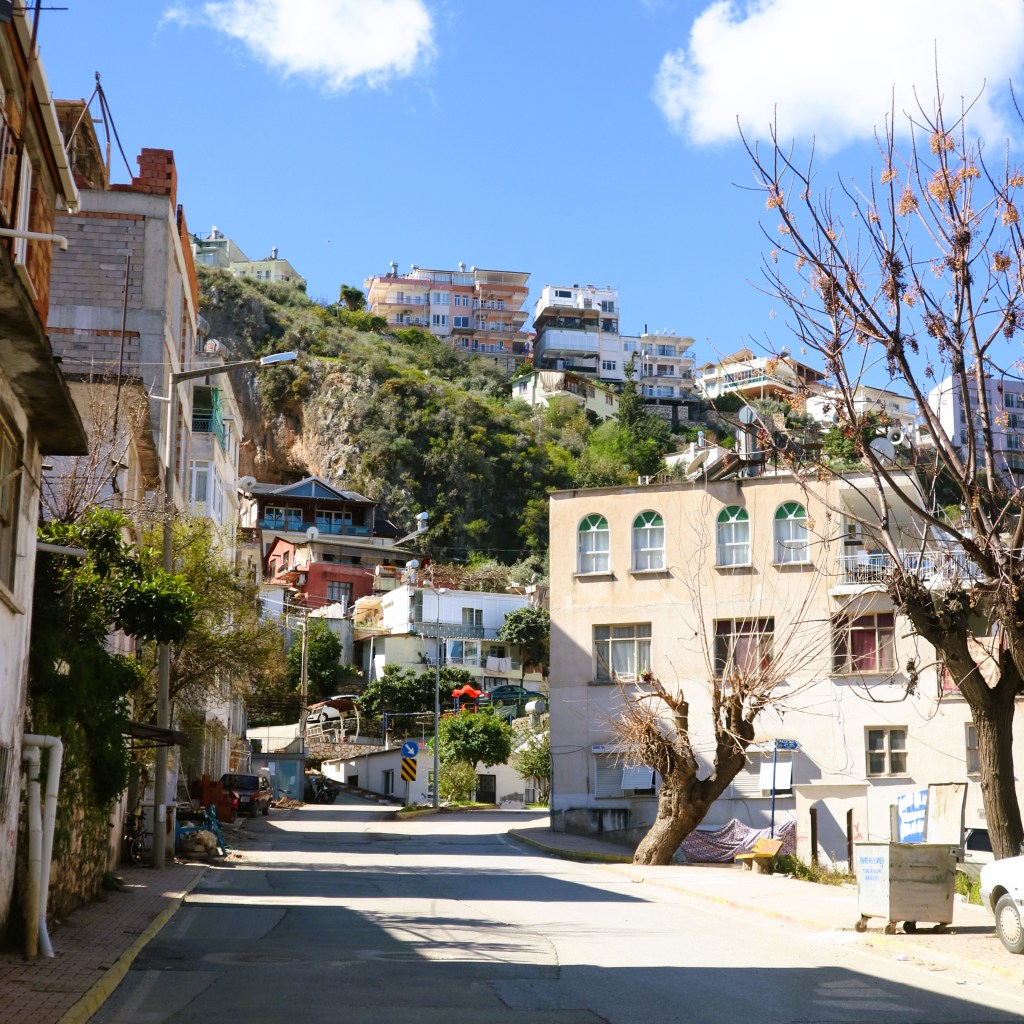
Wednesday was one of these “just because” adventures as we decided to walk up into the hilly suburbs behind the main streets of town. It wasn’t until we walked climbed the hillside (and I did a bit of research) that we began to appreciate the size of our “little town”.

The town has a population of around 12,000 people and the region boast almost 50,000, give or take the most recent births and deaths. I think this probably a conservative number at the moment given with the influx of those displaced by the earthquake and the war in Ucrania.

The agricultural foundation of the area dates back to at least 5 BCE when the region was known as  Phoenious. We were both surprised by the view looking back down toward the town and the acres and acres of greenhouses lay beyond the suburban spread. Agriculture and tourism are the main sources of income in the region, with oranges and other citrus fruit making up the largest crops. However, tomatoes, lettuce and all the good green, red and gold stuff are grown in enormous green houses. Of course the prime real estate along the coast is dotted with hotels and resorts, however even these compete with the farms.

At one time the area was ruled by the Byzantines, the Anatolian Seljuk State, the Tekeoğulları Principality and the Ottomans. You do not see much in the way of ancient history in Finike but it is on the Lycian Way so if you travel a short way in any direction, you’ll eventually trip over some ruin or archaeological wonder.

The ‘Battle of the Masts’, one of the major battles of antiquity, took place just off the coast of Finike in 655 ADE. This was the first decisive victory of the Arab fleet (200 ships) againstthe Byzantine fleet (500 ships). The Arab leader went on to Constantinople which, surprisingly enough, was named after his opponent Constantius’ Dad (or Grandfather, I can’t quite work it out which) Constantine the Great.

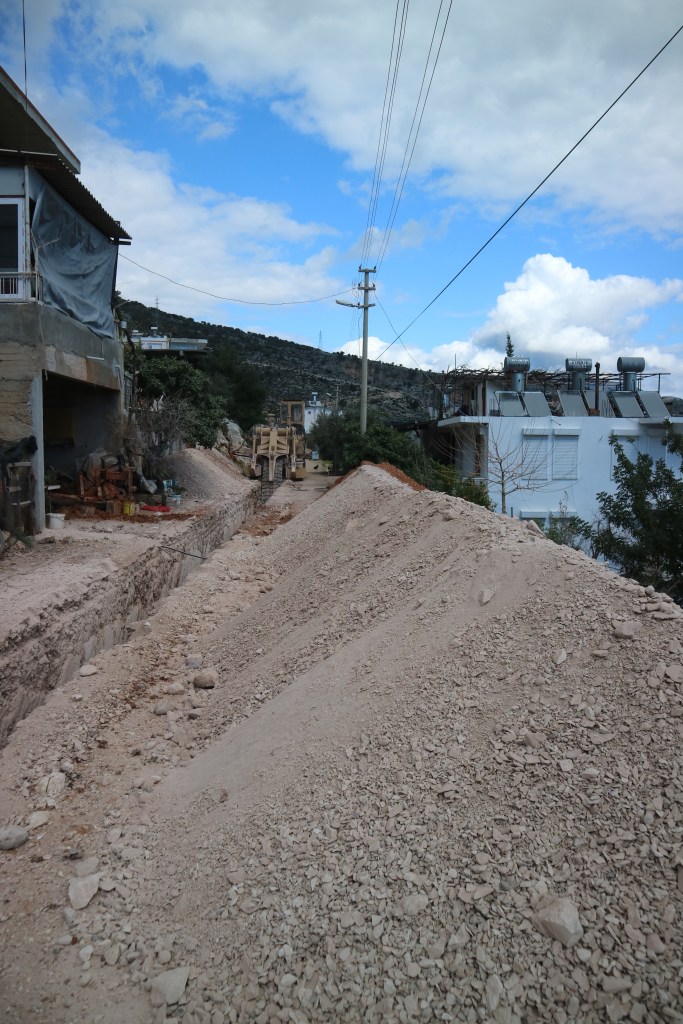
In more recent times, last Wednesday, we saw endless amounts development work going on. On some streets a new house or apartment block was being built. On other streets we saw road works, and sewage and other utilities being installed or upgraded. Occasionally all this work competed for space.

As you can see safety comes third

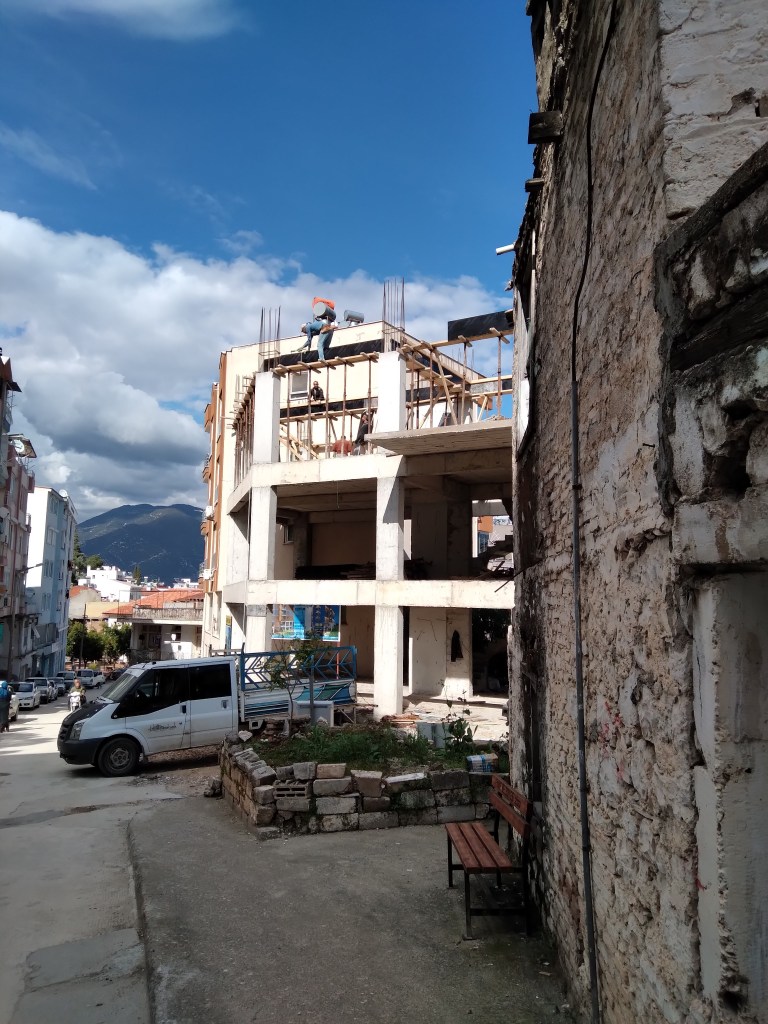
Yet, there is also decay and abandonment at every turn. There are half built buildings where folk a living on the lower floors while the upper floors are still bare steel and concrete. The Ministry of the Interior has a program called “Let My Home Be Your Home” that supports those who have lost their homes in the recent earthquakes. This would explain why so many of the partially completed residence are being occupied.

Ian also wisely suggested that the economy, the cost of money, politics will be having an impact on the construction and abandonment we see. I’m sure what he was saying is terribly clever, and the result of hours of inter-web research but I confess I was distracted by the lovely flowers.

For those that don’t know us well please don’t take my wanton sexist imagery as anything other than fact. Ian is dead keen on world economics, politics and such. I am not and count myself lucky that he worries about such things on my behalf.

There’s always a gaggle of kids’ about, playing games or riding bikes (the teenagers all ride mopeds). The younglings are watched by a distracted Mother or attentive Grandmother. The braver kids often say hello in English, pleased to be trying out their language skills. There’s always a wizened gentlemen or two sitting in the sun, a cigarette in hand and a çay beside them. No doubt they’re solving the world’s problems, if only we’d all listen! We always greet them with a sturdy Turkish “Merhaba” (hello). (çay – pronounced chai, a strong black tea made from Camellia)

To date I’ve been reluctant to intrude on folks time to ask for a photo but these two were happy to pose for a portrait.

We didn’t see many cats and dogs on this walk, however there were plenty of hens and more than a few confused roosters still calling out the sun despite it being lunchtime. We also heard the distinctive bleats and tinkling bells of a goat herd on a nearby hill. Beehives are also a distinctive feature of the landscape.

On one particular street we came by a rather special little creature. The street had a long deep ditch running the length of the road. I presume they are putting in cables or sewage pipes. The ditch was about 10 feet deep, at least 50 metres long and a few feet across. At one end was the ditch digging machine, and along the sides were large mound of dirt. Our side had enough room for us to walk pass, but the other side was quite tight for space. It was here that we came upon a tortoise. His shell no more than a hand span and in the way that all of these particular reptiles he looked ancient and wise. Unfortunately the little fellow wasn’t out for a stroll but was valiantly trying to cross over to the relative safety of our side of the road

No doubt he had designs on the shady garden behind us but tortoises can’t jump. (I know this because I checked on the inter-web: see http://www.tortoiseowner.com), so he was having some difficulties. As dirt skittered from beneath his feet into the ditch, I swear I saw him look plaintively at us as if to say “A hand here might be good. If you wouldn’t mind.” At which point, I may have squealed and danced about in useless panic. Thankfully, Ian, who is always better in a crisis, leapt to the rescue. Putting himself at grave risk of falling into the hole, he used the ditch digger as a bridge collected the beleaguered tortoise. He then returned to our side, and gently deposited the little reptile beneath a geranium bush.

I didn’t see if the tortoise gave Ian a nod of thanks so I made sure to give him a sloppy kiss as reward for his bravery.

As we went on our way, I pondered upon what the tortoise thought about his rescue. Ian, whose quick wit is faster than his leap into action, proclaimed it would have been something like, “Whilst upon my journies I came upon the Pit of Despair. And, whence I thought all was lost, the hand of the great All Mighty God came down upon thine shell and raised me up, as if upon golden wings, and carried me over the Pit to my salvation! For thine is the power O’ Great One.

So from the Mighty God and his adoring fan we say goodbye and… fair winds and a dearth of sea monsters for your coming week.