Gulets – the modern day (touristy) pirates

Hello, welcome, come aboard. It’s lovely to be back out on the deep blue wobbly! While we are waiting for Summer temperatures to hit we are enjoying the cool breezes and cooler evenings. In the last week or so we’ve visited some amazing ancient ruins and lovely anchorages, some of which will feature in up coming blogs. For a change of pace, I thought I’d tell you a bit about the gulets that are a feature in the coastal waters of Türkiye. Gulets are wooden sailboats, or pretend sailboats, which are used for tour and charters (often with a full crew). For sailors and cruisers, such as ourselves, gulets are the bane of our existence and rivalled only by the pretend square rigged party boats. They overrun the best anchorages, often with an astonishing lack of good manners, play loud doof-doof music until all hours and generally run rampant over everyone else.

Gulet captains are very territorial of their preferred anchorages. It’s difficult to pick what might be a gulet anchorage, except to say if the bay is particularly beautiful or has an interesting feature (ruins etc) you can bet your last dollar there’ll be gulets. In short anything and everything we are keen on seeing, too!

We once had a gulet captain yell at us to move our lines so he could squeeze in alongside us. It was a very tight anchorage, with realistically only room for one gulet or maybe two smaller boats. Ian and the gulet captain “politely” discussed the options. Ian informed the other captain that as we were there first the gulet would need to find another spot. The gulet captain would not be put off eventually ignoring us he overlapped our shore line with little regard for how close his gulet was to our boat. The gulet which had good 10ft on our 50ft, was close enough that I can tell you the passengers on board had a lovely grilled fish and salad for their dinner followed by strawberry sponge. I believe the white wine was Italian, which is unusual in Türkiye as imported wine is hideously expensive. Thankfully, the passengers were older so we didn’t have the doof-doof music until all hours, which is an added bonus when you are anchored in a beautiful secluded natural bay.

I get it, it’s their livelihoods and reputations at stake. Their clientele have every right to the same touristic experience us and for the most part we all share nicely. However incidents such as the one I mentioned are not uncommon. I recently read about some poor sod whose anchor became snared on a gulet chain, easy done as the gulets often lay a hundred metres on chain. Anyway the poor sod had their anchor cut off with an angle grinder. The gulet crew was kind enough to return the now detached anchor to its owner, who I can only imagine was drifting away to shores unknown!

To be fair, they are not all like this. We had one gulet, gamely try several times to berth his boat in a town port with very tight quarters without a peep or sign of frustration. In the end we moved to give him room and he was very grateful.

Notwithstanding the joys of sharing the seas with these cut throat captains, the gulets themselves can be very beautiful. They’re two or three masted wooden vessels which are rarely rigged for sailing and they are synonymous with this region.
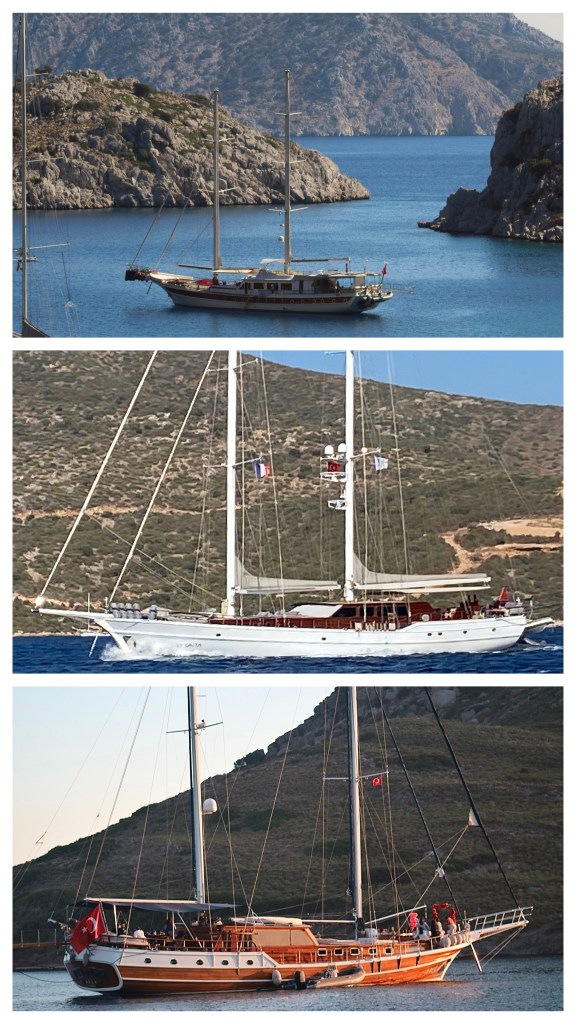
They really are quite pretty when they’re in the distance! We’ve seen just about every colour gulet you can imagine. I like the “au naturale” look best. You’ll notice of these three only the white boat is rigged for sailing.

Of course, there are others that have garishly fitted out to look like pirate vessels. “Pirates of the Caribbean” has a lot to answer for! Many of the Turkish gulets are built in or around Marmaris and Bodrum. Ian and I had the pleasure of visiting the Maritime museum in Bodrum which helped to shed some light on the history of these boats.
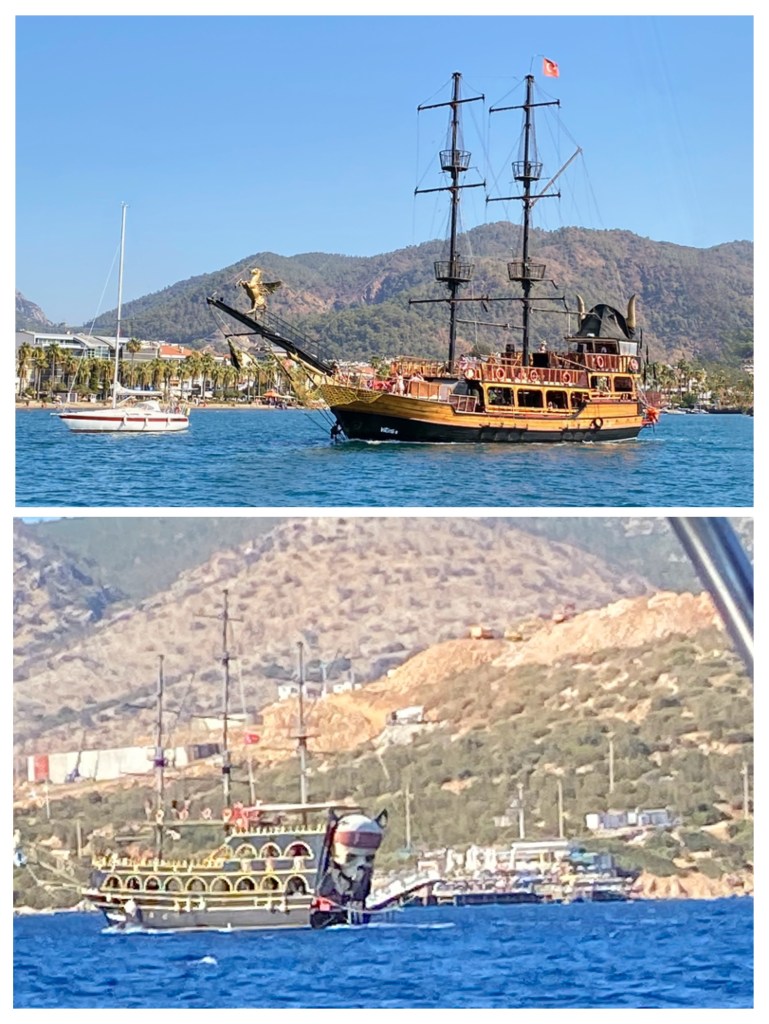
There are a few where you walk between the legs of Captain Jack or through Davy Jones’s mouth! A couple that we’ve seen have bubble baths on deck and there’s always loud musics, which is just a likely to be ABBA, Queen or Turkish pop music. Thankfully these boats don’t normally hang around after dark.

Bodrum is located where the Mediterranean meets Aegean Seas. It’s a busy harbour with ferries, gulets, yachts, motorboats, fishermen and even rowers sharing the water and all this is overlooked by a stunning castle (more on this in another blog). There are numerous shipwrecks in the area dating back as far as 14 BCE, attesting to the region’s rich maritime past, including a pirate or too. As stated at the Maritime Museum:

According to the ancient historians, the Leleges, who are currently accepted as the first inhabitants of the area, were engaged in piracy. Since there cannot be a pirate without a boat, one needs to accept that the marine culture of the area goes back at least three thousand years.

So with the risk of stating the obvious, boats have been a bit of a thing here since forever.

Here’s an interesting tidbit, there is written evidence of two female admirals: Queen Artemisia I of Halicarnassos (5th century BC), who commanded five ships at the Salamis sea battle between the Greeks and the Persians. The family tradition continued Artemisia II (4th century BC), a distant decedent, who defeated the Rhodians in the harbor of Halicarnassos and went onto conquer Rhodes. The King said of the victory

… my women have become men and my men have become women.

This region also has a rich Byzantium history which I’ll also write more about later but there would almost certainly have been some ships and boats floating about, though not much is known about their importance at that time. In fact, boat building in Bodrum didn’t appear in historical records until the Ottoman period (18ᵗʰ Century) when Sultan Selim III (1789-1807) led the reformation of the Ottoman Navy and provincial imperial boatyards, such as Bodrum, came into their own. These Ottoman galleons were 50 metre long wooden vessels propelled by oars and sails. Working at these boatyards would have been back breaking, sweat inducing and potentially lethal. Not the least because boat building in those days was dangerous. Records show that Captain Pasha during a Mediterranean voyage discovered numerous faults with his new Bodrum built ships. On returning to port he had the Bodrum harbor master and the mast builder hanged “in accordance with the new boatyard arrangements.” Now that’s a work clause many of us might like to include in contracts with various marine, car and home tradies.

When Ottoman Empire’s internal troubles steered the Sultans’ focus away from the sea. Even though there was a large sponge diving and fishing industry in the region, there is little evidence that the boat building at Bodrum extended beyond these naval ships to include fishing or merchant vessels. Instead the Bodrum region returned to agriculture and animal husbandry as its main source of income.

It wasn’t until a century later with the introduction of Muslim refugees from Crete in the early 1900’s that boat building returned to Bodrum. These refugees brought their seafaring, transportation and fishing heritage with them and they pioneered the development of boat building particularly boats used for sponge diving. This eventually lead to the transformation of Bodrum into the gulet building central it is today.
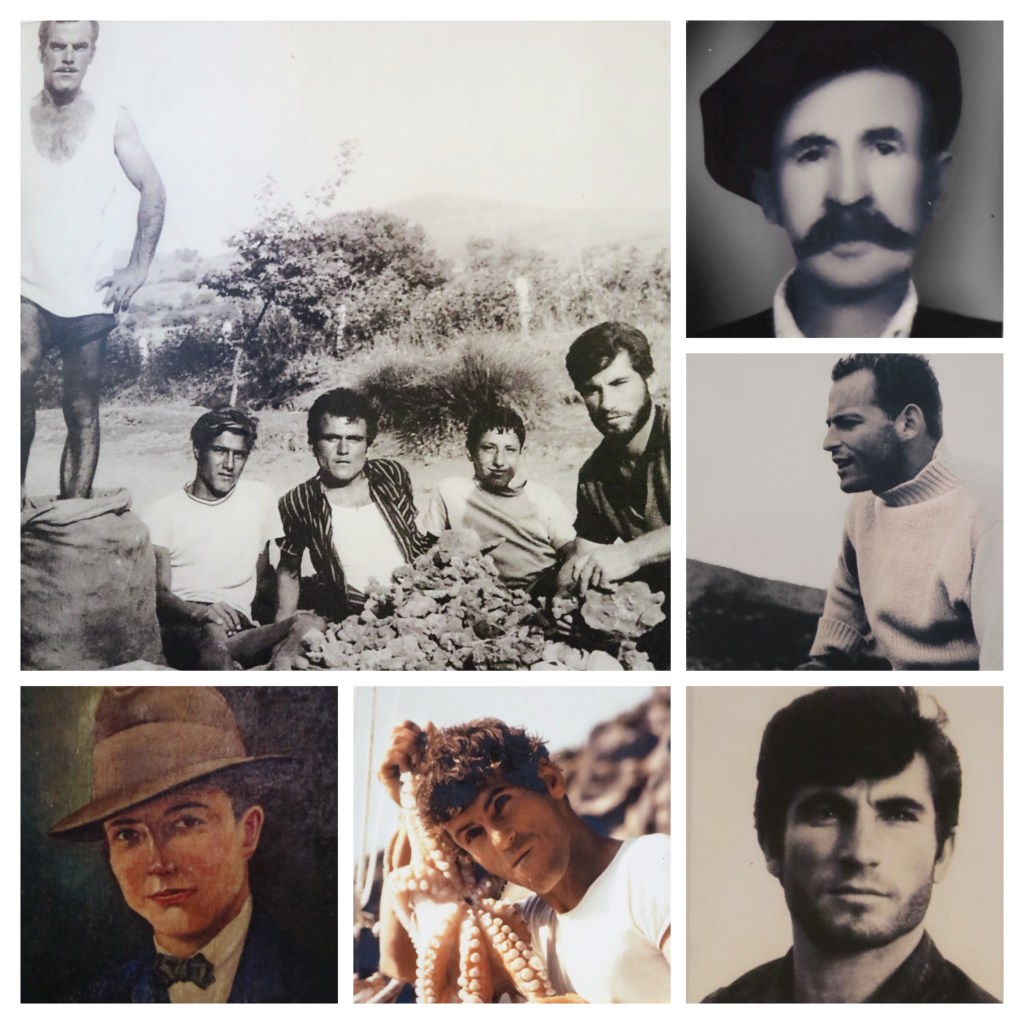
Some of the local fisherman throughout the ages. I especially like the guy with the direct line to Poseidon – must be a gripping conversation!

The design origin of the gulets, themselves, is controversial. Some say they are the offspring of the sponge and trawler fishing boats of the region. Others argue their forefathers were the French, Italian or Spanish fishing vessels called guletta (french), perhaps the design was brought by the Crete refugees. Others suggest that its origins hark back to the American gullet used in the Greenland banks, or the clippers carrying goods from India or Australia to England during the colonial era. Notably, all these boats are designed using techniques and materials that find their origins in medieval boat building such as that undertaken in Bodrum centuries ago.

The transition of the fishing and sponge diving gulets to the beautiful yet bothersome tourist attractions that annoy us with their loud music and pushy captains began in 70s when the local sponge populations in took a dive and some entrepreneurial type added cabins and other luxuries in order to lure tourists dollars.

Gulets always look special with their fairy lights light up!

Fair winds and a dearth of sea monsters and pesky gulets for your week to come.

Kayaköy – Modern Day Ghost Town

Hello, welcome come aboard. This post is the longest I’ve written. I had a lot to say and while I have tried to keep my thoughts brief, WordPress tells me you’ll need a cuppa and snack or given this is not my usual light reading perhaps a nice single malt whiskey. If you’re only interested in pretty pictures of ruins, I suggest you stop reading at the *. If you would like to know why the ruins exist, read on however I warn you there’s politics, war and even a little literary license (not mine for a change)

Recently we had the opportunity to revisit the lovely town of Fethiye. During our last visit we explored the Old Town and had fun playing “Indiana Jones” at the Lycian rock tombs. This time we decided to visit a very special place nearby that I had heard about from some friends. I’m usually the first to line up for any historical site. I love ruins. I love museums. I revel in tales of old and these places are remnants of stories. Stories of people’s lives, their hopes, their loves, their chores, and hardships. However, this town, now known as Kayaköy, is a sad place. Its ancient history is overshadowed by great hardship and tragedy in more modern times.

Kayaköy was once known as Carmylessus. It’s just 8 short km over rugged hills from Fethiye and about the same distance again to Gemlier Adsi (St Nick’s Island) on the coast. The region was inhabited for centuries, reaching the lofty heights as a Christian bishopric during the Byzantine Emperor Heraclius (640 CE). There’s evidence to show the St Nick Island inhabitants (Christian monks) would flee to Lebessos in time of pirate attacks. The town thrived well into the 20th century, however it is now a ghost town.

When I mentioned to Ian that I wanted to visit Kayaköy by bus he was ambivalent, that is, until I explained it was a “modern” ghost town. Intrigued he agreed and we set out on a bus that reminded me of an All-American yellow school bus, only white and a third the size. Unfortunately, in an effort to accommodate as many people as possible legroom was non-existent. Our cunning plan to be the cool kids at the back of the bus was soon foiled as we were forced into a corner seat. With my knees around my ears, I looked at Ian laughing at me and asked, “if he was mocking me for my choice of bus.” Thankfully the trip wasn’t too long and we were treated to a view of the suburbia behind Fethiye and the forested hills along the way.

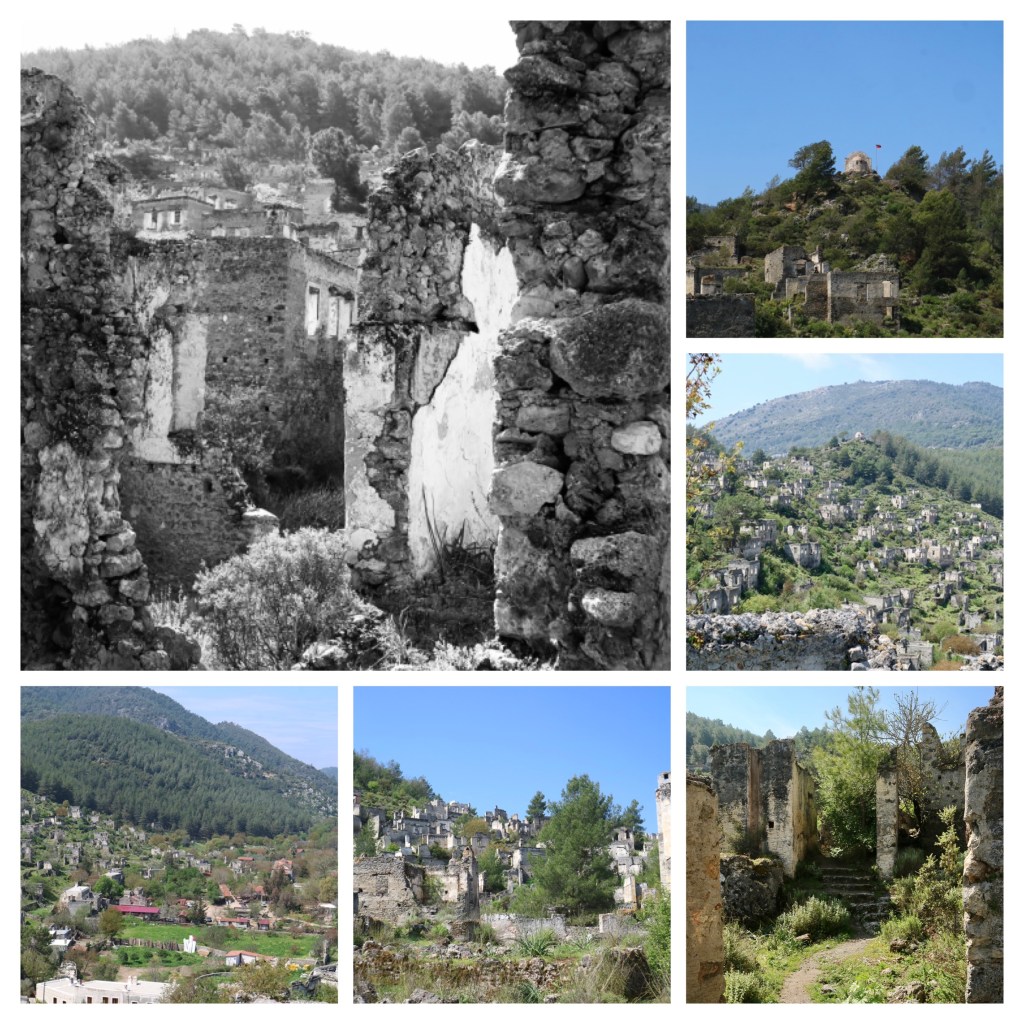
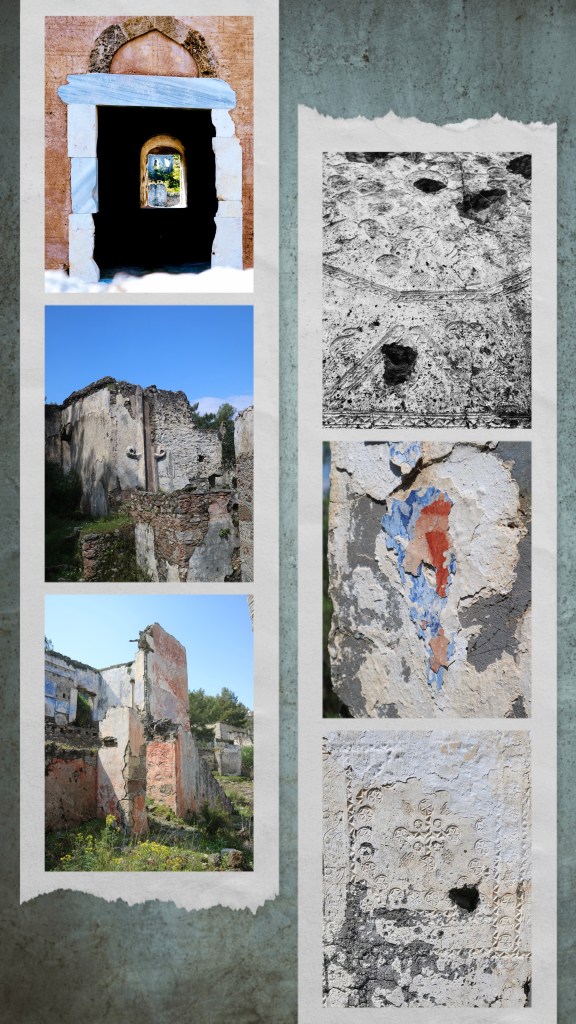
On our arrival we discovered Kayaköy that was once home to around 10,000 people is/was a town of contrasts. To the left of the main road there’s a craggy hillside. The ruins of two and three storey stone houses and buildings cling to the slope. The houses, and their underground cisterns, are all open to the elements. Nestled among the houses there are two schools, a municipality building, fourteen chapels and two churches. The most prominent chapel sits at the apex of the hill. It’s single room is tiny, room for perhaps six people, it has two postcard windows. One open seaward, the other behind the alter overlooking the town. The churches are bigger and grander, the other chapels would be difficult to recognise if not for the signs. At one time there would have been an ossuary behind the largest of the churches. These too are reminiscent of much old ruins; no doors or windows remain, roofs gone and walls tumbling down. Trees and shrubs reclaiming the environment. The town also suffered greatly when an earthquake shook the area in 1957.

Kayaköy ruins

The thoroughfares through the town are stoney tracks and stepped paths. There’s only room for man and beast, no space for wagons or cars.

Even in Spring the hillside reminds me of the Australian outback, shades of muted greens and brown, with only scraps of the colour and vibrancy I’ve come to expect from a Turkish Spring. Nature is winning. (funny thing, when I returned to select photos for this blog, I discovered that the township was a riot of Spring colour and not nearly as muted as I remember. I think my great sadness for this town overshadowed the vibrancy of memories).

Below the hillside, the valley is green and lush. The soil is rich and consequently much is given over to farming. There are wooden and brick houses there too. Though these show signs of inhabitants, atelliste dishes, washing airing in the breeze, the enviable cats and dogs. These homes skirt the flat land so there is no boundary between the town on the hill and the farms except the restaurants and tourist stalls along the main road. Here we found the first of the mosques sitting squat and imposing.

*Until recently (early 1900s) the hillside was populated mostly by Greek Christians and the valley by Turkish Muslims. There was also a thriving though small Armenian quarter. The Greeks, on their hill, were largely “middle class”, shop owners, government official, artisans, and the like. Their children attend the Greek school, learning to read and write, mathematics and science. The Turks, in the valley, were farmers, though there would have been a Turkish landowner, much like an Englishman nobleman who owned all the land. Their kids went to the mosques for their learnings. It’s unlikely they would have learned the three “r’s” instead focussing on the learning the Koran and teachings of Mohamed.

There were certainly similarities and crossovers. The religious men of both denominations would have been influential, the women probably more so in the day to day lives of the town. Turkish was spoken but written using the Greek alphabet.

A very heavily romanticised version of this village life was written by Louis de Bernières, of”Captain Corelli’s Mandolin” fame, called “Birds without Wings” (April 2004). This is a story of a town called Eskibahçe, which the author acknowledges is based on Kayaköy (and other towns that suffered the same fate), and tells of the last few years of the town as a focal point for the broader historical event that began with the decline of the Ottoman Empire in the late 18ᵗʰ Century and ended with the birth of modern Türkiye in 1923.

This is not a happy time in the world generally and in this region particularly. Within the Ottoman Empire, factions pushed for modernisation and the abolition of the Sultanate in favour of a democratic nation. During this turmoil, World War I breaks out, and the Ottomans ally themselves to the Germans. Most of us know of the Allied campaign at Cannakale (Gallipoli). The book gives an admirable account of this battle/s from the point of view of the Turks. De Bernières is graphic is his description of the appalling conditions that the soldiers, Allied and Turks alike, faced. While the war rages on, elements of Ottoman government attempt to further the Republican agenda. After the war much of Ottoman Empire was partitioned and so began the British, Italian and French occupation (1918-1922). This period overlapped the Turkish War of Independence (1917-1923). The Armitistice of Mindanya signed an 11 October 1922 and the Treaty of Lausanne signed on 24 July 1923 officially settled these conflicts. As part of the settlement negotiations, Greece and the newly formed Grand National Assembly of Turkey lead by Mustafa Kemal Atatürk) agreed to an amnesty for war crimes committed and made arrangements for the exchange of citizens that happened to live on the wrong side of the border.

Throughout this period of unrest, the Turks committed atrocities against the Greeks, Armenians, Syrian and Allied prisoners of war. The Greeks were given the opportunity to leave Turkey, voluntarily. Those that refused to leave willingly where forcibly removed through death marches; being permitted to take only those possessions they could carry and these were often “confiscated” by the soldiers. Those that still resisted were put to death. The Greeks reciprocated against the Turks and had a good go at the Armenians, as well. When researching I found plenty on the Greek and Armenian Genocide committed by the Turks. These, and the book, describe unspeakable cruelty and wanton bloodshed. Notably, I could find little on the atrocities the Greek inflicted on the Turkish people at this time. The one solid fact that everyone agrees on is that the victims were mostly innocent women and children left behind when the men went out to fight for their cause.

The triple contagions of nationalism, utopianism and religious absolutism effervesce together into an acid that corrodes the moral metal of a race, and it shamelessly and even proudly performs deeds that it would deem vile if they were done by any other.

Louis de Bernières, Birds with Wings, p324 (eBook version), April 2004

So, it is easy to believe that Kayaköy and others like must have been strife with unrest, civil disobedience and hate crime. Yet the book, which is based on oral accounts of those that lived in the region at the time or grew up with the stories of their elders, tells a different story. Eskibahçe was peaceful, there was no overt segregation (though the Armenians were generally disliked), except in religion. The women folk were friends, the kids played together, and the men played backgammon in the town square. There is a thread throughout the book regarding the gendarme’s prowess at the game, having all the time in the world to build their skills. There are snide comments behind closed doors and few good-natured snips, much along the lines as you would hear from rival football team fanatics among the town folk. Yet, the Muslim women are not above asking their Christian friends to leave offerings to the Virgin Mary Panagia Glykophilousa. The Imam gives a blessing to a Christian baby. The Christian men seek advice from the Imam. Even the Greek schoolteacher who is overtly pro-Greek is for the most part humoured. The town folk share a mutual undertone of rural mysticism and folklore.

When the soldiers finally come to take the Greeks away, the Eskibahçe, the Turks provide aid to their neighbour, they agree to care for their homes and belongings and some Turks make the journey to the port to ensure their friends are not hurt along the way. The book briefly tells of the arrival of the Greek Muslims and the distress of everyone involved in the exchange process, this is soothed eventually as acceptance of the people overshadows the method of their arrival. As the resettled people were unable to take their wealth with them many lived out the rest of their lives in poverty or near poverty. Most of Greek Muslim were farmers, like their Turkish counterparts. The lose of much of the Greek middle class in rural areas has held Turkey back. The Christian Turks were ridiculed and shunned in Greece. Many would have found it difficult regrow their prosperous businesses in their new homes.

Finding Turkish historical records and accounts of rural life (and the genocides that occurred) was hard. This is why I relied so heavily on Birds Without Wings. I’ve read a couple of reasons for this lack of written history, all are to have contributed. The Ottoman Empire was largely Muslim and did not believe written records of daily life were meaningful and importantly this is the period in which Mustafa Kemal Atatürk rose to power. He is revered here in Turkey as a modern man, great military leader and a benevolent leader. Atatürk literally means Father of Turks. He strongly believed government should be non-secular, democratic and looking towards the future not the past. Here the focus on Atatürk’s advancements: he was pro-suffrage, believed in non-secular education for all (including women) and wanted his country to be an active participant on the world stage. He also banned the fez and turban, making it mandatory for all men to wear western style hats in public places. This is known as the Hat Revolution. The Turks have written their own history, after all they were the victors.

I didn’t read Birds Without Wings, until after our visit to Kayaköy. I knew some of the modern history of Turkey and its impact on villages such as this one. And to say that I was ambivalent, bordering on reluctant to walk the streets of this ghost town, would be an understatement. This may seem contrary, but my love of history is largely restricted to ancient history. To times and places where I can tread without fear of seeing the futility of our modern world or find yet more evidence of our persistence in acting on our differences rather than embracing our sameness. However, having been in Turkey for eight months, I wanted to further understand this wonderful country. To do that, I need to know this awful history, so I can understand the people I meet. Frankly, as a result of this excursion into modern history, I’m even more surprised at how welcoming the Turks are given that just over 100 or so years ago, Australians were part of an invading force that attempted to tell them how their country should be run. At least that is how it must have surely seemed to the grandparents of the elderly folk that we pass every day on the streets and laneways here in Turkey.

I promise I will return to lighter and more ancient topics in coming posts. In the meantime, fair winds and an dearth of sea monsters for you and your loved ones.

The birth of an ancient sport: Yağli Güreş

Hello, welcome come aboard. We’ve been busy this week, preparing to head up to Bodrum to pick up our friends, Charlie and Megan. Bodrum is 167 nm away, Longo Mai has a conservative average speed of 5 or 6 knots thats between 27-33 hours of sailing. Unfortunately it’s not as simple as planning a car trip. The weather and safe anchorages play a large part in planning. We can’t leave Finike until after Thursday (06 Apr) and we need to be Bodrum Friday of the following week. Unfortunately the weather is finicky this time of year and while we have a day and a half of promised tailwind, it isn’t enough to get us all the way to Bodrum.

Especially as the following day’s forecast is predicting a head wind with gusts up to 30 knots. Over the last week the forecast has changed daily, and our plans have changed accordingly. Ian’s career was reliant on these environmental forces and his as relaxed as a Turkish dog resting in the middle of the road. (Trust me these dogs own the world and even the biggest trucks will swerve or stop and let them move in their good time.) He tells me if you plan early you’ll plan often. But he now takes it to the next level and is quite happy to wing it on the day. I’m not so lucky, its never been in my nature to be relaxed when there’s a deadline looming and I think it’s fair to say I’ve been a bit of a pork chop about it all. Thankfully Ian also weathers my moods well. Our friends are incredibly understanding and are now meeting us in the lovely town of Göcek. This is easily achievable for us and shouldn’t put too much of a dampener on our plans for their visit.

In the meantime we’ve also been taking advantage of the sunny day to mend the gel coat. This is a delicate grubby job with the sticky gel coat goop setting (going off) very quickly. The less excess goop the less sanding. Being new to this, Ian and I have a bit of sanding to do over the coming week.

We plan to leave Saturday and one of the last tasks will be to visit the Finike market in the morning before we leave. Just as it was in Brisbane, going to the market is a highlight of our week. There’s a restaurant on the way that makes a pretty good Menemen, which is like Shatsuka or Spanish eggs except the eggs are mixed in. Turkiye is predominantly Muslim country (officially non-secular) and as Finike is a conservative agricultural town, there’s no bacon or chorizo but the Menemen is always spicy and the ingredients are farm fresh making the flavours rich and flavoursome. The coffee is passable and my caffeine snobbery has been softened by necessity and now I’m just grateful its hot and passably drinkable.

After breakfast, we head down to the markets. Changing the route of our walk often; feeling like locals as we navigate the back streets. Next to the markets there’s a primary school and sports arena. Even on Saturday mornings there is the merry laughter and rambunctious shenanigans of kids at play during recess. Last Saturday we were lucky enough to see Yağli Güreş being practised at the sports arena.

Yağli Güreş is a popular sport in Turkiye. As a spectator’s sport its quite appealing. The wrestlers wear short leather trousers called “Kispet”, made of leather. The Kispet of adult wrestlers weigh a whooping 13 kilos. The only accessory the wrestlers, or pehlivan, team with their Kispet is a liberal dousing of olive oil. I guess there’s no surprise in me now telling you Yağli Güreş is known as oil wrestling.

The objective of oil wrestling, is not break your opponent but to to disable him. Therefore, unlike other wrestling sports the pehlivan can win by putting his hands down the other wrestler’s kispet and grasping the lower end of the pant’s leg and thereby prevent him from attacking. Yağli Güreş is serious business here in Turkiye with the National Champion winning 100,000USD, sponsorship and a very impressive gold belt.

The history of Yağli Güreş is as rich as you would expect given it dates back to 1000 BCE in Persia. The current rules date back to the Parthian Empire (238 BCE – 224 CE) and there is a strong tie to religion with the sport being conducted during Spring festivals. However, it didn’t become a sport in its own right until the reign of second Ottoman Sultan Orhan Gazi (1281-1362). Originally the matches could go on for days until someone won or died of exhaustion. It wasn’t until 1975 when someone with a little bit of common sense introduced a time limit.

This all very fascinating and impressive however I can’t help thinking how this wonderful sport really started. Maybe something like this.…

A troop of seasoned soldiers sit around a camp fire during a Spring Festival in some ancient city or other. They’re laughing and drinking as they boast about this battle or that fight. There’s a little more drinking and the crusty old veterans tease the junior soldiers about their lack of experience with their manly weapon. They all drink some more.

The camaraderie is high and spirits are flowing and everyone is happy until a procession of virginal maidens glide by, their hands in prayer and eyes cast down demurely. Their white shifts fluttering in the evening breeze, occasionally giving tantalising hints of the shapes beneath.

As the soldiers all quietened to watch the procession pass, Darius and Bahar, two of the younger fighters try to impress the ladies. Their mates egg them on as they all keep drinking. Their taunts and catcalls are sufficiently loud enough that the last virgin pauses and looks up with innocent doe eyes and blushes.

Darius and Bahar decide a wrestling match will prove their masculinity and prowess to this willowy maiden; ensuring her heart and more importantly her body is given freely and wantonly to the victor. So turning to their buddies, the two soldiers say “here hold our drinks” before throwing themselves at each other.

Their inebriation loosens their skills while heightening their emotions and soon the wrestlers forget the triviality of their purpose and begin to battle in earnest. Laughs become growling sneers. Curses become threats as a crowd grows around them. Their comrades and other spectators begin to wager on the outcome as more spirits flow lubricating the cheers and jeers.

Anoush, their wisened and grizzled sergeant, sitting at the next camp fire see ing the potential for a disastrous outcome, grabs a nearby jug and strides over to dump it’s contents over the two wrestling men. Except, alas, the jug isn’t full of water but olive oil. Slipping and sliding and unable to get a purchase on each other Darius and Bahar stop, gasping and spitting oil. Their surprise turns to humour and they begin laughing again.

Just as it looks like they’re about to clasp forearms and put aside their differences, someone in the crowd shouts out that Darius was the winner and he wants his bet paid out. Across the way there is a retort that Bahar was the winner “as any blind man can see”. Anoush, Darius and Bahar watch the mood of the crowd turn ugly. Anoush realising this could turn even nastier with the outcome worse than just the wrestlers getting mean and hurting each other, thinks quick and turns to Darius and Bahar and with a shrug, nods for them to continue.

The men struggle for a while as they figure out just how they’re going to win if they can’t get a good grasp. The crowd mood lightens as the fighters fumble along. Eventually, Bahar puts his hand down Darius’s pants grabbing the leg end and lifts him off the ground to dump him unceremoniously into a nearby pond. Anoush declares Darius the winner to the raucous laughter of the crowd. All threats and curses are forgotten as bets are paid out. Finally everyone toasts the wrestlers and plies them with more drink. There you have it Yağli Güreş is born!

Sometime later, Darius remembers the lovely maiden who had unwittingly incited the spectacle. He looks around thinking he’s in with a good chance. However she and her sisters have moved on (becoming bored long before Anoush intervened with the olive oil). Later Darius learns the maidens went on to the chieftain’s tent; which of course, is where all the money and power lies.

Fair winds and a dearth of sea monsters for your week ahead.

(Thanks to: Wikipedia, All about Türkiye, and A Sports with Religious Rituals from Hıdırellez Cult: “ Kırkpınar Oil Wrestling)

PS: I asked Ian what to call this weeks’s post and he suggested: “Lubed Up and Ready for Fun” or “it’s not romantic unless your eyes meet” (and that second one I’ve had to wave the politically correctness wand over) That’ll teach me for trying to include him in the creative process!

Yanartaş and Olympos – Mythological Beasts and Pirates

One of the touristy things that has been on our “to do” list since coming to Finike was to visit Yanartaş and the ruins of Olympos. So when the topic came up with our friends Mike and Mandy of SY Kirrikie, we decided that the time was right, especially as our days in Finike are dwindling fast and its always lovely to share experiences with other folk. Note to readers – this is a long post, you might want to make a cuppa and a snack.

Mike and Mandy of SY Kirrikie

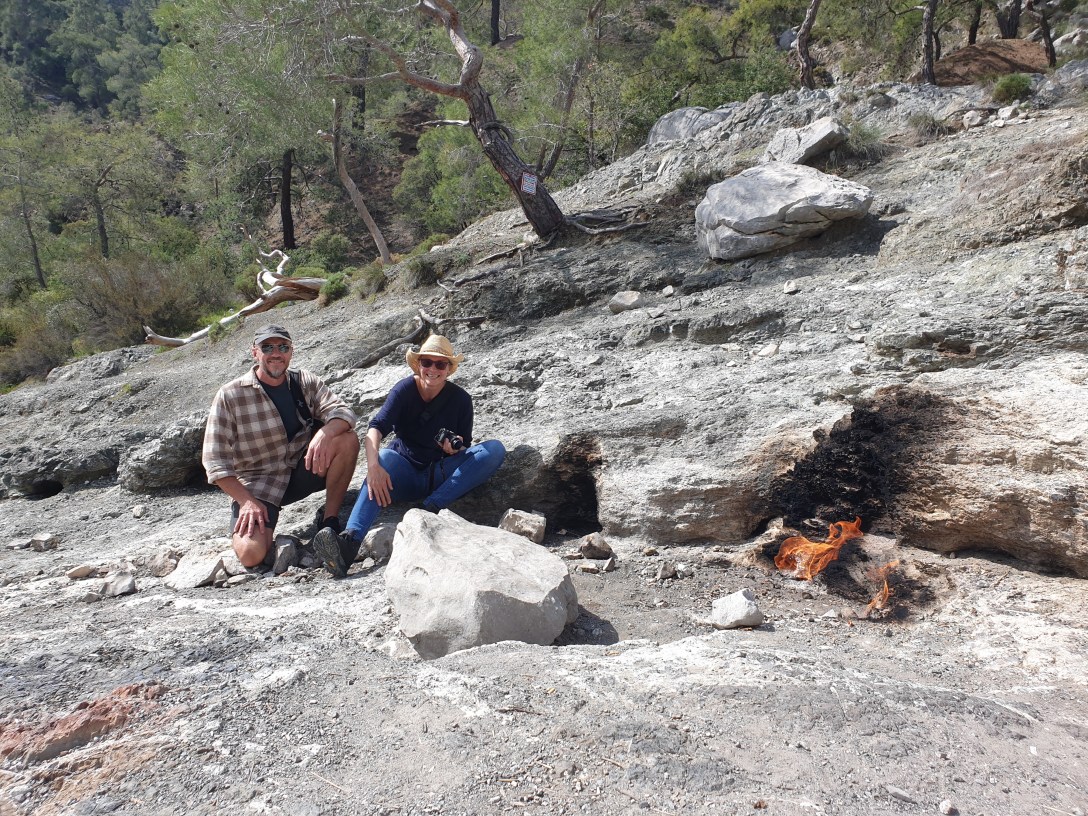
The hour drive North to Yanartaş was a thrill with Mike at the wheel and Ian navigating. Mandy and I tried not squeal as our rental car tore down the winding road, dodging trucks and cars hither and tither! Much to Mandy and my surprise we arrived safely at the base of Yanartaş. (We had to hurry. The flames had been burning for thousands of years so they must be due to run out of gas soon. You’d hate to be the person who dawdled and arrived just after they ran out.)

The entrance to Yanartaş National Park

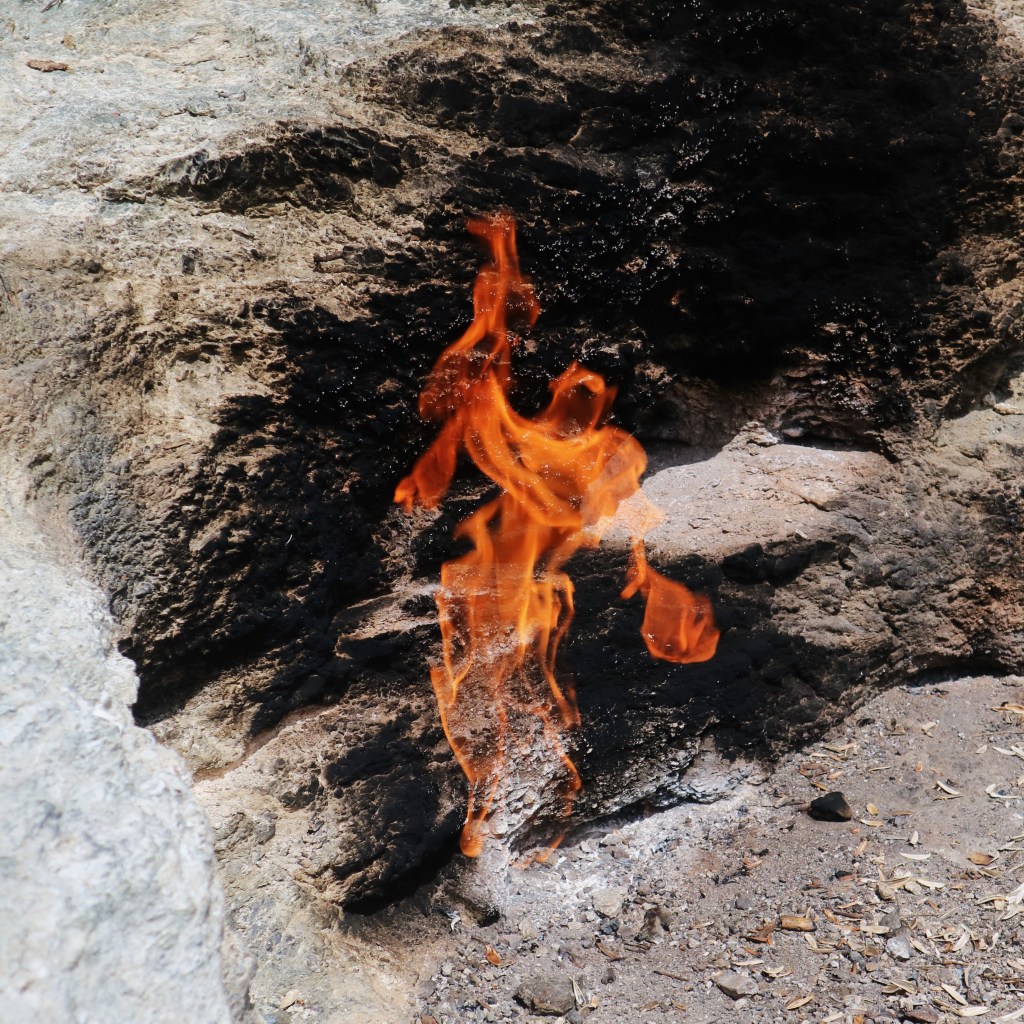
Yanartaş would be just like any other national park if it wasn’t for the natural fires that have been burning upon the mountain

These fires are the largest venting of abiogenic methane on the Earth’s terrestrial surface. They have been burning for over 2500 years, with historical records of the eternal flames stretching back several millennia. The flames breach the surface of the Earth through cracks in the volcanic rock. The original fire was much more powerful however as earthquakes changed the landscape the fire diffused into the smaller flames that can be seen today. the original flame was said to be used a navigation beacon by sailors. (Wikipedia)

I’m no scientist but google tells me this is mostly carbon, nitrogen and oxygen. the g13 CH4 is a reference to methane.
And am I the only one curious about the Foundation?

As you can imagine the site of a mighty flame spewing forth from the ground would have been awe inspiring. Unsurprisingly a temple was built at the site to honour the Greek God of Blacksmiths, Hephaestus. The legend goes that Hera cast Hephaestus, her own son, from Mount Olympos because he was an ugly cripple. Seems that ‘ his Mum didn’t think he was handsome’. Our hero took up blacksmithing to pass away his time on Earth, becoming the go to guy for the other Gods when they needed weapons or jewellery. Hephaestus apparently held something of a grudge against his mother and so made her a throne. This seems like a funny way to get back at someone until you discover the throne is actually a trap that catches Hera in its dastardly clutches. Eventually Zeus scolds his son for being a naughty boy and makes him release his Mother, and then rewards Hephaestus by honouring him with the position of God of Blacksmiths.

Unfortunately most of remaining ruins at the site date back to the Byzantine Period when a basilica was built over the temple. However there are still some Greek inscriptions and remains of the altar lurking among the ruins.

Hephaestus story is pretty cool however the local legends area is even more thrilling and steeped in controversy. The story goes that Prince Hippones of Ephyra killed his brother, Belleros, then changed his name to Bellerophontes (eater of Belleros) but for this post we’ll just call him Harry. When their father, the King, discovers Harry crime he exiles him. Harry takes refuge with the King of Argos, who is none too pleased to have the brother murdering lad in his realm. However, custom prevents him from killing someone who has taken refuge in his kingdom. Instead, the King of Argos decides to pass the young buck along to the King of Lycia. The King of Lycia, must have muttered some choice words about the other rulers inability to deal with their own problems. However he has his own issues to deal with so he hatched a cunning plan to punish Harry and solve one of his own nagging problems. You see there was a rather irritating monster, called the Chimera, who has been terrorising folk on mount Olympos. The King of Lycia decided that Harry is just the man to kill the Chimera. I guess the King thinks he’s on to a good thing here since at least one of his problems will be gone at the end of the day.

This depiction of the Chimera greets you at the entrance to Yanartaş. I’ve read a number of different descriptions and seen quite a few paintings and this is hands down my favourite Chimera.

Harry flies to Mount Olympos on his horse, Pegassos, and a mighty battle between him and the Chimera ensues. Finally our anti-hero, Harry spears the monster and inters it within the mountain where it remains to this day bellowing flames through the cracks of its prison. It seems that Harry feat of heroism is sufficient for everyone to forgive (or forget) his act of fratricide and honour him by arranging a race from the mountain to the city of Olympos. The athletes carry flaming torches set alight using Chimera’s breath and this, according to Anatolian legend, is the first Olympic Games and the Olympic Torch is the symbol of the Chimera flame.

There are plenty more pictures of this amazing place in the Gallery (which I will be releasing shortly). However Ian was keen for me to point out that Tϋrkiye takes care of its workers. He interpreted this sign as “after a day of toil blacksmithing or cutting stone the workers sit down and “suck on VB.” Personally, I think that if Tϋrkiye was really taking care of its workers it wouldn’t be giving them VB.

After our climb up to see the Chimera burping flames, we travelled down to the holiday town of Çirali for lunch. This little village is one of those places that lives for Summer and then dies away to become a peaceful ghost town the rest of the year. (The Ç in Çirali is pronounced Ch)

We were visited by a rather spirited tortoise who came by to pay homage to the O’ Mighty Tortoise God’. Unfortunately he was so excited that he moved too fast for me to get a photo. After lunch we headed on down to the end of the beach to see the ancient City of Olympus.

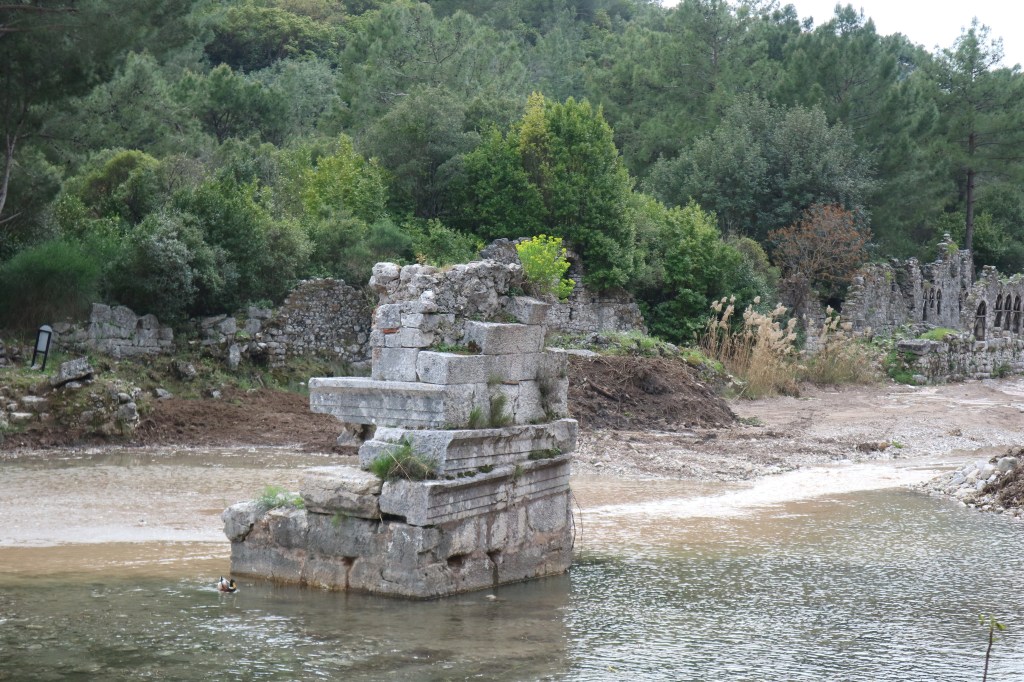
Unlike many of the ruins that we have visited the City of Olympos is managed and during our visit ongoing works were being done to take care of the site.

Habitation of the site dates back to about 800 BCE when a Doric colony (an ancient Greek ethnic group) made it their home, though it didn’t become a “city of import” until 200 BCE when it was recorded as having three votes in the Lycian League, as noted by the Greek geographer and historian Strabo (64 or 63 BCE – c. 24 CE). Coins from the Lycian League were also found at the site.

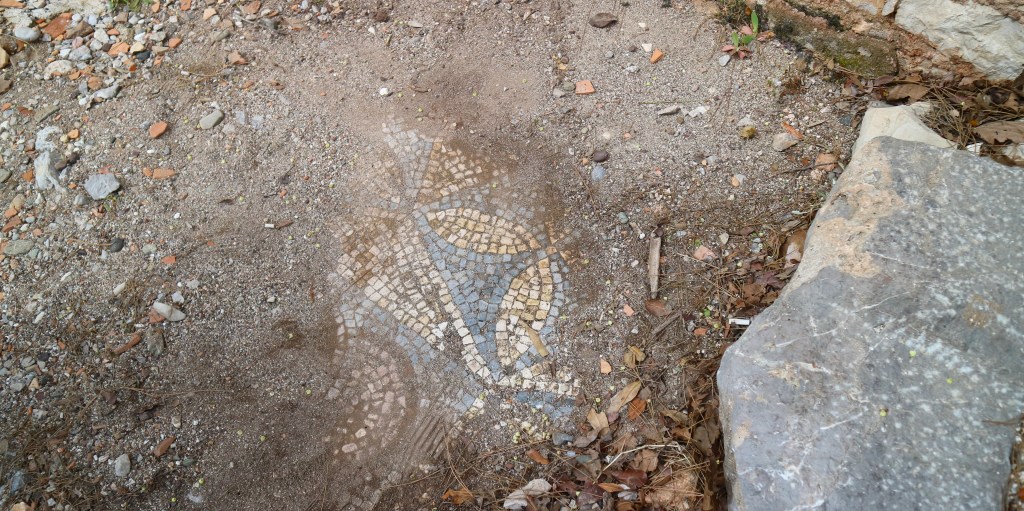
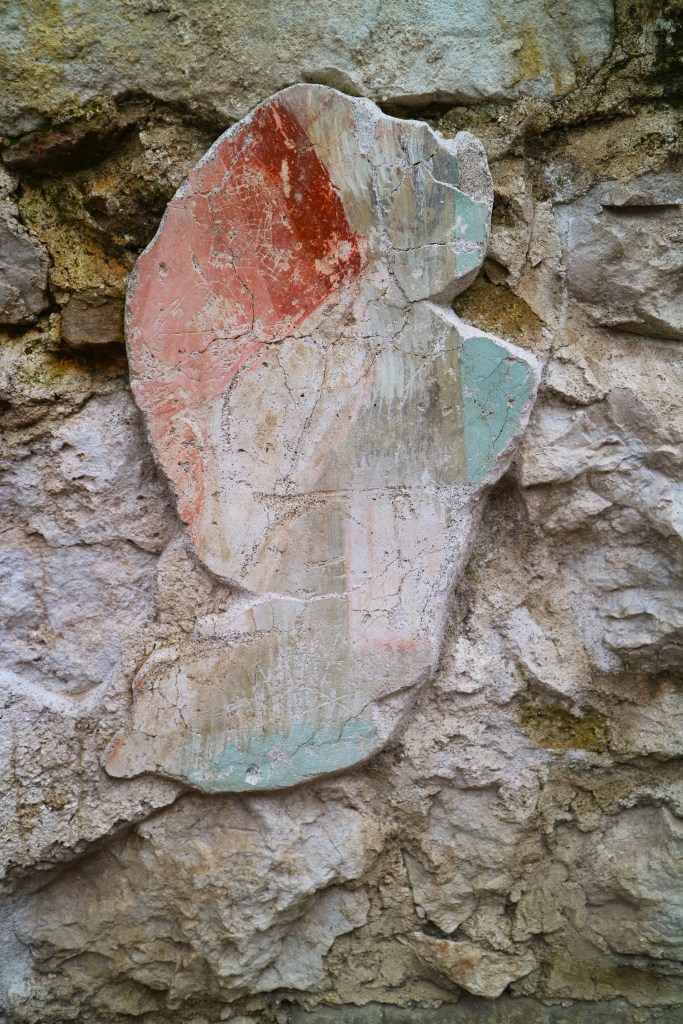
The mosaic is at the entrance to the two tombs, literally beneath our feet.

It seems the city was a thriving community with ties to the settlement on Yanartaş. And, around circa 100 BCE a Cicilian pirate called Zeniketes took over the city.

The Cicilian pirates are named after the region and were tolerated by the Romans for a long while as they supplied cheap slaves. When researching Zeniketes I came upon this interesting little side story. In 75 BCE another Cicilian pirate captured and held Julius Ceasar hostage on Farmakonisi (a Greek Island in the Agean Sea) for 38 days. According to Plutarch, Julius Caesar was incensed by the amount of his ransom insisting it be increased and then he negotiated on behalf of the pirates to have it paid. Once he was released, Caesar raised his own naval force (he didn’t hold a military office at the time) and returned to the island to apprehend the pirates. When it looked like the State wasn’t going to punish the pirates appropriately, Caesar had his men crucify the pirates. (Courtesy of http://www.britannica.com)

The historian Plutarch in his work, The Life of Pompey, explained the challenges faced by the Roman General, Pompey the Great when he decided to finally put an end to Cicilian pirates:

Their flutes and stringed instruments and drinking bouts along every coast, their seizures of persons in high command, and their ransoming of captured cities, were a disgrace to the Roman supremacy. For, you see, the ships of the pirates numbered more than a thousand, and the cities captured by them four hundred. (75 CE) (Courtesy of National Geographic UK)

Back to the City of Olympos and Zeniketes, the Cicilian pirate. He ruled over Olympos and the area that stretched from the Bay of Gelidonya to the western coast of Antalya (approx. 100 km of coast). There is evidence that Zeniketes was a worshipper of Hephaestus and would probably have made the journey up to see the eternal flames. His rule ended in 77 BCE when he set himself, his family and his crew alight rather than succumb to Roman rule. According to archaeologists the site thrived after his reign.

Christianity came to town around 300 CE when Methodius was named the first bishop of the Lycian region. Methodius was martyred in 312 CE for defending Christianity during one of the many persecutions. The only definitive text remaining that is attributed to Methodius is a treatise on the virtues of Christian virginity. So I’m guessing Olympos was not a fun place to be during his time. (Wikipedia)

The city of Olympos remained in one form or another throughout ancient history and into the middle ages with the Venetians, Genoese and Rhodians all having fortresses and settlements along this coastline. It was abandoned sometime before the arrival of the Ottomans in 1500 CE. The cities demise being attributed to war, earthquakes and plague. (https://www.allaboutturkey.com/olympos.html)

We capped off our day with a coffee at a beach side restaurant, before making the trip back up the hillside and then safely home. Thank you to Mandy and Mike for making this such a wonderful day and for sharing your photos.

Fair winds and a dearth of sea monsters for your week ahead.