How the Wind Blows

Hello, welcome, come aboard. Oh, how the wind blows! The last month has been both joyful and frustrating. Since dropping Ned off, so that he can continue his journey to Copenhagen and then Vietnam, we have been plagued by the pernickety wind gods but at least we’ve had beautiful surrounds.

We headed back to Fethiye so that Ali and Ray on SV Chill could attend to some important upgrades to their dinghy and arch. Having work done on your boat in a non-English-speaking country, or more correctly in a country where you don’t speak the language, can be challenging. Ian uses a mixture of Google translate, technical drawings and interpretative dance. It works most of the time and when it doesn’t it’s very entertaining. Thankfully, SV Chill had an English-speaking agent helping with the negotiations, so Ian and Ray didn’t need to bust a move. Still as with all technical work there were complications and delays, but the outcome is spectacular and well worth the wait. They now have Red Rocket, a Highfields dinghy with a 20 HP outboard. Let the dinghy races begin! They also have an arch that supports solar panels and can stow Red Rocket safely for sailing.

In between this important work we hung out in Göcek National Park and Fethiye. We made the trip up to Käyakoy (see our blog of 30 May 23). I love this ghost town for its modern history, as sad as it is, and we were keen to share this mournful place with our mates on SV Chill. We eased the load by tagging on a trip to the stunning beach at Oludeniz. Where we had ice cream as we strolled along the foreshore watching paragliders attempt to land on the beach. These paragliders piqued our interest and we attempted to drive up the mountain to see these nutters take off. We made it about two-thirds of the way when we called it quits. There were buses full of tourists, Mama and Papa’s on their mopeds, and numerous late 70’s Russian sedans bravely or naively making this trip, these Turks are made of stronger metal than we were. I refused to get out of the car when we stopped to take in the view, as my fear of falling off* the mountain had taken over. So, only the photo, that Ian took.
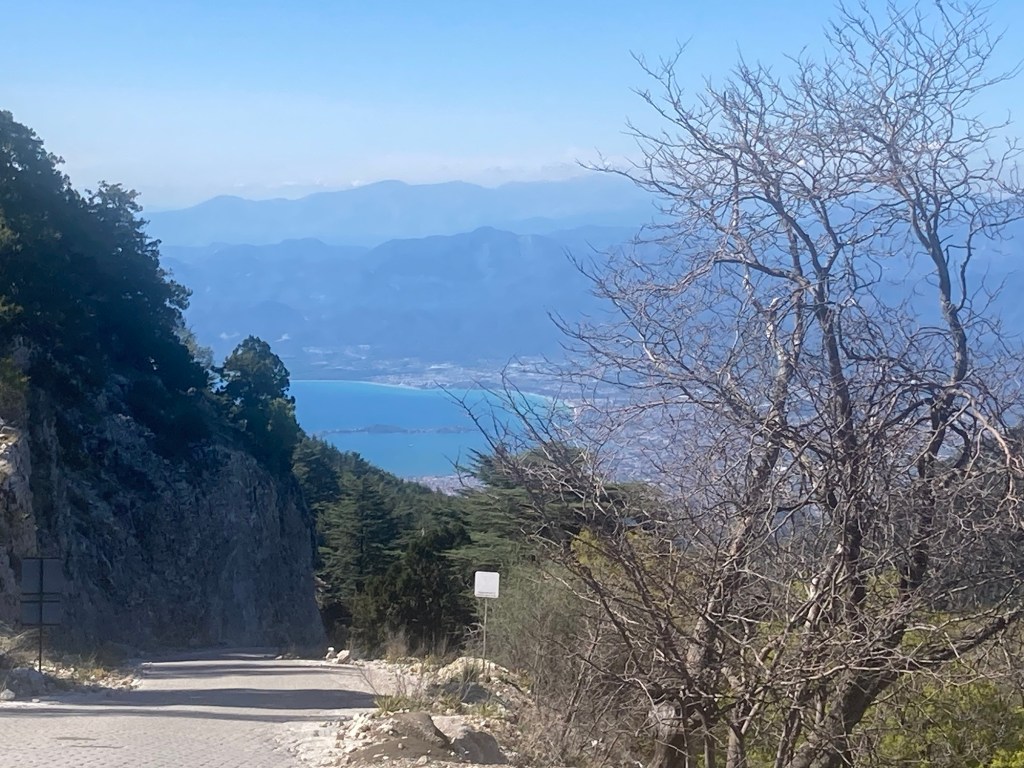
*I’m not frightened of falling down the mountain but up off it. This irrational fear has something to do with not being closer to the centre of the earth and therefore gravity has less of a hold on me. And as I had no rock in my pocket weighing me down, I could not bring myself to get out of the sturdiness of the car. (Ron and Ned stopping laughing)

Dalyan and Kaunos

Once all was well and spiffy with SV Chill, and Red Rocket was stowed as safe as a safe thing, we decided to sail to Ekincik. It was from here that we took a river cruise up Dalyan Strait, with stops at Kaunos Anti Kenti and the Kaunos Tombs of Kings which overlook the pretty village, Dalyan. This was high on my list of places I wanted to see.

Kaunos was once a seaport but now lies seven kilometres inland due to earthquakes that caused the ports to silt up. Consequently, the town and much of the surrounding area was deserted after a breakout of malaria decimated the local population.

I’m glad we stopped but it wasn’t as noteworthy as I expected. Which made me ponder whether I am becoming jaded with all this history? I tried to discover an oddity or unusual snippet about this region’s past and came up somewhat wanting. Though legend has it that Kaunos was named after a man who ran away from home to escape his sister’s romantic advances! The legend doesn’t say whether he ran away because her desires were morally corrupt or if he just wasn’t feelin’ the love? This restored my faith sufficiently for me to continue with my visits to ruins in search of the quirky, magical, and downright loopy factoids that keep me entertained and out of Ian’s hair. (Mind you it’s not hard to keep anything out of Ian’s hair)

Unusually, these ruins are quite lush with shady olive trees and springy grass. There is work being done at the ruins to give a better idea of how some of buildings would have been originally. The stone work is quite spectacular with detailed carvings.

Dalyan is a lovely little village, and the King’s Tombs are impressive. These tombs are not dissimilar to the Lycian tombs in Fethiye and were built between 5-2 centuries BCE. There are more than 150 rock-cut tombs, twenty of them have temple-type façades which suggest they were the Kaunosian Kings’ tomb and these feature Hellenic Columns and such. Many are smaller, simpler, and designed only to hold cremation urns and/or bones. The grandest tomb is only partly completed, and it’s believed that this was due to the lack of gin and tonics at the time. The carvers started from the top and were working down, which gives it the appearance of an image stalled on a computer.
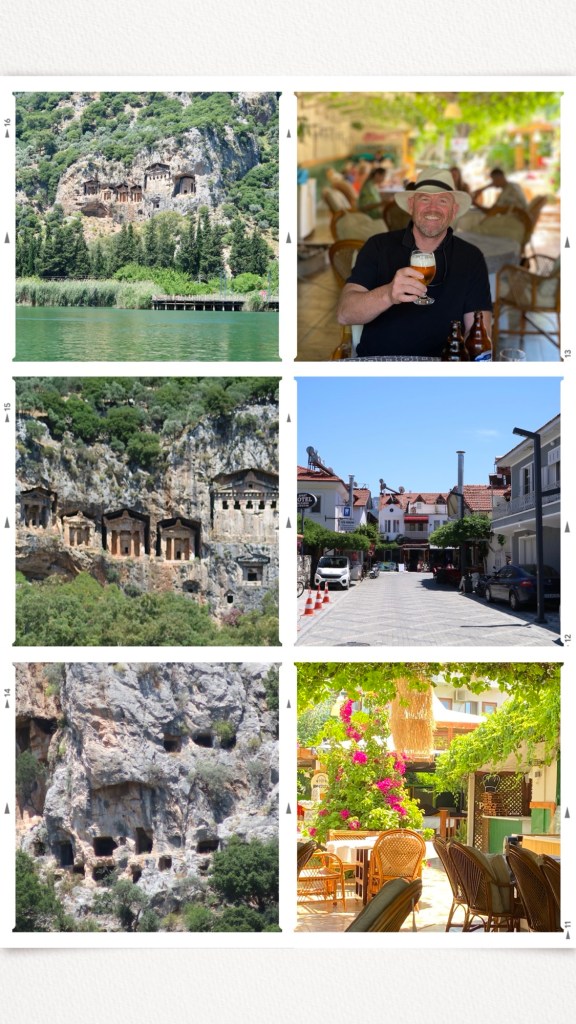
The photos on left show the impressive tombs. In the middle photo you can see the partially completed tomb. The tombs at the bottom were for the not-so VIPs might have had their bones or ashes stored in.
The handsome, relaxed gent top right, is Ray. Ray is recently retired, can you tell? We had a lovely lunch in Datça.

The highlight of the day for me was the trip along the Dalyan Strait on the quaint river boat, “not unlike the boat in the African Queen” but really nothing at all like it. Dalyan means “fishing weir” in Turkish. Bass, Mullet, and Sea Bream swim upstream through the strait to Köyceğiz Lake to breed. Along the strait there are permanent fish nets called dalyans with fishing shanties alongside. Due to the profusion of fish the area is also a turtle-urtle (scientific name for the common turtle) breeding ground. According to the information provided on the boat there are three kinds of turtle-urtles: “the caretta-caretta which is a pradator, the chelonia mydas is a wegetarian, and the other one is the river nile turtle”. I was keen to see a turtle-urtle and was beginning to despair when in the last few minutes leaving the strait I caught a glimpse of a big ol’boy coming up for air; not sure if he was a pradator, wegetarian or river nile type though.

The Datça strait.

Weathering the Weather

While in Ekincik, the weather forecast predicted some stronger north-westerly winds for the coming days. Interpreting the weather forecasts can be further complicated as they don’t always adequately reflect the effects of local land features. Though not so important when sailing it’s crucial when choosing an anchorage during high winds. When I try to read the forecasts, I feel I should be donning my floaty skirt and bangles like a fortune teller before trying to read someone else’s tarot cards. Whereas Ian has years of experience in reading the weather and an understanding of the isolated effects of local terrain, so I have normally left this mystery to Ian.

We have plenty of tools to help with these decisions: three weather Apps, with nine weather models (some twice), displayed in a variety of ways. Is this too many? Yes, we generally use one called Windy (.com not .app) and rely mostly on one model (ECMWF). It seems to us to be the most consistent and conservative, it almost always shows the highest predicted wind strengths, and means we are preparing for the worse rather than hoping for the best. In the beginning we looked at all the models and deliberated and worried, but this only caused me anxiety. Then dealing with my anxiety causes Ian consternation, so for a long time I’ve only used the other Apps and models sparingly as validation tools. Ian also looks at google earth to get a feel for the surrounding land masses when we are picking anchorages.

We also consult our electronic charts for anchorage info such as depth and obstacles and the Bibles of Anchorages, Navily and No Foreign Lands, for up-to-date information on what human comforts are nearby. Trust me there is nothing worse that being stuck on the boat in an anchorage without the confidence to go ashore or somewhere to go even if you can get ashore. How do we know? Five days riding out high winds stuck on the boat beneath a mine site on the back end of a Greek Island. Not something either of us want to do again.
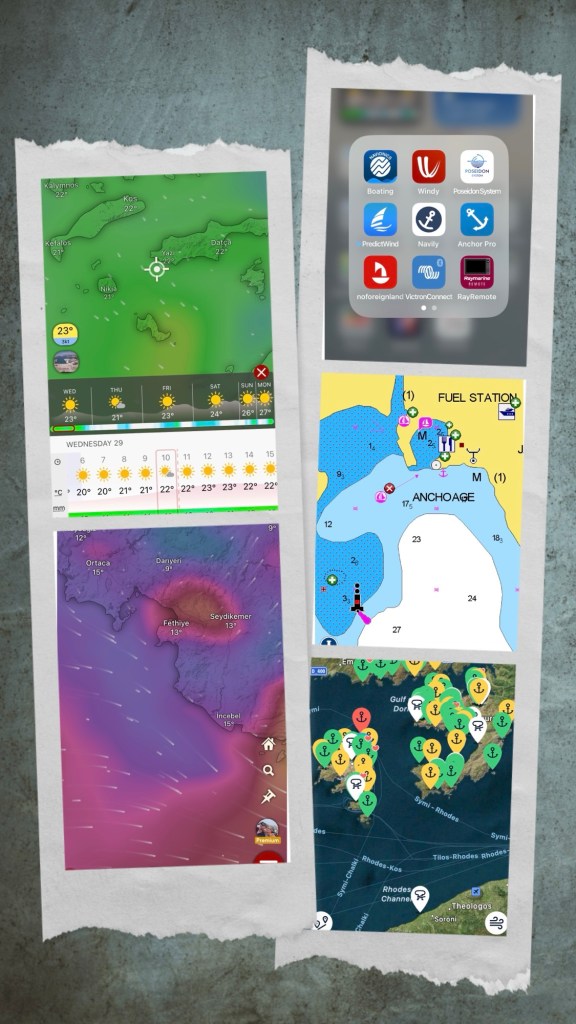
1. Windy.com weather map with general wind and weather detail. It will also show is swell; nobody likes a bumpy ride.
2. On Windy these pretty pinks and purples are a sure sign that we will be anchored somewhere save preferably with a nice big mountain between us and the very strong winds they represent.
3. These are some not all of my boating Apps.
4. This is Navionics on my phone. It replicates our navigation on the charter plotter on the boat. It’s the modern sailors charts and maps. Rightly or wrongly we don’t have physical maps on board … at the moment. We can both use them and when we go for long off shore trip, like crossing the Atlantic, we will consider having them on board as a redundancy. At the moment our connectivity does not warrant physical maps.
5. Finally this picture is from Navily and gives you an idea on just how many anchorages, ports and marinas we have to choose. So much to see, and so much time to do it in.

So before leaving Ekincik, the crews of SV Longo and SV Chill convened a war counsel to determine a safe place to hole up until the pernicious wind gods blew out their idjits. Idjits are not related to idiots but that icky jittery feel you sometimes get when stupendously bored. I do sometimes wonder if the wind gods are idjits idiots.

Lately, I’ve been trying to help out more with trip planning and anchorage choice, so I took a seat at the big kid’s table, and I didn’t even don my skirt and bangles.

Serce Limani (Sparrow’s Bay)

Our chosen bolt hole is called Serce Limani or Sparrow’s Bay. It has a narrow entrance that opens out into a nice T shaped cove surrounded by hills. We decided to take up a mooring ball outside of Captain Nemo’s, a rustic restaurant. It’s been a while since used a mooring ball and a first for SV Chill, but the staff of the restaurant gave us a hand, and it all went without a hitch. When the winds came in, we listened to it howl over the tops of the hills snug in the knowledge that we were safe. I helped pick this spot, so I was feeling a bit pleased with myself.

The cost of the mooring was a meal at the restaurant and as it was still early in the season, Captain Nemo was happy for us to stay a few nights even though we only ate there once. The food was simple, the beer was good, and the anchorage very safe.

Before the big winds hit, Ian, Ali and I decided to take a hike over to the next anchorage which is one of Ian and my favourites coves in Tϋrkiye. The cover photo of our blog pages shows Longo sitting pretty tied back to the shore of this cove.

We were halfway up the hill on our walk when Ali, said from behind me in her very calm English accent “there’s a snake”. My exclamations of alarm and wild gesticulations must have been comical compared to her calm utterance. When she pointed over to the other side of the ravine to a cluster of dried weeds that was madly shaking, I calmed a little, perhaps it was leaving. A moment later not one but two snakes locked in mortal combat reared up out of the grass, my nerves kicked into overdrive notwithstanding the distance and deep ravine between us and the snakes. The display was impressive and terrifying. I wasn’t taking my eyes of the snakes to grab my phone, but Ian tried to get video. Unfortunately, it looks those photos of the Loch Ness or Big Foot, so you’ll just have to take our word for it – they were huge snakes, with ten-foot fangs and ready to stop their fight and join forces to attack us. Meanwhile the three of us stood transfixed for what seemed like hours but was likely a minute or so, I suspect the others were watching the spectacle, I was panicking.

I had read somewhere that Turkey had only a couple of types of snakes and that they were mostly timid or harmless. As a consequence, I’d started to feel safe and allowed my natural Aussie born and bred fear of all things bitey to weaken. Finally, those instincts came rushing back with a vengeance and I announced “nope! Just nope. I’m done, time to leave”. Unsurprisingly neither Ali or even Ian questioned my decision, and we trooped back down the hill to the dinghy. Later, Ali and I both did some research and separately came up with the fact that there are LOTS of snakes in Turkey (well duh!) and that these feisty ones were most like Ottoman Vipers and yes, they are venomous. They might not kill you as fast as some of our Aussie snakes but your chances of coming out of an encounter breathing when you live on a boat moored in an isolated anchorage is not good.
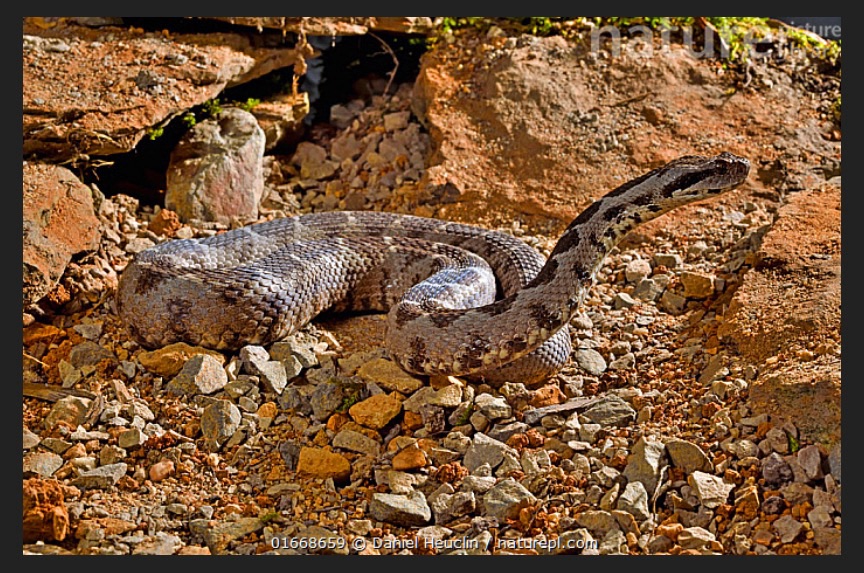
The Ottoman Viper!

Finally, our pulses and the weather slowed enough for us set out on our next adventure.

Bozburun

Our next port of call was the town of Bozburun, another quaint village with a couple of nice safe anchorages protected from the North-West by large hills. Ian insisted we, he and I, had been here on our first trip along the Turkish coast but I had no recollection of the town and no photos to help jog my memory. It wasn’t until we dinghied into town and were walking through a kid’s playground that I said “that’s right! I had a melt down on that stone fence over there. You were trying to sort out fuel, a pump out and water at the harbour”. Ian held his own counsel on this remembrance as he’s a wise man with years of experience.

Last time we visited Bozburun, we were tired beyond belief. We had just sailed from France to Turkey in too short a time, suffering our first Meltemi stuck on the boat for five days, had a mainsail car break leaving us with only our foresail to work with and then only just scrapping through the Turkish check in (with only two days left on our European Schengen time). We were looking forward to a few nights in the marine but the agent confessed they had forgotten to book it as promised and so we had to bugger off as there was space available. There’s an exceptionally long post about this trip somewhere. Bozburun was only our second anchorage in Tϋrkiye.

My meltdown while sitting on that stone fence was because of the dreaded Turkish black water pump out regulations. These regulations require boats to hold their black water (i.e. what goes down the loo) in a tank “for safe keeping”, I mean disposal. This tank is pumped out every couple of weeks at a marina. The principle of these regulations is noble, it’s supposed to protect the beautiful clear turquoise waters we all enjoy sailing. The reality is vastly different. Our observation is that these regs only to apply to foreign boats and not the local tourist boats or big gϋlets. Not unreasonably we are required to pay for these pump outs. The cost varies, our most recent one being 1,000TL (about AUD50.00). The cost of this service is determined by the volume in your tank.

We’ve had successful pump outs where they pump out the entire contents of holding tank, tell us how much they’ve pumped, we get our blue card updated, the official record of the pump out, we pay and go on our merry way. We’ve had partially successful pump outs, where they try to pump out or pump out some of the contents but not all and tell us how much etc etc. Or before doing the pump out they ask us how much they are going to pump out because we all know how many litres we flush, right? We’ve learned that if we say anything less than 50 litres it’s cheaper. Finally, there are the virtual pump outs, where you take a guess at how much you’ve been carrying around for the last how-ever many days, pay the arbitrarily determined fee, receive your all-important blue card tick, and go on your merry way without every having seen a pump out machine.

No matter which kind of pump out you’ve had the next time you’re out on the big blue wobbly, you do what the locals do and release the Kraken*. The Coast Guard are the enforcers and will fine you, sometimes thousands of dollars if they catch you or if you don’t have evidence (the blue card tick and receipts) of pump outs every 14 days. This time allocation is regardless of your tank capacity or how many onboard. *The kraken is what we affectionately call the contents of our holding tanks.

Before continuing I have to say just how proud I am of myself for getting through that without once using the word “poo” once! Shit, I’m good!!

So, the first time we were in Bozburun, I was stressing as we had just been told we couldn’t get a pump out. It hadn’t even been five days and we weren’t due, but in my tired, overwhelmed state it was just too much for me. I will go a long way to keep within the rules. I have given up trying to defend myself against Ian’s claim that I have “good girl syndrome” because he’s right. I’m the overly conservative yin to his mischievous yang. Ian isn’t one to break important rules, but he is more than willing to “adopt local customs”; when in Rome and all that.

This was the memory I had when I saw that little stone fence in Bozburun. Having identified the cause of the blackhole in my memory and relishing how relaxed I’d become; I was now free to fill the space with wonderful memories of a sleepy village loved by the locals.

This is Ali, Ray’s partner. Ali is also recently retired! Can you tell? The delicious and beautiful mezze platter was courtesy of Ozman’s in Bozburun.

Sticking to our promise to go slow this year, we hung around for several days just living. Ray and Ali had some bibs and bobs that they needed to do on SV Chill so they took up a berth along the town quay, while we hung out in the anchorage. We met some two and four legged locals. There’s a wonderful restaurant called Osman’s Place, the chef speaks brilliant English and is always happy to have a chat about the region, his time on boats and to help wherever he can. The restaurant even has shower facilities available to us salty seadogs. There was also the quaint laundry service that lowered our washing from a second-floor window using a long rope. There’s even a decent cup of coffee at one of the many cafes and the local market was small but had everything we needed.

When the strong northerly wind came through, we treated ourselves to that guilty pleasure known as schadenfreude as we watched a couple of late arriving charter boats try to anchor and then opt for taking a berth in port. At one point they, one a smallish monohull, and the other a larger cat, were vying for the same berth; the cat won. The mono found a spot but only after he laid his anchor in an interesting right hand turn which had us wondering who he might have overlayed. For the record, We’re not total assholes. When we can we help, we’ll pop the dinghy down and Ian will don the Bundy rescue hat then zoom off to help guide a boat that has trouble. Like most sailors we know we’ll help with docking, tying lines and such, we’ll take lines ashore, offer advice or give a boat a bump to help get it in place. On this occasion there was nothing we could do to help and besides, it was gusty so having the dinghy in the water would not have been safe for us or the other boats. The boats were not in that much danger other than from the actions of their captains. They were both charter boats so hopefully they had comprehensive insurance.

I guess a time will come when our wrongdoings and misdemeanours are weighed against our honourable deeds, and our schadenfreude on this day will be just another grain of sand on the scales. I hear Lucifer holds all the best eternal parties “down below” anyway.

With that I bid you farewell until next time. May your seas be calm, your winds fair and there be a dearth of sea monster for your journey ahead and no mammoth snakes with ten-foot fangs duelling it out in your path.

We’ve been busy … now it’s time to go slow.

Hello, welcome, come aboard. Well, two months in and I’ve already broken my promise to put out a blog every month. In my defence, it’s been a big couple of months, and it’s been mostly about being with our friends. January saw us off to Edinburgh, Scotland, for the wedding of our dear friends Georgia and Tim. We tagged on to this a road trip down the east coast of the UK to visit one of my favouritest people in the world. On our return we ramped up our efforts to get Longo ready for the coming Summer. While this was happening our friends, Ray and Ali, were just beginning their grand retirement plan of buying a boat and sailing the Med. That’s right our mates decided that we were having such a blast that they decided to join us but on their own boat! Just as we were finishing up with our preparations for Summer, they found their new floating home in Malta. Since Ray and Ali are new to sailing and because we just couldn’t wait to see them again (they were at the wedding too!), we flew out to Malta to help with prep and move their boat to Cyprus.

Many of you will have heard about some of our adventures on FB, if so, feel free to put this blog up now and go about your day knowing you aren’t going to miss much here. For those of you that may not have had the benefit of Ian’s infrequent but lively updates on FB here are the highlights.

The Nuptials of Georgia and Tim Di Nardo. You know how sometimes you come across two people and think to yourself ‘these two are like G&T’s on a hot summer’s day’. Refreshing and a joy to be around in any situation. Well, that’s Georgia and Tim; the personification of G&Ts! We were genuinely chuffed to bits to receive our wedding invitation to what promised to be one of the best wedding events. Despite being true blue Aussie’s, the happy couple with the help of the incomparable Janie Rowe, Mother of the Bride, planned a very lavish affair at Carberry Towers Mansion House on the outskirts of Edinburgh, Scotland.

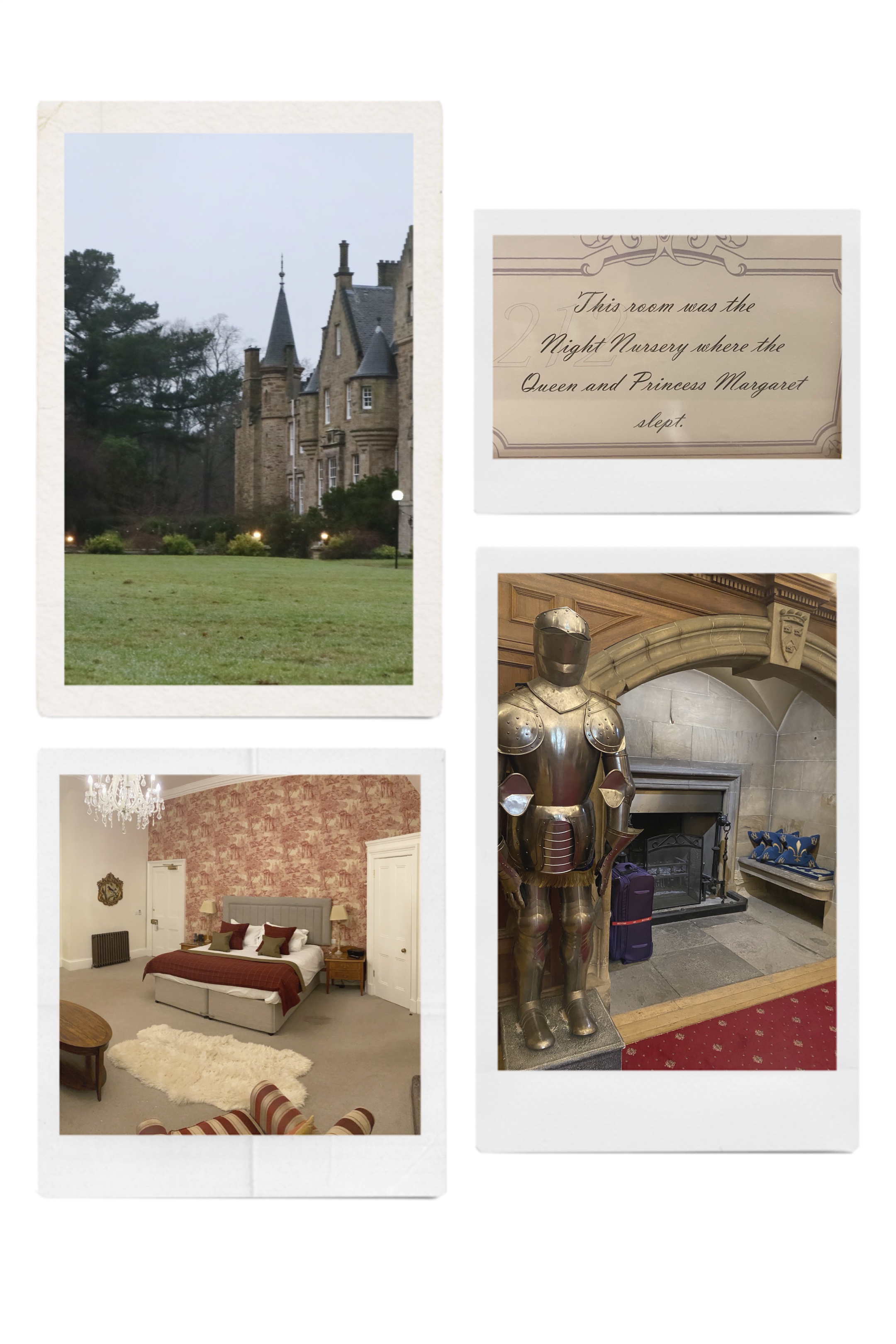
This is the beautiful and tranquil Carberry Towers Mansion House. Our suite was once the Night Nursery for late Queen and her sister Princess Margaret. I think this is likely the closest I will ever get to Royalty, unless you want to include being married to the Clown Prince of Pyrotechnics.

For three glorious days we helped Georgia and Tim celebrate with old and new friends. It was a wonderful time with loads of highlights, especially for me as I was asked to be back-up photographer to the extraordinarily talented Susie. It was an honour and a joy to help lay down memories for the happy couple and their families.

Meet the lovely Mr and Mrs Tim and Georgia Di Nardo. The Middle photo at the bottom is me with the lovely and very talented Susie, photographer extraordinaire

Road Trip and Visiting Coleen. The only downside to the wedding was that some of us came away with nasty colds. It was to be expected given that we had all flown in from across the world and planes are a hotbed of ickiness. Unfortunately, I was included in the inflicted and our UK adventures were curtailed as I needed a few days to recover. Thanks to the generosity of Ian and Janine of SV Deejay, we had a beautiful place in which to base ourselves in the lovely village of Seaton Delaval. So, when I was able to, we went exploring, with trips to Warkworth, Amble, Craster, a drive by of Bamburgh Castle of “the Last Kingdom” fame, Newbiggin-by-the-Sea, ST Mary’s Lighthouse (of the TV show “Vera” fame), Whitley Bay, Tynemouth, and Housestead Roman Fort. The rest of our time was spent with me cuddled up on the couch and Ian playing nurse. Thanks again to the crew from SV Deejay who provided invaluable advice on our itinerary.

Northumberland in January is a beautiful place. The clarity of the sunlight and the crispness of the air were at time breathtaking, literally as well as figuratively. The smoked fish at the Jolly Fisherman in Crasters was delish – thanks to the crew of Deejay for the wonderful tip. … And no the bridge is in Newcastle on Tyne – this is said to be the inspriation for its younger but much bigger brother/

Finally, our time in Northumberland came to an end and we drove our way down to York. York is one of my favourite UK places and I really wanted to show Ian this incredibly special town. Like most of the touristy places in the UK in January, York was quiet. This suited us perfectly. A highlight for me was the trip into the York Minster crypt. I hadn’t had time to do this before and it didn’t fail to amaze. The layers of history on this one spot are breathtaking, with Saxon and Norse ruins overlaying Roma ruins all surmounted with the years of York Minster history. We stayed only a day, but it was worth every minute.

Our next and final stop before heading back to Longo in Cyprus was to visit Coleen and her family. Ian and I first met Coleen almost twenty years ago in Saudi Arabia and despite the time between visits, Coleen will always remain one of my dearest friends. As Ian commented when Coleen and I sat down together we just picked up our last conversation like we’d only said goodbye the day before. In addition to seeing Coleen, we were lucky to meet her friend David, and to catch up with Annabelle, Coleen’s second born. We also caught up with Coleen’s folks, Madge and Peter. Along with Charlotte and Rory, Coleen’s other kids, these are people are very much part of our British family. Given my nomadic life*, Coleen’s life is breathtakingly alien and wonderful to me. Though she has travelled widely, Coleen lives in the same community she grew up in. During our day out in Robin Hoods Bay, Flylingdale and surrounds, Coleen regaled us of her youthful antics, including pointing out where she fell of her horse and dragged along the road. Surprisingly, Coleen still loves horses so much so that she teaches others to ride. No doubt saving many from her younger self’s fate. We walked the tiny lanes where Coleen, her siblings and friends played chasey. We passed by the many buildings and shops that her family had a connection to and we had lunch in the hotel where she was once a chamber maid. I even got my feet wet in the North Sea as stood watching the waves. Special thanks for the wonderful accommodation supplied by Alexander of Flylingdale School.

The lovely ladies in the large photo are Coleen and her daughter Annabelle. Coleen gifted Ian his new “going out” beanie. It is patterned in the cable used to identify Robin Hoods Bay fisherman. I had always thought that the various cable styles were just whims of the knitters but it turns out that each style represents a fishing town. When drowned sailors were washed ashore the cable knit of their jumpers was used to identify their home ports.

*Not including our adventures on Longo, I have lived in three countries, five Australian states (most of these more than once), well over eighteen towns/cities, and moved between twenty-five homes. My time on Longo is my increasing countries visited (and lived in) though my home now remains the same!

Return to Longo and the Prep for Summer. All too soon our UK adventures were over, and we returned to Cyprus to prepare Longo for our next Summer of galivanting around the Mediterranean. As part of our contract with the marina we had the opportunity to haul Longo out. Due to a wonky rudder, we hauled out in May last year in Finike and while the boat was out, we discovered it needed a bit of work including new antifouling for her hull to stop barnacles, weed and other icky stuff sticking to her butt. So, we had this done then and didn’t really need to haul out this year. However, as we had already signed the Kapraz Gate contract and the haul out was included, we weren’t about to let that this opportunity to slide (haul outs can be extremely expensive). Besides, we are in marina surrounded by cow paddocks what else were we going to do for that week?

The hard (slang for a boat stored on hardstands in the yard) in Cyprus is big until you look at the size of the crane and realise its turning circle is really big! So, the hard can only accommodate around ten or fifteen boats consequently, there is a cue of people eager to get work done and only so much space available. We asked to be lifted mid-February but were told many projects were running overtime and a que was forming. So we were surprised when we got a call around 1100 to say that they had space and could haul us out at 1330 the same day! We scrambled to get prepared, it wasn’t pretty, our bed became a soft place for all the odds and sods, like the TV, that would normally go in a safe place when underway. While I was doing that, Ian was preparing the boat above. Unfortunately for him this included a quick dip in the chilly water to take of the plastic bag that protects our prop from unwanted barnacle growth over winter. Ian managed the job in one lung full of air, impressive (but given his adventures later Ray and Ali’s boat not really that impressive), however he also came up trailing blood. He had managed to slice open his finger in the process. It was nasty enough that it left a trail of blood through the cockpit and stole the words from his mouth for a while, just as well as he was shivering so much had he tried to swear he would have surely bitten his tongue.

Finally, the boat was ready, and we let loose the lines. Every sailor loves to lose the line but when you’re only going 500 metres under engine it takes the fun out of it. Still in such a small time I managed to slip down the companionway and jar my shoulder and hip. Between Ian’s finger and my shoulder not an auspicious start, especially as we knew there was plenty of work ahead.

It’s always a bit of a nervous moment when you give your boat-home over to someone to lift out of the water. However, the team here were very professional and their calm assuredness eased my worries a good deal. There was a little bit of tension on the sidelines when the boat owners ahead of us in the cue came by to query why we were being lifted before them; a perfectly reasonable question given they were before us in the cue. The marina staff explained that as we plan to do the work ourselves, with almost no practical assistance from the yard, it was, in the marina’s opinion, an easy solution to pull us out and let us crack on while their teams were working on other jobs. It pays to be nice to the gatekeeper!

Once the boat was out, the first job is to power wash the hull. This is the only job we can’t do ourselves. During the sailing season Ian maintains the hull by free diving down and scrapping the hull to remove any unwanted growth. The antifouling paint we had put on in May making this an easy job and sailing itself does a lot since a “sailing boat gathers no barnacles”. It would be nice if the antifoul and sailing stopped all the growth but unfortunately some barnacles and weed growth is inevitable especially over winter when Longo isn’t sailing. The power wash is brutal, and we stood by as the entire topcoat of antifoul sloughed away along with the weed and slime. Never mind we planned to repaint anyway.

Once she was clean the crane moved her into her new home for the next few days. The marina here is a little more professional than the last haul out we had. Before we had rough logs and wedges holding her up. This time we have sturdy adjustable steal stands that are tied together for added security. Just as well we had forecasts for a bit of wind and a storm coming our way.

Last time we stayed in an Airbnb while Longo was on the hard, this time we stayed on board. It has its challenges. We don’t have shore power; we could have but Ian has already installed our new kick ass inverter, so we still have coffee and toast. We don’t have water other than what is in our tanks, and we can’t just let that go down the drain since that would just be splashing on the concrete below. Still, we are standing only metres from the door to the marina facilities, so we took advantage by taking long hot showers.

By the end of the haul out day, Ian had polished one side of the hull (above the water line), and I had made a start on cleaning the pesky waterline where the antifoul ends and the water laps against the white gel coat. The next day, we were up early and began the boring task of sanding the hull ready for the new coat of antifoul. We had to do this by hand as machine sanders are too aggressive. We also had to scrape of any barnacles that the power wash missed, for example in the bow thruster tunnel. As we had been expecting to do this job for some time we had already bought throw away overalls. These are a great invention and I thoroughly recommend them. I also recommend you wear them … which we did not! And we looked like a pair of 6’ blue smurfs. Working together we knocked over the sanding quickly and moved straight on to painting.

It took us two hours to paint one coat of the hull. The good thing about this kind of painting is that it needs to be even but otherwise it doesn’t really need to be pretty. Just as well, I’ve been told I lack the skills required to do a spiffy paint job. (I’m not heartbroken by this at all! It just means I don’t help if it needs to be pretty). Ian did the high line, and I took care of the underneath. Having over 13 tons of boat over my head gave me pause for a moment and then I just cracked on and did the job. I was surprised that it only takes just over one can of paint to do one coat of the boat. Throughout the day the marina painters would pop over to offer advice and let us know we are doing an excellent job. Ian was a little surprised with the ease of the work so naturally decided that instead of the two coats we had planned we might as well do three. Yay!

A few days later we had finished all our jobs, and it was time for Longo to go back into the water and back to her Winter berth. Just as well because Ali and Ray were hot on the heals of their perfect floating home and we had just enough time to finish up most of our summer season prep before we got the call to say they were heading to Malta to look at a very promising boat called “Chill”.

Captain Smurf tells me he will always wear his PPE in the future and that’s me (wearing my PPE) painting the underside of the keel, it’s the last job to be done before Longo returns to the water. At this point she is in the strops of the crane.

The beginning of Ray and Ali’s Big adventures on Chill. It turned out Chill, a 45’ Benetaeu Oceanis, was exactly what they wanted and as they signed a contract, we made plans to go to Malta to help them prepare the boat and then sail it closer to where we had Longo as we plan to buddy boating through Turkey, Greece, Albania, Croatia and then on to Montenegro for Winter.

Before we could leave Malta, Ray and Ali had to provision and equip the boat for the season. Ian had loads of fun in the chandlery spending Ray’s money, quipping every few minutes ‘you’ll need this and three of those and…My friend will pay!’ whenever the staff walked by. Funnily enough the chandlery gave them shopping-beer and invited them back. Now if I can only find a friend with an open wallet and a dress shop that serves champagne.

We didn’t get much time to explore Malta, but we loved what we saw and have plans to go back at some point in the future. However, we did manage to catch up with friends from Finike, Kerry and Stephen of SV Sailing with Thankfulness. They’ve been in Malta at anchor for some months undertaking repairs and preparation in readiness for their Atlantic crossing. It was an unexpected delight and their joy and enthusiasm for Ray and Ali’s burgeoning adventures was infectious.

The next morning, we threw the lines and headed for Milos, Greece. With plans to travel on to Rhodes before crossing to Cyprus. A multi-night passage is a wonderful way to get to know your boat and gain your sea legs (poor Ali had a nasty case of sea sickness to battle through) and this trip brought back memories of our first trip from France to Sardinia.

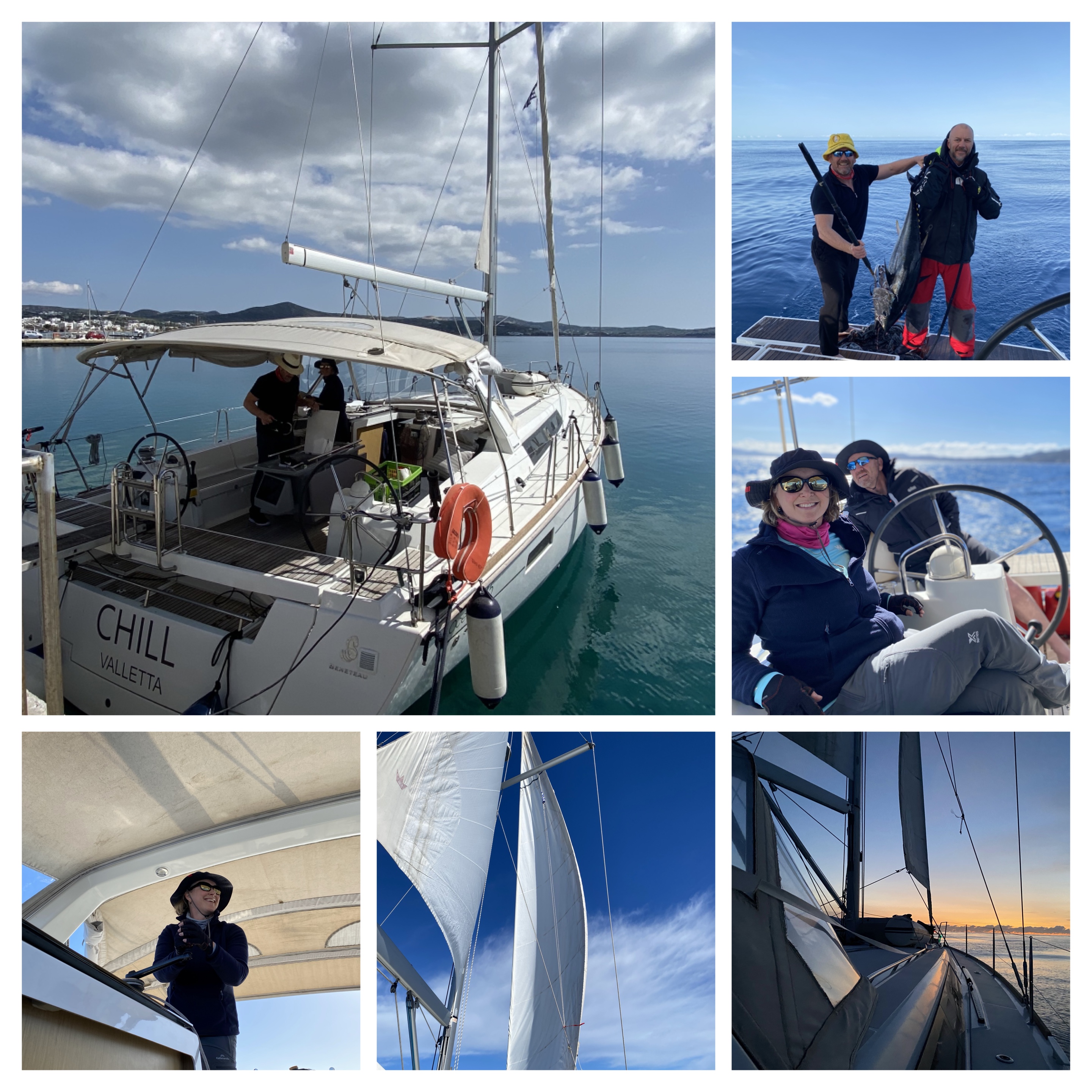
Meet the crew of Chill, Ray and Ali, they will be appearing in many of our future posts as we will be buddy boating for the season. Chill is a Beneteau Oceanis 45, so yes our Longo is a bit bigger, so I think I will take to calling Chill our Little sister. (not that we’re competitve or anything)

Our first stop was Milos in Greece. An island that Ian and I have ambivalent memories of, as we sheltered in one of its bays for five days during our first Meltemi (strong northerly winds). This time we would be stopping at the town quay, and everything was going smoothly until it became a bit blowy. That’s when the harbor master offered to move us into the small, sheltered fishing harbour alongside the quay. He assured us there was sufficient depth to cater for Chill’s 2.3 metre depth. On arrival Ray and Ian were cautious and backed in slowly despite the Harbor Master and his cronies making twits of themselves hollering for us to ‘come back more, no problem’. However, there was a problem and the bottom of the rudder hit the harbour floor. At this point, the Harbor Master and his mates all melted away and left us (or more correctly Ray) to survey the damage. Thankfully, Ray and Ian’s conservative approach meant there was nothing more than a cosmetic scratch.

Milos continued to deliver, with the guys and the Harbour Master playing a game of Uno with shore power (a box on the town quay or pontoon that delivers AC power to the boat while in port).

Round 1: Our new shore power cable had the wrong size plug, so the marina gave us an adapter.

Round 2: Uno Reverso – The loaner-adapter was ‘homemade’, and the active/neutral wires were crossed so we had a warning light on the boat. This increases the risk of fire and the tingly dance.

Round 3: Uno Reverso multi-meter and screwdriver – We diagnosed the problem with the multi-meter and wired it correctly to standard convention.

Round 4: Uno Reverso new shore power box – When we moved to the new berth inside the fishing boat harbour and connected our correctly wired cable and adapter to a new shore power box but the warning light came back on. The shore power box was incorrectly wired.

Round 5: Uno Reverso screwdriver – So we re-crossed the neural and active wires on the adapter to correct the incorrectly wired shore power box.

There’ll be no tingly dancing on our boat!

They say bad things come in threes, and this was definitely the case In Milos! The day before leaving we arranged to refuel the boat. Without going into too much detail, let’s just say Ray ended up paying for 209 litres of diesel despite the tank only being able to hold 180 litres and being quarter to a third full. Our advice: always watch the operator zero the gauge, get a receipt and don’t be worried about calling the port police in to help.

The next leg of the journey, Milos to Rhodes, was reasonably uneventful except for Ray catching a mammoth tuna. It was big enough to feed an army and took both Ray and Ian to successfully land it on the boat. Ian is particularly chagrined as he’s been trying to catch a fish in the Med since we arrived, and Ray caught a massive Tuna on his first day out. I was simply happy to be eating sashimi tuna as it was being sliced off the bone.

Rhodes was a pitstop and not much more. Ali and I reprovisioned at the local Lidl laughing at our sea legs on land which made walking and reading Greek challenging. The next day we set off for the longest leg of the trip with the proposed destination being Cyprus. Unfortunately, the sea got a little wobbly with a confused following swell. At the same time Ray and I were suffering from a nasty head cold and Ali’s seasickness returned. Ian as always, the bestest captain and crewmate, managed to keep us on course, fed, watered and took on all the galley duties. Then, when about three quarters of the way to Cyprus we suffered a couple of electrical problems which caused us to divert to Alanya (Turkey). Notwithstanding our issues the Harbour Master wouldn’t allow us to check in to Turkey through his port as Chill’ was travelling on a provisional Polish registration (the official registration is due to arrive in Turkey in a week or so). Instead, the Harbour Master allowed us to take on fuel and told we could anchor for a brief time to rest before moving on. Our electrical issues included a fault with our depth gauge, so anchoring in an unknown bay was not a viable option. Consequently, we had to turn around as the weather window to Cyprus was closing. We hoped to check in at Finike (the next town along) where Ian and I had a contact who we thought could help us. However, the same Harbour Master manages Finike so we had to continue for another night further north to Kas where they would allow entry on the provisional registration for a “small administrative fee”.

By now the crew were all tired and looking forward to an easier passage with the destination that included a stable berth, hot showers that didn’t wobble, help with the electrical issues, a chance to do a load of washing and walk on solid ground for more than an afternoon. Of course, that was still away off and our final difficulty is best described by the hero of the moment, Ian:

Snuggled in the cockpit wearing three layers of clothing under our full foul weather gear to keep warm we started to feel the unmistakable vibration of a fouled prop. It turned out to be a large piece of tightly wrapped plastic. Of course, this only happens when it’s a dark night, cold and in the middle to the ocean. It took a few deep breaths before committing to going over the side. Thanks Janine and Craig of SV Inelsamo for the great tip to tie a rope under the boat to hold onto. It would have been a bit untidy to drift from the boat at night wearing a dark wetsuit.

Here’s what it looked like alone in the dark with faithful Mr Stabby hacking into plastic while the boat was banging up and down on my head. (Ian made an artistic representation of his view while under Chill, however, you can achieve the same thing if you turn the lights out and close your eyes!

Ian came up with two dark patches of antifoul on his head where he met underside of the boat and an overwhelming tiredness. Thankfully Ali is a doctor, and, on her advice, we fed him up like you would a recovering marathon runner (I will always keep lollies on my boat for emergencies) and put him to bed. Thankfully, the rest of the trip was easier and when we finally docked in Kas after clearing customs, we all breathed a sigh of relief.

Ali and I took the opportunity to celebrate her sea legs in Milos. The marina shown here is Kas, where we left Chill to return home (more on that below) and you can see Ali, top left, still smiling when we finally reached Kas.

This trip in total was a lazy 1024nm first sail of the season for us and first ever sail for Ali and Ray. Ian and I are grateful that Ray and Ali have not taken this eventful first sail too much to heart and are still looking forward to a wonderful summer sailing with us.

Not long after arriving at Kas, Ian and I hopped on a bus to Antalya where we caught a plane back to Cyprus. Three days later he and I set out in Longo for Turkey. We’re currently on day four of this adventure holed up in an anchorage waiting for some nasty wind to die down so we can finish our trip Fethiye, where we will meet up with Ray and Ali on SV Chill. Fethiye will mark the true beginning of our season with the arrival of Ned, who is stopping by for ten days or so on his way to Copenhagen for a conference.

We hope the last few months have been kind to you and the next holds fairs winds (surely, we are due for some?) and a dearth of sea monsters (unless they are monster tunas).

Winter in Neverland

Hello, welcome, come aboard and most importantly Merry Christmas and Happy New Year! We hope 2023 and the festive season has been kind to you. I know I am month or two late, what can I say I’m a slack tart.

Our 2023 sailing season has been over for quite a while, and we’ve been well and truly bedded down for the colder months. Winter is a different kind life, tucked away in our marina berth in Cyprus. We’ve been here a while and I had intended to begin putting together more blogs about our adventures long before now. Alas, I succumbed to the doona’s call, and it’s taken me a little while to regain my groove. There was also a trip to see friends in the UK so it’s not all due to my being slack and idle. I guess a reset period was to be expected as we covered a lot of ground last year. The good news is my creativity light began flashing recently and I’m happy to be back at my “writing desk”. Thanks to those who have asked for more and apologies for it taking so long. Before I begin with what we did for the second part of the 2023 sailing season, let me tell you about our Winter home.

The island of Cyprus lies forty miles of the Turkish Coast and 480 miles from mainland Greece. The trip to Cyprus was about as unadventurous as you can get and still be on a sailboat. We left late in the day from the tiny Greek Island of Megisiti (Kostellorizo), which is just 2.1 nautical miles off the coastal town of Kos in Türkiye. It took us about 36 hours to travel the 230 nautical miles to Cyprus. Of that we sailed for about half an hour and had the sails up for about an hour hoping for wind which never came. They don’t call it the Med (Motor Every Day) for nothing! It was without doubt the most uneventful passage we have experienced. The highlights were floating through an eerie moonlit, oil slick smooth ocean, glorious sunsets, sun and moon rises, and the moment of excitement when we passed a mammoth bait ball. I have no photos of the fish as it was a scramble to turn the boat around and cast the lines out. Surely this was the moment when Ian would catch a fish. We passed through the bait ball three times and Ian stands by his claim that his inability to hook a fish is because there are no fish in the Med.

The one benefit of a no-sail sail is I had the chance to capture the changing sea and sky. The two photos on the right are the moon. The bottom right photo is unedited and gives you an idea on just how calm and smooth the trip was, especially on our second night.

We arrived here in Cyprus in November, and we have subsequently developed mixed feeling about our decision to call this home for Winter 23/24. The marina is in Northern Cyprus and on a cloudless day you can see Türkiye across the water. The facilities are the best we’ve experienced and while some of the marina rules and the culture are at times incomprehensible, it’s certainly entertaining. Wearing flippers in the pool is forbotten even if you are the only one in the pool. And please don’t ask for a glass of tap water in the restaurant, safety dictates that this is also forbotten. The marina bar’s 5-8 happy ”hour” (two-for-one) every day is a bonus we are trying not to abuse.

None of this should really be a concern since we intended to focus on boat projects over the cooler months. Our main project being the installation of an inverter which will give us AC power for hot water on demand while at anchor (hallelujah!), a microwave and might extend to me being able to occasionally blow dry my hair; it’s the simple pleasures that matter. We’re also installing a diesel heater for future winters. However, the isolation of the marina and the limited shops here are proving to be an under-estimated challenge. Ian can’t even buy stainless bolts, so our recent trip to Scotland for a friend’s wedding became a boat job shopping trip as well. Hopefully more on this trip will follow in a future post.

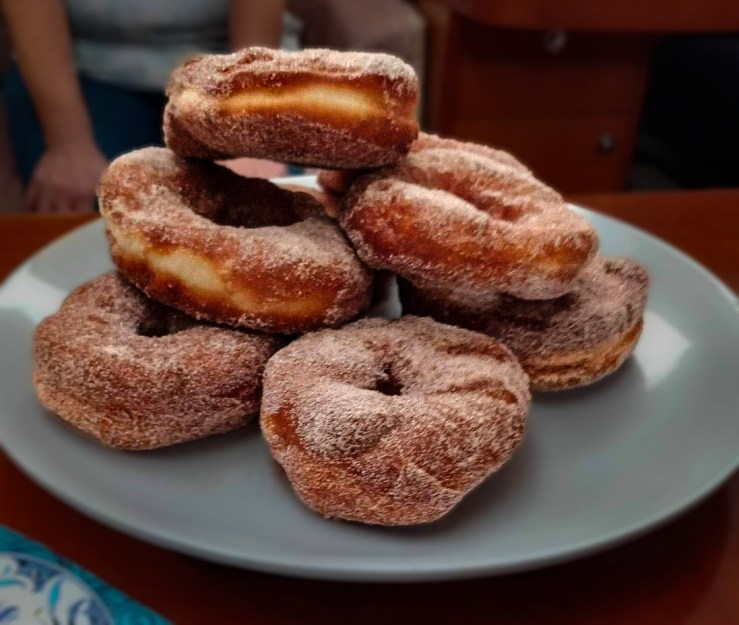
The upside of this marina is the lively live-aboard community. Many of our old friends are here and unsurprisingly we’ve found it easy to meet new people since Ian has been refining his doughnut making technique. Between, the exercise group, craft, movie nights, doughnut mornings and drinks at the bar we are keeping busy. We are also exploring this “Neverland” when we can, thanks to friends with a car and a willingness to include us in their adventures.

I couldn’t resist sharing this photo of Ian’s Doughnut achievements. They’re a huge hit with our friends; we especially enjoy the chatter and laughter on the boat – it makes any gloomy week a little bit brighter.

Our adventures here have certainly offered us a unique perspective on how political and international relationship issues impact on day-to-day life here in Cyprus. Due to it’s rich Copper deposits, throughout history the Assyrians, the Egyptians, the Persians, the Romans, the Byzantine, Lusignan, Genoese, Venetian, Ottomans and finally the British, have all had a shot at ruling this tiny island. The population is Greek Cypriot in the South and Turkish Cypriot in the North. The Turkish Cypriots are the minority. Both consider themselves “Cypriots” but if you ask a Greek Cypriot if a Turkish Cypriot is a “Cypriot”, the answer will be a resounding “no”. However, the same does not necessarily apply in the reverse.

How did this duality of patriotism occur? As I mentioned the island has always been a prize for one Empire or another. The most recent dispute began prior to World War I. At about that time, Cyprus was part of Türkiye however the Sultan asked the British to take care of the day-to-day management of the island. During this time there was a large Turkish presence, though most of the population consisted of Greek Cypriots with a flourishing British Expat community. When Türkiye and Britain found themselves on opposing sides of the war, the Brits retained control of the island. When Greece changed their allegiances to that of the allies, many more Greek immigrants came to Cyprus seeking a haven from the war. Throughout this period the Greek Cypriots began calling for Enosis, which refers to a formal union between Cyprus and Greece.

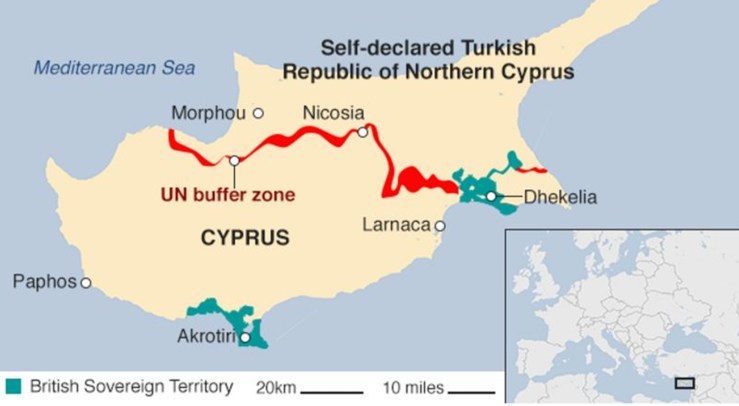
As I’ve written before, the Greeks and Turks aren’t exactly the best of neighbours. Over the years there have been varying levels of unrest along their border. In recent years, no place has seen more rioting, bombings and assassinations than Cyprus. In essence, Türkiye said if you can’t play together nicely you’re going to have a time out. The Turkish Army invaded and annexed the north of Cyprus. Greeks living in the north were ‘removed’ and it was untenable for Turks to remain living in the south. A truce of sorts was reached in 1964 at which time the “Green Line” (demilitarized zone) was established. This is controlled by a UN Peacekeeping Force which is charged with separating the Republic of Cyprus in the South (Greek – I’ll call this Cyprus for the sake of this blog) and the unrecognized Turkish Republic of Northern Cyprus (which I will call TRNC). The Green Line is 180 kilometres long and passes through the Cyprus/TRNC capital of Nicosia. The Green Line’s width varies from less than 20 metres to more than seven kilometres.

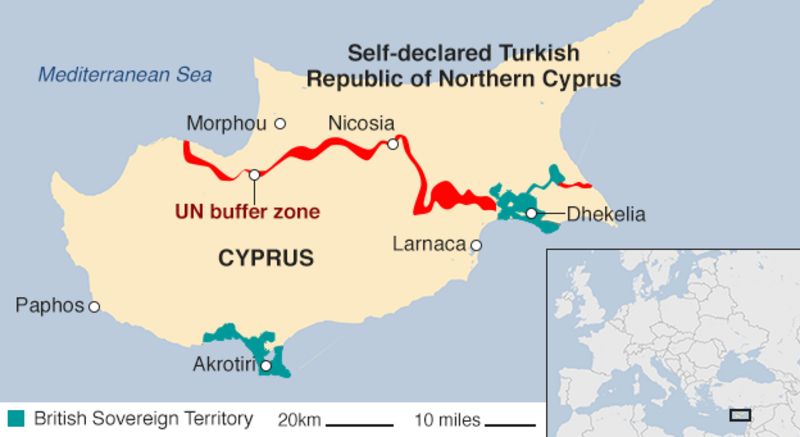
We are located roughly where the “ish” in Turkish is located on this map. It takes around two hours to drive to Nicosia. Image courtesy of https://ichef.bbci.co.uk/news/

The Brits and the United Nations have tried many times to mediate a solution between the Greek and Turkish Cypriots, however these efforts have been unsuccessful. Reunification is gaining popularity again as both Cypriot governments are keen to join the European Union and reunification is a precondition to this occurring.

From a historical perspective I can understand both sides of the story. For the locals, they fear the erosion of their beliefs and way of life. The sides have opposing foundations in language, religion, education, health, and governance. So, reunification will not be an easy path. In the meantime, people continue to live their lives as best they can, and we do too.

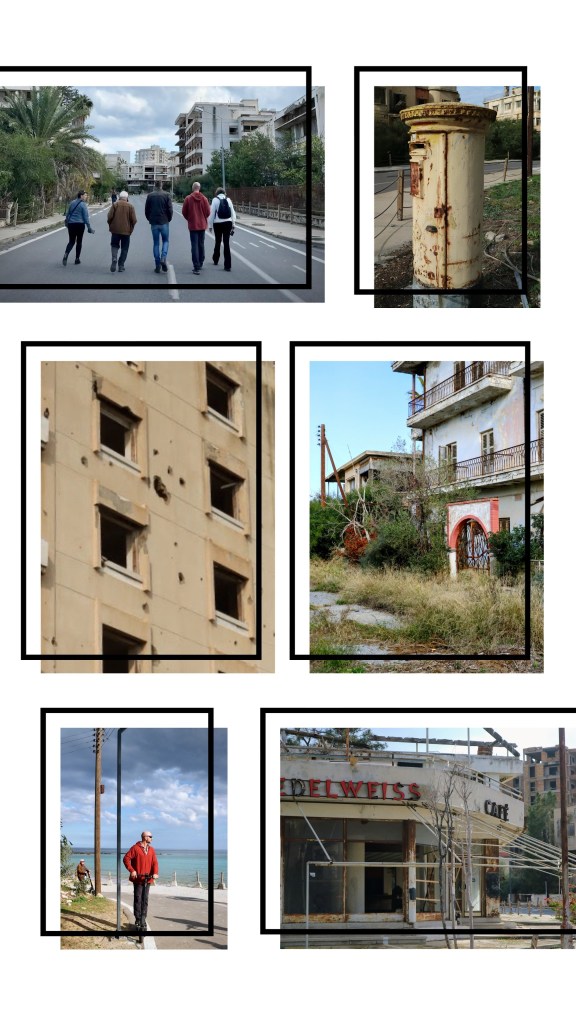
We recently had the opportunity to visit the Famagusta/Gazimağusa (Greek/Turkish names) ghost suburb of Varosha. This suburb has been uninhabited since the second phase of the Turkish invasion of Cyprus took place in 1974. Turkish tanks overran the surrounding plain and Turkish planes bombed the town. Most of the Greek and British population escaped however the invasion resulted in dozens of deaths. After taking the town, Turkish forces fenced off Varosha and it has remained vacant until recently when TRNC reopened areas to the public.

Along with our friends from SV Deejay and SV Matabele we hired electric scooters to tour the area. It was a surreal experience, though it lacked the melancholic atmosphere of the ghost town of Kayaköy which I’ve written about before. Perhaps it was the electric scooters, or the modernity of the derelict buildings, the presence of a UN office and Turkish posts, the proximity to busy streets and thriving businesses and the stop for a beer at the café by the beach that eased the air? Nonetheless it was a joyless place, especially when you consider that folk who once lived there have returned to find their homes looted and now crumbling into dust. I admit my heart hurt when I realised the pock marks in one or two of the buildings were signs of the battle and represented the loss of life that must have occurred not that long ago.

On a lighter note, some of your ears may have pricked up when I mentioned hiring electric scooters. Yes, Ian rode a scooter. He tested its speed and manoeuvrability without losing teeth or too much of his dignity.

Varosha was “described as the “hub of art and intellectual activity” and “the French Riveria of Cyprus”. Celebrities including Richard Burton, Elizabeth Taylor, and Brigitte Bardot are said to have visited the area in its heyday. (https://www.businessinsider.com)
For the readers: There are numerous books written about the troubles in Cyprus. I am currently reading “Bitter Lemons” by Lawrence Durrell, which is exceptionally good. There is also “The Sunrise” by Vicotria Hislop which is based in Varosha.
Thank you Lorna of SV Matabele for the first picture.

Given the embargo most countries and the UN have placed on TRNC, this side of the Green Line is something of a Neverland. It is however a haven for folk from countries that are not currently part of the “in-crowd”. Vodka is easy to find if you catch my drift. Having said that there is also an active British Expat community taking advantage of the weather and favourable exchange rate. The influx of international residents and a more liberal approach to religious doctrine means that we are enjoying a plenitude of one of my favourite things in the world – bacon!

Modern TRNC is a place of contrast. Flashy new apartments and houses are going up alongside partly finished and crumbling buildings; there is a very new and impressive restaurant at the entrance to Varosha. This is not that disimilar to Türkiye and many of the Greek islands we have visited. Aside from Gazimağusa and the Capital of Nicosia there is only one other significant town on this side of the Green Line. HOwever, there are many private universities, and flashy international medical facilities – dentists and IVF clinics are popular. Despite the global unwillingness to acknowledge this side of the border, tourism is a large part of the economy with dozens of hotels and resorts dotted along the coast and in the towns. Many include casinos and, going by the high-end cars we see driving around, there is money to support them.

Yet … and yet … it’s nothing unusual to see a goat herder tending his flock on a roundabout or a farmer on his ancient tractor trundling through the village. Mounds of rubble and rubbish abound everywhere as do the ubiquitous stray but well cared for cats and dogs. The people are patriotic. Northern Cypriot and Turkish flags are flown everywhere. Atatürk statues and portraits are plentiful. The road signs and maps sport both Turkish and Greek names. In fact, people are comfortable with using these names interchangeably without any disgruntlement. Religion is lowkey. Mosques are favoured this side of the Green Line; however, we’ve seen well-kept churches and at least one monastery/church with a healthy patronage.

There are some oddities here which are due to the international embargo placed on this side of the Green Line. iPhone maps won’t provide directions yet, for some reason, Google Maps works just fine. Local bureaucracy and cost make it exceedingly difficult to receive anything shipped from overseas with import duties as much as 150%. To get around this, there’s an active “safe hands” protocol for getting goods and mail in and out of the country.

Travel between North/South Cyprus is complicated. Going South doesn’t present any problems, TRNC are happy to “stamp you in and out” of the country. At the airport recently, customs asked if wanted a stamp in our passport. We answered “no, thank you” as it can cause issues when travelling through other countries, particularly Greece. No Surprise there! Conversely, as the Greek Cypriots do not recognize North Cyprus, they won’t stamp you out of Cyprus, if you are passing into TRNC territory. This results in the records showing you never left and consequently have overstayed on your visa. And don’t even think about sailing from TRNC to Cyprus! Stories abound of the Greek Cypriot Coast Guard turning boats away or confiscating boats that persist. This is not a problem if you never intend to return to Cyprus, but we’d rather not burn any bridges. So, we will check out and head straight back to Turkey and leave Cyprus (the Greek side) for another time.

Despite the politics of living in ‘contested, or occupied, territory’ the locals have been very friendly. They face the same issues we do regarding travelling and obtaining goods etc. Most people speak English and are happy to help us work on our Turkish. Just like the Turkish mainland, crime is almost non-existent. We will have to adapt our ways when we return to a western community and to return to locking up our belongings. In the meantime, we are attempting to make the most of our time here while trying hard to look past the inconvenience of living in Neverland. Unfortunately, this hasn’t extended to Ian embracing a Peter Pan wardrobe of green tights and a jaunty hat. Something I’m sure we would all like to see!

Until next time fair winds, and a dearth of sea monster for the days ahead.

Lithium Be Light

Hello, welcome, come aboard! This instalment of Sailing Longo Maï comes from the pen of the El Capitan and Wizard of All Things Technical: Ian. (Italicised notes are from Malia because she can’t help herself):

We’ve had a bit of a geek out on our electrical system. Please don’t read any further unless you’re into boat electrical and /or geek stuff. (I think it’s a good read for anyone. Unfortunately, I now know so much geek stuff that I am questioning the evolutionary pathway from luddite to geek and whether it’s possible to voluntarily regress.)

We had a 580ah house battery system which should have been ample for our needs. However, we were finding that if we sailed through the night (no solar or engine charging) in rough weather and the autopilot was working hard we were excessively draining the system. At times we had to turn the fridges off to conserve power. So, the situation needed to be fixed. (Ian has called the autopilot – Brittany Steers. And no one likes warm G&Ts hence the original necessity to remedy the situation.)

Based on observations of our current system 600ah of lithium batteries should be an OK solution. The advantage of lithium is you can discharge them to 10-20% whereas you should only use about 50% from a conventional battery. Then we had a few beers and decided 800ah would be better. No one ever complains about having too much power. (I didn’t have beers? When were beers had? Were these beers with your salty sailor buddies? Why wasn’t I invited? – mind you I don’t even like beer but it would have been nice to be asked to the lithium party.) (It was man business!)

After 10 minutes on the interweb it became apparent that the change to lithium is a bit more complicated than just dropping in new batteries. So, before I got started, I figured it was worthwhile taking a good look at the current system. It should be in pretty good shape since we had a ‘full’ survey by a licensed surveyor prior to purchase. After about another 30min on the interweb I felt a suitable level of expertise to audit our system.

Well. The more I looked the more I found wrong or at least suboptimal with our system:

The battery bank contained different size batteries (nope) which were parallel wired through one battery (nope). This means the first battery takes most of the load and ages prematurely. This then drags the whole system down. It is probably the main reason why we had under floor heating and such poor overall system performance. (As is always the way one poor sod does all the work and when they are worn down by the load the whole system fails! Sounds like every workplace I know.)

There were also no covers on battery terminals (nope) and no fuses (whole lot of nope). There’s a lot of energy in this system and this represents a serious safety issue.  (If you accidentally stepped on the suckers, we’re talking not just an unintentional perm but the smell of roasting meat)

The batteries weren’t secured (nope). The boat tends to move around a bit and having the batteries secured is the industry standard.

The cabling couldn’t have been any worse (again a whole lot of nope here). Open ended cable lugs were used instead of closed ones which prevent moisture ingress. The lugs were hammer crimped instead of hex crimped. Insulation tape was used to seal some of the lugs and where proper heat shrink was in place it wasn’t heat shrunken. The cables were mismatched and inadequate for the amperage and length. Also, automotive cables were used instead of tinned marine cable which is not the end of the world but they’re not going to last very well. Put all this together and it explains why there was evidence of corrosion inside the cabling.

I’m taking this as bit of a lesson on paying ‘experts’ to do work on your boat, or at any time really. The previous owner would have paid full retail prices at Port Corbières, France, for a self-proclaimed expert to install a battery system. What he received was something the work experience kid could have done a better job after five minutes on google. It’s almost like every opportunity to cut corners and do the wrong thing has been leapt upon with wanton glee. Good thing we paid a professional surveyor look at the boat before we bought it!

The lithium system batteries are individually fused and connected to a busbar using equal length cables. The busbar is then protected by a class “T” fuse. It’s charged by 2 Victron Smart Solar Controllers and a Victron DC-DC Converter which enables charging from the main engine without overloading the alternator. We also installed a Victron Shunt, which measures the capacity of the system and how much power we’re using. (Two things – Firstly the class “T” fuse is thus called because if ever it blows, we will be saying “Thank God (and Ian) for that Thing. Lastly – All the nifty Victron devices are blue toothed so Ian doesn’t have to guess or open up the bilge to see what is happening, so that’s nifty!)

Now that we have the new system installed, we can tell how much power we have and how much we’re using. I think we’ve overachieved a little and now need to find more appliances to justify the cost of the installation. (Happily, this means we can use our fan at night. Ian wants sensible things like a microwave, but Janie R has taught me they are the devil’s appliance and I no longer see the need. I’m getting me a hairdryer and a hair straightener and air-conditioning and if I can find the space maybe I can convince Ian to buy a coffee machine?)

Here’s some before and after shots our batteries:

Finally, because I like to have the last word and because I need to say out loud just how wonderful Ian is and how hard he has worked on this and the many other projects he has completed over the last few months. Ian knew almost nothing about batteries and wiring until a little while ago. Between the interweb and many conversations with fellow salty sailors (special shout out to Phil E and Steve N), he has gone from novice to expert in a very short time. In doing so he has saved us money, improved our quality of life, and most importantly saved our lives (the last system was a disaster waiting to happen). He is now paying forward the learning by helping others looking at doing the same thing. While undertaking this project he has also project managed and/or completed the other work that needed to be done on Longo. Much of the time battling the language barrier; he has become the master of interpretive dance and technical drawing. On top of all this he has made sure I have been gainfully employed in projects big and small; increasing my knowledge and usefulness as crew. He’s also put up with my occasional whine about not being “out there”. So, I cannot express just how much I love this man and how grateful I am for his commitment, patience and willingness to learn. He is an example to me and all that meet him. However, he is a god to the tortoises, only.