Arriving in Greece – Dealing with the Schengen Shuffle and seeking Devine Intervention

Hello, welcome, come aboard. We’ve been busy adventuring, doing new things and hope that you have had an equally lively and happy time since our last post. I’m a bit behind on my blog, so for a quick update, since I last wrote we’ve battled to escape the Meltemi winds, visited Athens and Delphi, viewed the Corinth Canal from above, then motored Longo through. After exiting the canal, we pounded into wind and waves with green water flowing over cabin top for over an hour. Aarrgh, the decks were awash! To make it even better, a thunderstorm was developing near our destination. It wasn’t close enough to cause any real problems, but we did have to push through a 37 knot squall which dropped our speed down to 3 knots (5.5kph) for about 20 minutes before reaching a safe harbour.

Now that’s all behind us, the Ionian thus far is proving to be sedate and beautiful. But we are having to zoom through quite quickly while taking notes for our next visit when we have more time. I’ll cover more in future blogs, but for now I must jump back to the end of my last.

Land Ho! – Greece

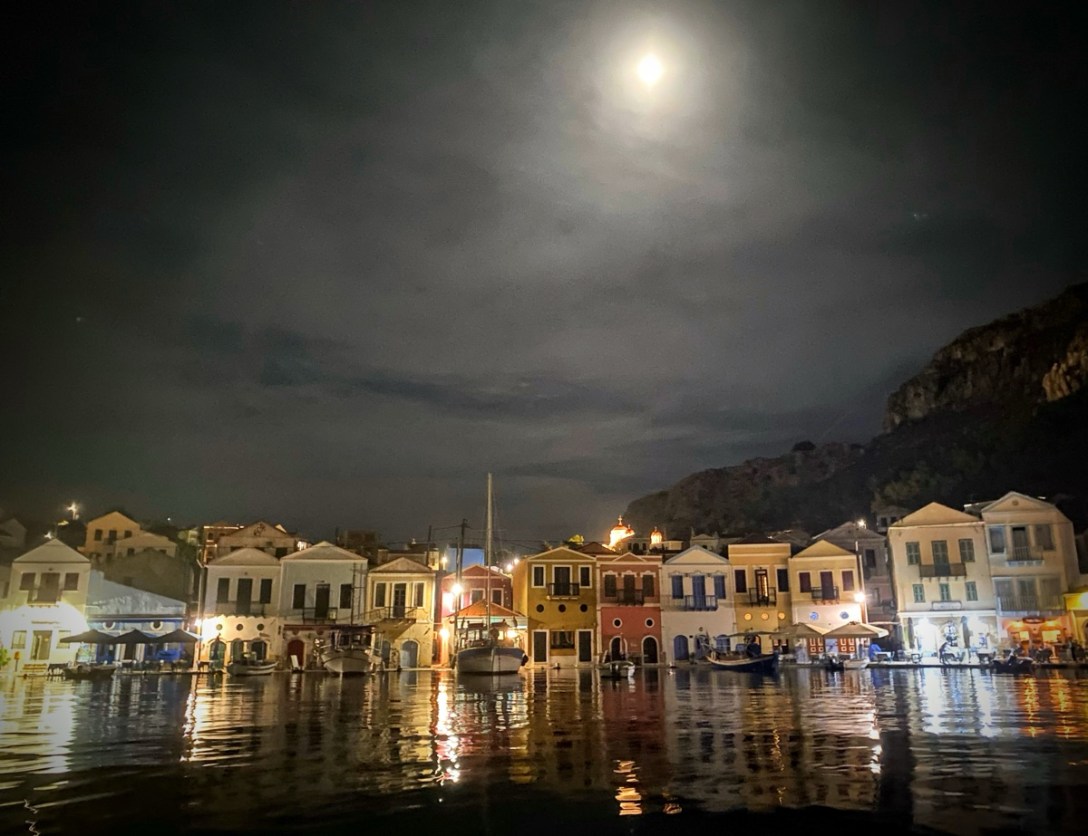
On that note, we left you in our last post as we headed for the little Greek island of Symi also known as Syme, Simi or Σύμη. This island is just 13 nautical miles (24.08 km) from Türkiye and on a good day you can sail across in just over two hours. Interestingly, it’s not the closest Greek island to Türkiye. This is claim goes to the tiny island of Kastellorizo (aka Castellorizo, Καστελλόριζο, Kastellórizo, Megisti) which is just 1.4 nm (2.5 km) from the Turkish mainland. You can sail this in about ¼ of an hour, not including raising and lowering the anchor. We visited Kastellorizo twice in the last 18 months, once with the lovely Rhonda; here are some photos of this gorgeous little Greek island.

The tiny island of Kastellorizo reminds me a handful of Sweetheart Lollies. In addition to the pretty little village, there are a string of caves that are accessible by dinghy and kayak. The largest and best known is the Blue Cave. I wonder why? The ferry comes in a couple of times a week, even the Coast Guard and the Navy boats move out to let it come in.
We were lucky to share our second visit to this island with Rhonda. Rhonda is very dear to us, as her daughter, Georgia is marrying our Ned. And when Ned was extremely ill it was Georgia and Rhonda who took care of him when he was in Canberra. Ned and Georgia’s wedding in April 2025 will make our family ties official.

The open loathing these two “NATO allies” have for each other makes crossing the sea border interesting. Both Coast Guards and Navies actively patrol the borders and it’s not unusual to see fighter jets flying the border above. We’ve been shadowed by both Coast Guards numerous times while sailing along the border. We’ve also heard the Greek Coast Guard transmitting whistles over the radio calls of the Turkish Navy to disrupt their military games.

Nonetheless it’s common place for many motorboats, yachts, ferries, cruise ships and fishing boats of different nationalities to travel between the Greek islands and the Turkish mainland. Most of the time the appropriate check out and in formalities (Quarantine, Customs etc) are adhered to, though the little fishing boats don’t seem to care about such lofty things like national borders. The increase in refugee boats between the countries does have the Greek Coast Guard paying more attention to smaller boats than they may have in the past.

The Madness that is Summertime in the Greek Islands begins

Our trip across the borders this time was uneventful, and we puttered into the anchorage outside the village of Pedi, on the island of Symi, in short order. Last year we stayed in the nearby town of Symi, and it was madness. Symi town is a hub for tourist ferries from within Greece and those coming from Türkiye. The town dock is conveniently close to the town centre, but the regular ferries create large wakes which bounce your boat about. This is not only irritating but can be dangerous if we aren’t securely moored some distance from the stone town wall. It’s like being home, doing your housework when suddenly you (and your home) are on a particularly gnarly roller coaster ride. The neighbouring boats are the other carriages but instead of them being in front and behind you they’re all tethered alongside, rubbing fenders and hulls for those unlucky enough to not have adequate fenders. It’s enough to make even a hardy sailor swear.

This time, on advice from a hardy sailor, we arrived in the quieter bay of Pedi. Pedi has no ferry traffic, only the occasional water taxi leaving a small dock that’s big enough for just one boat. There’s also a small “town dock” marina to the side which is well maintained and has helpful staff (to be fair Symi’s staff are helpful if a little harried). There’s also an option to anchor out which is always our preference as the boat can swing with the breeze which is much cooler.
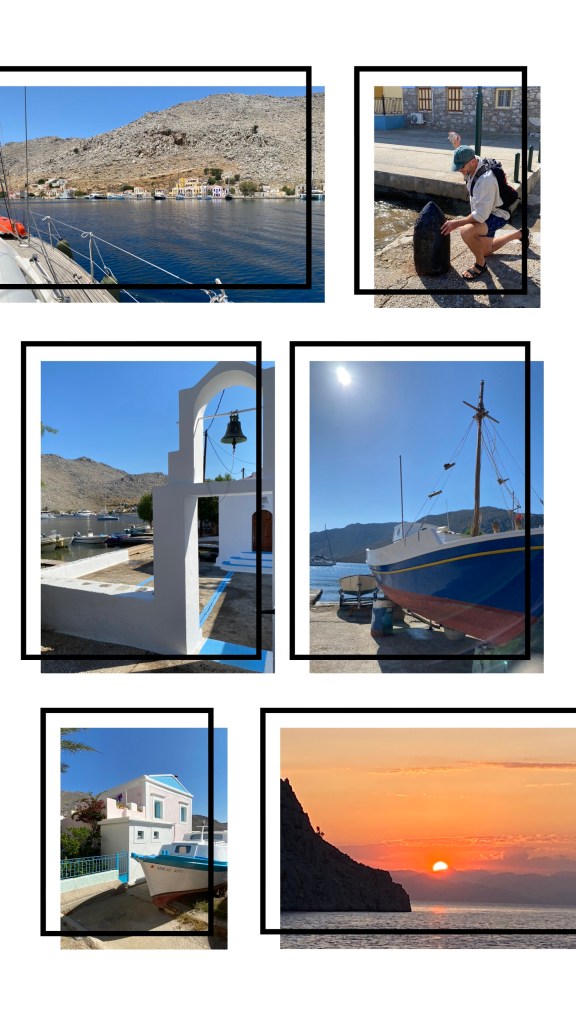
This is Pedi on the island of Symi. It speaks for itself … except the picture of Ian applying for a job as an ordinance expert. Needless to say, he’s still retired.

It’s Just a jump to the Left – Bureaucracy in the Schengen Zone

You’ll remember in our last post I mentioned getting an agent in Türkiye to check us out of the country. Greece is much simpler; the option of agent is always there but it isn’t a requirement. Since we’re trying to understand the Schengen rules better, we took the opportunity to do our own paperwork in order to ask some questions along the way.

For those non-yachties you may be vaguely interested to know that one of the biggest pains in our transom (that’s a boats ass) is the dreaded Schengen Shuffle. As anyone who has flown into the Schengen zone* will know, you can only stay for 90 days in every 180 days. However, since the sailing season is April through to November, we must use non-Schengen countries* and trips home to fill in the rest of our time. Of course, the non-zone countries have their own visa restrictions. This all makes it a bit of a tricky thing to plan a sailing odyssey, especially when you consider the weather implications that always overlay our decisions to sail.

In addition, there are the laws that apply to our boat that we must consider. Thankfully Longo is Polish registered** and VAT paid (like GST), so unlike her crew, she can stay in the zone forever. Many of our friends, who proudly fly the Australian, Kiwi, or other non-Schengen zone flags, have additional requirements they must meet while sailing the Zone.

A lot of mental effort and anguish goes into how we can manage our time in and out of the Schengen zone. Dealing with bureaucrats is a source of lots of conversations and consternation, which only adds to the anguish. Stories abound of cranky officious bureaucrats who don’t know their own regulations or are just having a dreadful day. We’ve heard of favouritism and/or bias against certain ethnicity and even boat flags (apparently our Polish flag could lead to us being mistaken for pirates!). Unfortunately, from a recent conversation I understand that there may also be some prejudice against female skippers, with some officials asking for evidence of their credential but not that of male captains. In other words, the bureaucrats are just people with all the normal biases and fallibilities as other human beings; unfortunately, they have a certain amount of power which allows them to exercise those biases and fallibilities more often.

I have a secret weapon at my disposal that comes in very handy when dealing with even the crankiest of cranky official. That secret weapon just happens to be Longo’s devilishly handsome captain! I can confidently say I’ve yet to meet an official, man or woman, who has not succumbed to Ian’s polite respectful charm. Or is it the sparkling green eyes and that roguish smile of his? I’ve never asked. We’ve had our crew list fee waived because the lovely Port Police lady was shocked that he was a grandfather (“surely too young”) that she blushed hand to chest in a swoon. She wasn’t interested in me being a grandmother … hmmm. Some years ago, using this same charm and his Aussie accent, Ian was fast tracked through USA Department of Motor Vehicles process while I had to wait in line for a further twenty minutes. Alas we were different lines so I couldn’t ride his coat tails on that occasion. His manner always wins out and thus far we’ve never had any problems (I note that most of the other skippers I’ve met are all just as polite and respectful as Ian, perhaps it really is Ian’s devilish smile?)
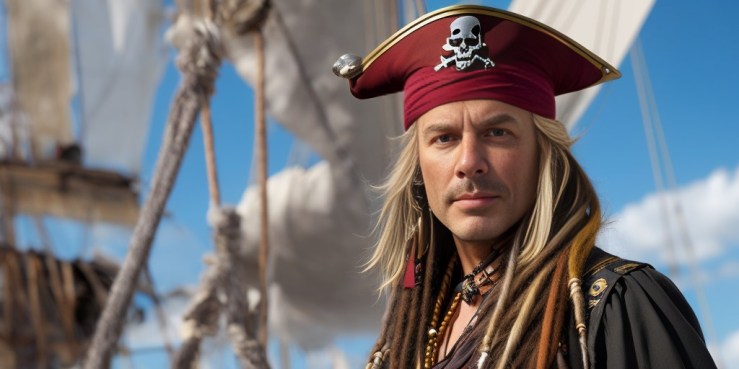
It’s easy for Ian to be confident when this is how he thinks he looks after a bottle of champagne!
Thanks Truman for the excellent picture.

Most of the sailors we’ve meet, try hard to “live within the rules”. Though we are always open to any regulation interpretation or loophole that we might be able to exploit to extend our stay. So, Ian applied a little of his charm and we managed to spend the better part of an hour with the Port Police in Symi trying out various scenarios and interpretations of the regulations to see what might give us more than the allotted 90 days in Greece. Thankfully, it was a quiet day in Symi, and the lovely officer was more than happy to answer our questions. This time we weren’t successful in eking out more time in Greece, but we will be more prepared next time.

At this point I acknowledge those of you who may be experiencing a spot of schadenfreude when I talk about our very “first world” problems of not having enough time to sail our yacht in the countries with the prettiest islands and anchorages, historical hotspots, and lively culture! Yes! We are bloody lucky to be here, even though we worked bloody hard to make it happen.

Before we had our discussions with the Port Police in Symi we did a little bit of online sleuthing to see what might give us a better chance of extending our Greek adventures. What I thought was most interesting from our little journey down that rabbit hole are the following two non-bureaucratic tid-bits:

  • Whenever we cross a border into a new country, we must fly a yellow flag called a Q Flag, or the Quebec or Yellow Jack flag. This flag is only removed after all the check-in procedures have been completed. Historically this signified a vessel that is, or might be, harbouring a dangerous disease and needs to be quarantined. Two Q Flags flown together is an express request for health clearance, i.e. you know you’re carrying the plague. Nowadays the Q Flag signals that the vessel has not been cleared into the country. This process can include Customs boarding and inspecting Longo. We’ve only had this happen once and they were very respectful of our home. They’re mainly looking for undeclared people, but officially they’re also looking for cigarettes, other contraband or greater than the allowed bottles of alcohol. Ian’s investment into spirited commodities could seriously be at risk unless he can turn that sparkling charm to effective use and convince them that an entire bilge filled with gin and another with champagne are just our normal personal use holdings. On the subject of “undeclared people” we had an interesting conversation with a Greek technician working on our boat last year about the profitability of such activities. This is the kind of story best left for the bar stool.
  • Greece has over 6,000 islands, not to mention the mainland, all worthy of exploration, I think! Of the 6,000 islands, there are only 200 that are inhabited by 50 people or more. Then there is Italy, Croatia, France, Spain, Malta and Portugal and their satellite islands, the biggest that come to mind being Sicily and Sardinia (Italian), and Corsica (French). We might not visit every anchorage or even every island, but we are keen to explore every country fully. By my count we’ve only visited, most of Türkiye, 16 Greek islands and part of the Greek mainland, and a handful of Italian and French locations (our trip to Matla to pick up SV Chill doesn’t count); we have a way to go.

Symi, an Island of Contrasts.

Symi is a rugged island with a history of ship building and sponge diving. It now exists almost entirely on tourism. If the name of the island is familiar that might be because it was where Dr Moseley unwisely went for walk in the heat of the day and didn’t come home.

Symi town is crazy with the noisy hub bub of tourists. This is a sharp counterpoint to the sombre and weary faces of the refugees we saw being marched through the town on a previous visit. At the height of the season, when it’s hot and sticky, the hordes can be oppressive and there is little respite in the form of a breeze or shade unless you find a chair at one of the plentiful cafes.

Pedi, on the other hand, is much quieter. It feels like the place where the locals go to hide from the crowds. Consequently, it’s a lovely mellow place but it’s not quite my favourite place on this island. More on this in a minute, first a few interesting facts about the island generally:

  • Symi is mentioned in the Iliad as the realm of King Nieus who fought in the Trojan war. Nieus would have been the most handsome man in the Aegean forces if it hadn’t been for Achilles. I wonder how he felt about of being the runner-up.
  • In 1943 the Nazi’s occupied Symi which was previously “owned” by the Italians who may have nicked it from the Greeks who nicked it from the Ottomans who nicked it from the Greeks and so-on and so-on. However, in 1945 it hosted the formal surrender of German forces in the Aegean to the British. The British then governed the island until it was handed back to Greece in 1948.
This is Symi in all its glory .  The owner of this boat needs to employ the same bird removal method as Ian uses on Longo – a handful of crackers after sunset. A rare shot of a vacant laneway a couple of streets back from the town dock. The impressive gentleman is Stathis Hatzis, was a free diver who in 1913 dove to a depth of 88 meters, for 4 minutes, in an attempt to locate and tie the anchor of the Italian battleship Regina Margherita which had been lost on the ocean floor. It took Stathi three days to find and secure the lost anchor, making a total of 16 record free dives from 50 to 88 meters depth.

Monastery of the Archangel Michael at Panoramitis.

All this is interesting, but for me the gem of the island is the Monastery of the Archangel Michael at Panoramitis. This sits in a beautiful and protected bay on the other side of the island from Pedi and Symi town. We’ve anchored here twice before but this time we didn’t get the chance to go back as we had important places to be. Still, I wanted to share this marvellous magical little place with you.

The beautiful Anchorage of Panoramitis. Ian is approving the local visitor’s rules which bans among other things nudity. This might seem obvious to most, but after being in the Med for a while now I can say that the ban is necessary to maintain the modesty of the Monastery. (Ian and I have not worked out why but it’s mainly Germans that shed their togs the minute they drop anchor.)

In addition to being one of the safest anchorages in the area it is host to friendly turtles. I had the privilege to have one pop up to say hello when I was out on my kayak. It’s a shallow, but not too shallow, basin with plenty of room for a few boats at anchor. It’s protected on three sides by island hills that are craggy and might be considered uninviting to any but the hardest olive trees and goats.

However, there seems to be a thing here in Greece about building beautiful monasteries and churches in the most rugged of places. Panoramitis is by no means the most rugged or isolated monastery we’ve seen but it is one of the most stunning.

Archangel Michael of Panoramitis Monastery is one of the seven sacred sites along an imaginary line stretching from Ireland to Israel,  known as “The Sword of Saint Michael”. Michael holds a place in all Christian denominations, Islam, Judaism and Baha’i Faith. So not a light weight by any stretch.

The monastery is a beautiful 18th century Venetian building with the highest baroque bell tower in the world. Within its wall is a church, which is reasonably new, but it rests on the foundations of an earlier church dating back as far as 450 CE. This older church rests over an ancient temple dedicated to Apollo. Panoramitis is amongst my most treasured places from our adventures. Its tranquillity is only broken by the bells ringing out to welcome the small tourist boat that brings folk from the nearby island of Rhodes once or twice a day.

At other times you can hear the monks singing. There is only limited accommodation within the walls of the monastery and a semi-regular bus service. Otherwise, there’s a taverna, a cafe and a brilliant little bakery, the ubiquitous goats and not much else going on. It’s not what I would call a hotspot for most visitors to the region. For all these reasons, I love this place.

I love goats and their can-do attitude! We’ve learned never to leave hire cars under any lush trees. The odd photo of a mechanical dinosaur is actually a WWII gun turret which still has most of the gun in place. Ian (inside the turret) was a tad disappointed to find out that there was no bang left.

I’m not the only one that loves Panoramitis. The Archangel Michael is especially fond of Panoramitis. In fact, folks claim to have heard him sweeping the floor of the church at night. He must like to tidy house after a busy day of smoting. Consequently, it is common practice for supplicants to bring Michael a broom in the hope he will grant them a boon in return. It is also common to see bottles containing prayers inside the Panoramitis church. These bottled prayers are said to be the prayers of Greek sailors that have washed up on the shores of the monastery.

The Archangel who is also known as Saint Michael the Taxiarch. A taxiarch is a brigadier. In this context Michael is the leader of the heavenly host. He’s definitely not someone you want to piss off. Michael is not above showing his displeasure at those that promise a broom and don’t deliver. He’s has been known to prevent ferry boats from leaving the dock when they’re carrying wayward passengers. The captains on the ferries will make an announcement over the PA to the passengers saying that someone has forgotten to fulfil their promise and the ferry can’t leave until a broom is procured from the cafe and left in the church for the Archangel.

I’ve read the reviews of a few cruisers who don’t hold the same fond memories of Panoramitis, claiming dragging anchors and rolly nights. I’m not sure I would be brave enough to write such a negative review myself, Michael is after all the Angel that cast Lucifer “the Morning Star” out of heaven!

Some shots taken inside the Monastery and the Church. The silver Icon is of Archangel Michael in all his glory. Below is more information about this incredibly special icon. In the last photo you can see one of a broom left propped inside the Monastery, ready for when Michael has a hankering to come a clean house. (Thanks to Ian for taking the photos inside the Church.)

Michael is the patron saint of the island and guardian of sailors in the Dodecanese. I guess this is a role he shares with Saint Nicholas. The church is home to a very special icon of the Archangel Michael. Here’s the best inception story of the Monastery that I could find:

 “While a pious hostess – “Mario of Protenios” – was digging on her property in Panormos, she found under a roof a small old icon of the Archangel Michael. With extreme secrecy, she took the Icon and carried it to the iconostasis of her house in Symi, where she was burning a dormant candle. The next day, however, she found that the Icon had disappeared. When she later went to her estate in Panormos, she found the Icon in its original position under the rope. The housewife brought the Icon back to her house, but it surprisingly returned to the place where it was found. This event was repeated three times. The woman’s sorrow ceased, when she saw in a dream the Archangel Michael, who expressed to her, his desire to remain in Panormos. After this, the pious woman now announced the fact and with the assistance of her compatriots, she erected a small naydrio, on which she enthroned the Admiral”.

This website also notes that the silver work on the icon was a later addition likely done in the 1700s. www.panormitisymis.gr

Such miraculous icons are known as Acheiropoietia which means they are “made without hands”. The most well-known and maybe controversial(?) is the Shroud of Turin. We have seen at least one other acheiropoieton, which I will tell you about in my next post.

Finally, I found a Greek news report (Archangel Michael Miracle) that details the miraculous disappearance and reappearance of the face on the Icon during the Great Vespers service on 07 November 2008 (the Feast Day of Saint Michael). Unfortunately, though reasonably, the news report is in Greek.

I had best stop there or else I will be accused of writing a book on this beautiful and magical little place.

I was disappointed that our visit to Symi this time wouldn’t include Panoramitis as it meant I didn’t get to deliver a broom to Saint Michael which I had plan to do, maybe I’ll drop a bottle in the ocean with a prayer asking for assistance with the bureaucracy instead. However, we had to set sail for Kos, where we would be collecting one of my best mates, Lesley. But I’ll cover that next time, and until then, we wish you fair winds and a dearth of sea monsters on your journey through life. And an extra special thank you to all those who have stuck with this rather lengthy post until its end, I love you all. x

* EU Schengen Zone: Austria, Bulgaria, Belgium, Czech Republic, Croatia, Denmark, Estonia, Finland, France, Germany, Greece, Hungary, Iceland, Italy, Latvia, Liechtenstein, Lithuania, Luxembourg, Malta, Netherlands, Norway, Poland, Portugal, Romania, Slovakia, Slovenia, Spain, Sweden, and Switzerland. Those in bold represent the countries are all part of “the Med” where we will be sailing over the next few years. In addition to these countries the non-Schengen countries in the Med are Türkiye (2022 winter), Cyprus, Nth Cyprus (2023 winter never again!!), Montenegro (this year’s winter) and Albania.

** The Polish flag is a “flag of convenience”. Its benefits include a once off registrations (non-annual), for us no requirement to complete a survey (the boat has been surveyed but not for registration purposes), its cheap (always a bonus), and can be completed online (we love automation that works for us). It is also for these reasons that some officials believe that pirates and refugee runners use it.
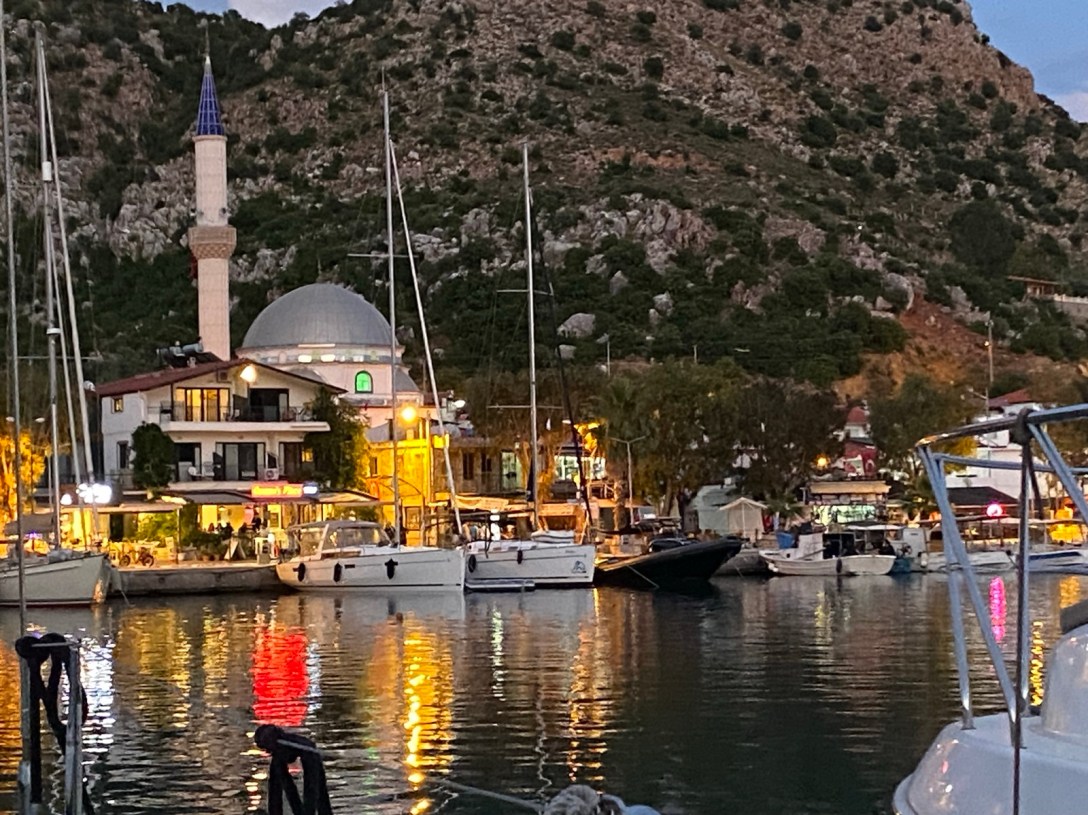
How the Wind Blows

Hello, welcome, come aboard. Oh, how the wind blows! The last month has been both joyful and frustrating. Since dropping Ned off, so that he can continue his journey to Copenhagen and then Vietnam, we have been plagued by the pernickety wind gods but at least we’ve had beautiful surrounds.

We headed back to Fethiye so that Ali and Ray on SV Chill could attend to some important upgrades to their dinghy and arch. Having work done on your boat in a non-English-speaking country, or more correctly in a country where you don’t speak the language, can be challenging. Ian uses a mixture of Google translate, technical drawings and interpretative dance. It works most of the time and when it doesn’t it’s very entertaining. Thankfully, SV Chill had an English-speaking agent helping with the negotiations, so Ian and Ray didn’t need to bust a move. Still as with all technical work there were complications and delays, but the outcome is spectacular and well worth the wait. They now have Red Rocket, a Highfields dinghy with a 20 HP outboard. Let the dinghy races begin! They also have an arch that supports solar panels and can stow Red Rocket safely for sailing.

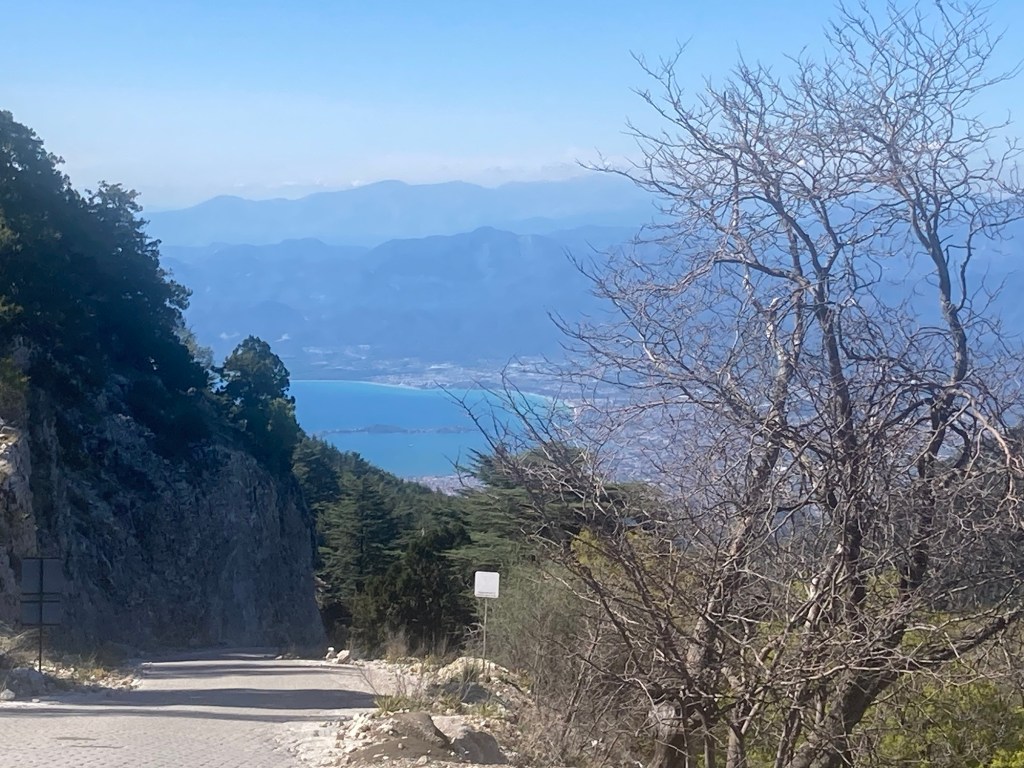
In between this important work we hung out in Göcek National Park and Fethiye. We made the trip up to Käyakoy (see our blog of 30 May 23). I love this ghost town for its modern history, as sad as it is, and we were keen to share this mournful place with our mates on SV Chill. We eased the load by tagging on a trip to the stunning beach at Oludeniz. Where we had ice cream as we strolled along the foreshore watching paragliders attempt to land on the beach. These paragliders piqued our interest and we attempted to drive up the mountain to see these nutters take off. We made it about two-thirds of the way when we called it quits. There were buses full of tourists, Mama and Papa’s on their mopeds, and numerous late 70’s Russian sedans bravely or naively making this trip, these Turks are made of stronger metal than we were. I refused to get out of the car when we stopped to take in the view, as my fear of falling off* the mountain had taken over. So, only the photo, that Ian took.

*I’m not frightened of falling down the mountain but up off it. This irrational fear has something to do with not being closer to the centre of the earth and therefore gravity has less of a hold on me. And as I had no rock in my pocket weighing me down, I could not bring myself to get out of the sturdiness of the car. (Ron and Ned stopping laughing)

Dalyan and Kaunos

Once all was well and spiffy with SV Chill, and Red Rocket was stowed as safe as a safe thing, we decided to sail to Ekincik. It was from here that we took a river cruise up Dalyan Strait, with stops at Kaunos Anti Kenti and the Kaunos Tombs of Kings which overlook the pretty village, Dalyan. This was high on my list of places I wanted to see.

Kaunos was once a seaport but now lies seven kilometres inland due to earthquakes that caused the ports to silt up. Consequently, the town and much of the surrounding area was deserted after a breakout of malaria decimated the local population.

I’m glad we stopped but it wasn’t as noteworthy as I expected. Which made me ponder whether I am becoming jaded with all this history? I tried to discover an oddity or unusual snippet about this region’s past and came up somewhat wanting. Though legend has it that Kaunos was named after a man who ran away from home to escape his sister’s romantic advances! The legend doesn’t say whether he ran away because her desires were morally corrupt or if he just wasn’t feelin’ the love? This restored my faith sufficiently for me to continue with my visits to ruins in search of the quirky, magical, and downright loopy factoids that keep me entertained and out of Ian’s hair. (Mind you it’s not hard to keep anything out of Ian’s hair)

Unusually, these ruins are quite lush with shady olive trees and springy grass. There is work being done at the ruins to give a better idea of how some of buildings would have been originally. The stone work is quite spectacular with detailed carvings.

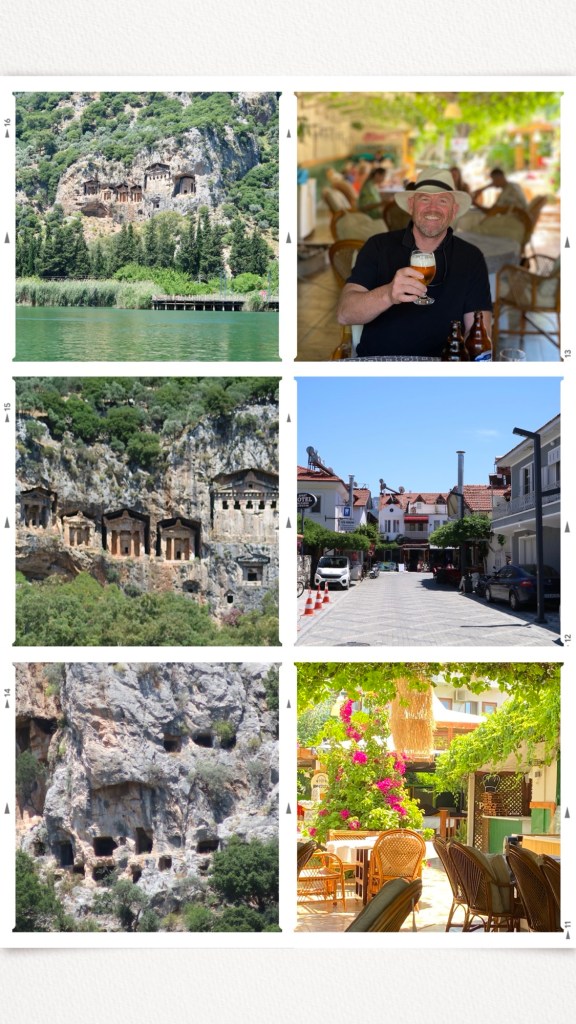
Dalyan is a lovely little village, and the King’s Tombs are impressive. These tombs are not dissimilar to the Lycian tombs in Fethiye and were built between 5-2 centuries BCE. There are more than 150 rock-cut tombs, twenty of them have temple-type façades which suggest they were the Kaunosian Kings’ tomb and these feature Hellenic Columns and such. Many are smaller, simpler, and designed only to hold cremation urns and/or bones. The grandest tomb is only partly completed, and it’s believed that this was due to the lack of gin and tonics at the time. The carvers started from the top and were working down, which gives it the appearance of an image stalled on a computer.

The photos on left show the impressive tombs. In the middle photo you can see the partially completed tomb. The tombs at the bottom were for the not-so VIPs might have had their bones or ashes stored in.
The handsome, relaxed gent top right, is Ray. Ray is recently retired, can you tell? We had a lovely lunch in Datça.

The highlight of the day for me was the trip along the Dalyan Strait on the quaint river boat, “not unlike the boat in the African Queen” but really nothing at all like it. Dalyan means “fishing weir” in Turkish. Bass, Mullet, and Sea Bream swim upstream through the strait to Köyceğiz Lake to breed. Along the strait there are permanent fish nets called dalyans with fishing shanties alongside. Due to the profusion of fish the area is also a turtle-urtle (scientific name for the common turtle) breeding ground. According to the information provided on the boat there are three kinds of turtle-urtles: “the caretta-caretta which is a pradator, the chelonia mydas is a wegetarian, and the other one is the river nile turtle”. I was keen to see a turtle-urtle and was beginning to despair when in the last few minutes leaving the strait I caught a glimpse of a big ol’boy coming up for air; not sure if he was a pradator, wegetarian or river nile type though.

The Datça strait.

Weathering the Weather

While in Ekincik, the weather forecast predicted some stronger north-westerly winds for the coming days. Interpreting the weather forecasts can be further complicated as they don’t always adequately reflect the effects of local land features. Though not so important when sailing it’s crucial when choosing an anchorage during high winds. When I try to read the forecasts, I feel I should be donning my floaty skirt and bangles like a fortune teller before trying to read someone else’s tarot cards. Whereas Ian has years of experience in reading the weather and an understanding of the isolated effects of local terrain, so I have normally left this mystery to Ian.

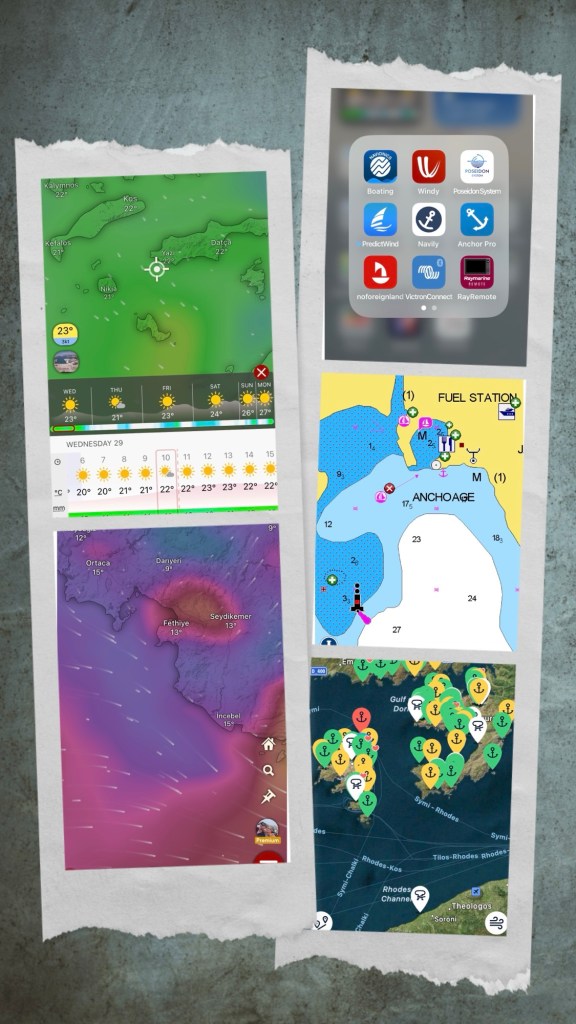
We have plenty of tools to help with these decisions: three weather Apps, with nine weather models (some twice), displayed in a variety of ways. Is this too many? Yes, we generally use one called Windy (.com not .app) and rely mostly on one model (ECMWF). It seems to us to be the most consistent and conservative, it almost always shows the highest predicted wind strengths, and means we are preparing for the worse rather than hoping for the best. In the beginning we looked at all the models and deliberated and worried, but this only caused me anxiety. Then dealing with my anxiety causes Ian consternation, so for a long time I’ve only used the other Apps and models sparingly as validation tools. Ian also looks at google earth to get a feel for the surrounding land masses when we are picking anchorages.

We also consult our electronic charts for anchorage info such as depth and obstacles and the Bibles of Anchorages, Navily and No Foreign Lands, for up-to-date information on what human comforts are nearby. Trust me there is nothing worse that being stuck on the boat in an anchorage without the confidence to go ashore or somewhere to go even if you can get ashore. How do we know? Five days riding out high winds stuck on the boat beneath a mine site on the back end of a Greek Island. Not something either of us want to do again.

1. Windy.com weather map with general wind and weather detail. It will also show is swell; nobody likes a bumpy ride.
2. On Windy these pretty pinks and purples are a sure sign that we will be anchored somewhere save preferably with a nice big mountain between us and the very strong winds they represent.
3. These are some not all of my boating Apps.
4. This is Navionics on my phone. It replicates our navigation on the charter plotter on the boat. It’s the modern sailors charts and maps. Rightly or wrongly we don’t have physical maps on board … at the moment. We can both use them and when we go for long off shore trip, like crossing the Atlantic, we will consider having them on board as a redundancy. At the moment our connectivity does not warrant physical maps.
5. Finally this picture is from Navily and gives you an idea on just how many anchorages, ports and marinas we have to choose. So much to see, and so much time to do it in.

So before leaving Ekincik, the crews of SV Longo and SV Chill convened a war counsel to determine a safe place to hole up until the pernicious wind gods blew out their idjits. Idjits are not related to idiots but that icky jittery feel you sometimes get when stupendously bored. I do sometimes wonder if the wind gods are idjits idiots.

Lately, I’ve been trying to help out more with trip planning and anchorage choice, so I took a seat at the big kid’s table, and I didn’t even don my skirt and bangles.

Serce Limani (Sparrow’s Bay)

Our chosen bolt hole is called Serce Limani or Sparrow’s Bay. It has a narrow entrance that opens out into a nice T shaped cove surrounded by hills. We decided to take up a mooring ball outside of Captain Nemo’s, a rustic restaurant. It’s been a while since used a mooring ball and a first for SV Chill, but the staff of the restaurant gave us a hand, and it all went without a hitch. When the winds came in, we listened to it howl over the tops of the hills snug in the knowledge that we were safe. I helped pick this spot, so I was feeling a bit pleased with myself.

The cost of the mooring was a meal at the restaurant and as it was still early in the season, Captain Nemo was happy for us to stay a few nights even though we only ate there once. The food was simple, the beer was good, and the anchorage very safe.

Before the big winds hit, Ian, Ali and I decided to take a hike over to the next anchorage which is one of Ian and my favourites coves in Tϋrkiye. The cover photo of our blog pages shows Longo sitting pretty tied back to the shore of this cove.

We were halfway up the hill on our walk when Ali, said from behind me in her very calm English accent “there’s a snake”. My exclamations of alarm and wild gesticulations must have been comical compared to her calm utterance. When she pointed over to the other side of the ravine to a cluster of dried weeds that was madly shaking, I calmed a little, perhaps it was leaving. A moment later not one but two snakes locked in mortal combat reared up out of the grass, my nerves kicked into overdrive notwithstanding the distance and deep ravine between us and the snakes. The display was impressive and terrifying. I wasn’t taking my eyes of the snakes to grab my phone, but Ian tried to get video. Unfortunately, it looks those photos of the Loch Ness or Big Foot, so you’ll just have to take our word for it – they were huge snakes, with ten-foot fangs and ready to stop their fight and join forces to attack us. Meanwhile the three of us stood transfixed for what seemed like hours but was likely a minute or so, I suspect the others were watching the spectacle, I was panicking.

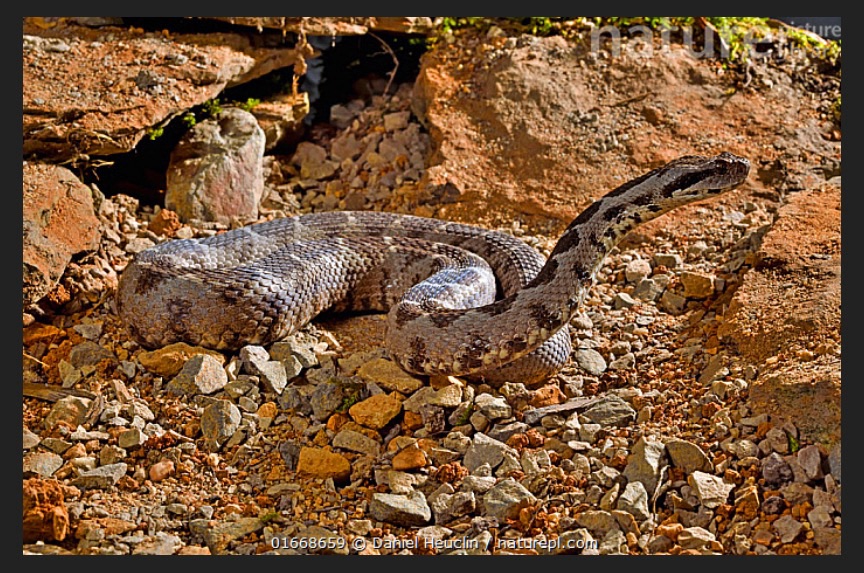
I had read somewhere that Turkey had only a couple of types of snakes and that they were mostly timid or harmless. As a consequence, I’d started to feel safe and allowed my natural Aussie born and bred fear of all things bitey to weaken. Finally, those instincts came rushing back with a vengeance and I announced “nope! Just nope. I’m done, time to leave”. Unsurprisingly neither Ali or even Ian questioned my decision, and we trooped back down the hill to the dinghy. Later, Ali and I both did some research and separately came up with the fact that there are LOTS of snakes in Turkey (well duh!) and that these feisty ones were most like Ottoman Vipers and yes, they are venomous. They might not kill you as fast as some of our Aussie snakes but your chances of coming out of an encounter breathing when you live on a boat moored in an isolated anchorage is not good.

The Ottoman Viper!

Finally, our pulses and the weather slowed enough for us set out on our next adventure.

Bozburun

Our next port of call was the town of Bozburun, another quaint village with a couple of nice safe anchorages protected from the North-West by large hills. Ian insisted we, he and I, had been here on our first trip along the Turkish coast but I had no recollection of the town and no photos to help jog my memory. It wasn’t until we dinghied into town and were walking through a kid’s playground that I said “that’s right! I had a melt down on that stone fence over there. You were trying to sort out fuel, a pump out and water at the harbour”. Ian held his own counsel on this remembrance as he’s a wise man with years of experience.

Last time we visited Bozburun, we were tired beyond belief. We had just sailed from France to Turkey in too short a time, suffering our first Meltemi stuck on the boat for five days, had a mainsail car break leaving us with only our foresail to work with and then only just scrapping through the Turkish check in (with only two days left on our European Schengen time). We were looking forward to a few nights in the marine but the agent confessed they had forgotten to book it as promised and so we had to bugger off as there was space available. There’s an exceptionally long post about this trip somewhere. Bozburun was only our second anchorage in Tϋrkiye.

My meltdown while sitting on that stone fence was because of the dreaded Turkish black water pump out regulations. These regulations require boats to hold their black water (i.e. what goes down the loo) in a tank “for safe keeping”, I mean disposal. This tank is pumped out every couple of weeks at a marina. The principle of these regulations is noble, it’s supposed to protect the beautiful clear turquoise waters we all enjoy sailing. The reality is vastly different. Our observation is that these regs only to apply to foreign boats and not the local tourist boats or big gϋlets. Not unreasonably we are required to pay for these pump outs. The cost varies, our most recent one being 1,000TL (about AUD50.00). The cost of this service is determined by the volume in your tank.

We’ve had successful pump outs where they pump out the entire contents of holding tank, tell us how much they’ve pumped, we get our blue card updated, the official record of the pump out, we pay and go on our merry way. We’ve had partially successful pump outs, where they try to pump out or pump out some of the contents but not all and tell us how much etc etc. Or before doing the pump out they ask us how much they are going to pump out because we all know how many litres we flush, right? We’ve learned that if we say anything less than 50 litres it’s cheaper. Finally, there are the virtual pump outs, where you take a guess at how much you’ve been carrying around for the last how-ever many days, pay the arbitrarily determined fee, receive your all-important blue card tick, and go on your merry way without every having seen a pump out machine.

No matter which kind of pump out you’ve had the next time you’re out on the big blue wobbly, you do what the locals do and release the Kraken*. The Coast Guard are the enforcers and will fine you, sometimes thousands of dollars if they catch you or if you don’t have evidence (the blue card tick and receipts) of pump outs every 14 days. This time allocation is regardless of your tank capacity or how many onboard. *The kraken is what we affectionately call the contents of our holding tanks.

Before continuing I have to say just how proud I am of myself for getting through that without once using the word “poo” once! Shit, I’m good!!

So, the first time we were in Bozburun, I was stressing as we had just been told we couldn’t get a pump out. It hadn’t even been five days and we weren’t due, but in my tired, overwhelmed state it was just too much for me. I will go a long way to keep within the rules. I have given up trying to defend myself against Ian’s claim that I have “good girl syndrome” because he’s right. I’m the overly conservative yin to his mischievous yang. Ian isn’t one to break important rules, but he is more than willing to “adopt local customs”; when in Rome and all that.

This was the memory I had when I saw that little stone fence in Bozburun. Having identified the cause of the blackhole in my memory and relishing how relaxed I’d become; I was now free to fill the space with wonderful memories of a sleepy village loved by the locals.

This is Ali, Ray’s partner. Ali is also recently retired! Can you tell? The delicious and beautiful mezze platter was courtesy of Ozman’s in Bozburun.

Sticking to our promise to go slow this year, we hung around for several days just living. Ray and Ali had some bibs and bobs that they needed to do on SV Chill so they took up a berth along the town quay, while we hung out in the anchorage. We met some two and four legged locals. There’s a wonderful restaurant called Osman’s Place, the chef speaks brilliant English and is always happy to have a chat about the region, his time on boats and to help wherever he can. The restaurant even has shower facilities available to us salty seadogs. There was also the quaint laundry service that lowered our washing from a second-floor window using a long rope. There’s even a decent cup of coffee at one of the many cafes and the local market was small but had everything we needed.

When the strong northerly wind came through, we treated ourselves to that guilty pleasure known as schadenfreude as we watched a couple of late arriving charter boats try to anchor and then opt for taking a berth in port. At one point they, one a smallish monohull, and the other a larger cat, were vying for the same berth; the cat won. The mono found a spot but only after he laid his anchor in an interesting right hand turn which had us wondering who he might have overlayed. For the record, We’re not total assholes. When we can we help, we’ll pop the dinghy down and Ian will don the Bundy rescue hat then zoom off to help guide a boat that has trouble. Like most sailors we know we’ll help with docking, tying lines and such, we’ll take lines ashore, offer advice or give a boat a bump to help get it in place. On this occasion there was nothing we could do to help and besides, it was gusty so having the dinghy in the water would not have been safe for us or the other boats. The boats were not in that much danger other than from the actions of their captains. They were both charter boats so hopefully they had comprehensive insurance.

I guess a time will come when our wrongdoings and misdemeanours are weighed against our honourable deeds, and our schadenfreude on this day will be just another grain of sand on the scales. I hear Lucifer holds all the best eternal parties “down below” anyway.

With that I bid you farewell until next time. May your seas be calm, your winds fair and there be a dearth of sea monster for your journey ahead and no mammoth snakes with ten-foot fangs duelling it out in your path.

Lithium Be Light

Hello, welcome, come aboard! This instalment of Sailing Longo Maï comes from the pen of the El Capitan and Wizard of All Things Technical: Ian. (Italicised notes are from Malia because she can’t help herself):

We’ve had a bit of a geek out on our electrical system. Please don’t read any further unless you’re into boat electrical and /or geek stuff. (I think it’s a good read for anyone. Unfortunately, I now know so much geek stuff that I am questioning the evolutionary pathway from luddite to geek and whether it’s possible to voluntarily regress.)

We had a 580ah house battery system which should have been ample for our needs. However, we were finding that if we sailed through the night (no solar or engine charging) in rough weather and the autopilot was working hard we were excessively draining the system. At times we had to turn the fridges off to conserve power. So, the situation needed to be fixed. (Ian has called the autopilot – Brittany Steers. And no one likes warm G&Ts hence the original necessity to remedy the situation.)

Based on observations of our current system 600ah of lithium batteries should be an OK solution. The advantage of lithium is you can discharge them to 10-20% whereas you should only use about 50% from a conventional battery. Then we had a few beers and decided 800ah would be better. No one ever complains about having too much power. (I didn’t have beers? When were beers had? Were these beers with your salty sailor buddies? Why wasn’t I invited? – mind you I don’t even like beer but it would have been nice to be asked to the lithium party.) (It was man business!)

After 10 minutes on the interweb it became apparent that the change to lithium is a bit more complicated than just dropping in new batteries. So, before I got started, I figured it was worthwhile taking a good look at the current system. It should be in pretty good shape since we had a ‘full’ survey by a licensed surveyor prior to purchase. After about another 30min on the interweb I felt a suitable level of expertise to audit our system.

Well. The more I looked the more I found wrong or at least suboptimal with our system:

The battery bank contained different size batteries (nope) which were parallel wired through one battery (nope). This means the first battery takes most of the load and ages prematurely. This then drags the whole system down. It is probably the main reason why we had under floor heating and such poor overall system performance. (As is always the way one poor sod does all the work and when they are worn down by the load the whole system fails! Sounds like every workplace I know.)

There were also no covers on battery terminals (nope) and no fuses (whole lot of nope). There’s a lot of energy in this system and this represents a serious safety issue.  (If you accidentally stepped on the suckers, we’re talking not just an unintentional perm but the smell of roasting meat)

The batteries weren’t secured (nope). The boat tends to move around a bit and having the batteries secured is the industry standard.

The cabling couldn’t have been any worse (again a whole lot of nope here). Open ended cable lugs were used instead of closed ones which prevent moisture ingress. The lugs were hammer crimped instead of hex crimped. Insulation tape was used to seal some of the lugs and where proper heat shrink was in place it wasn’t heat shrunken. The cables were mismatched and inadequate for the amperage and length. Also, automotive cables were used instead of tinned marine cable which is not the end of the world but they’re not going to last very well. Put all this together and it explains why there was evidence of corrosion inside the cabling.

I’m taking this as bit of a lesson on paying ‘experts’ to do work on your boat, or at any time really. The previous owner would have paid full retail prices at Port Corbières, France, for a self-proclaimed expert to install a battery system. What he received was something the work experience kid could have done a better job after five minutes on google. It’s almost like every opportunity to cut corners and do the wrong thing has been leapt upon with wanton glee. Good thing we paid a professional surveyor look at the boat before we bought it!

The lithium system batteries are individually fused and connected to a busbar using equal length cables. The busbar is then protected by a class “T” fuse. It’s charged by 2 Victron Smart Solar Controllers and a Victron DC-DC Converter which enables charging from the main engine without overloading the alternator. We also installed a Victron Shunt, which measures the capacity of the system and how much power we’re using. (Two things – Firstly the class “T” fuse is thus called because if ever it blows, we will be saying “Thank God (and Ian) for that Thing. Lastly – All the nifty Victron devices are blue toothed so Ian doesn’t have to guess or open up the bilge to see what is happening, so that’s nifty!)

Now that we have the new system installed, we can tell how much power we have and how much we’re using. I think we’ve overachieved a little and now need to find more appliances to justify the cost of the installation. (Happily, this means we can use our fan at night. Ian wants sensible things like a microwave, but Janie R has taught me they are the devil’s appliance and I no longer see the need. I’m getting me a hairdryer and a hair straightener and air-conditioning and if I can find the space maybe I can convince Ian to buy a coffee machine?)

Here’s some before and after shots our batteries:

Finally, because I like to have the last word and because I need to say out loud just how wonderful Ian is and how hard he has worked on this and the many other projects he has completed over the last few months. Ian knew almost nothing about batteries and wiring until a little while ago. Between the interweb and many conversations with fellow salty sailors (special shout out to Phil E and Steve N), he has gone from novice to expert in a very short time. In doing so he has saved us money, improved our quality of life, and most importantly saved our lives (the last system was a disaster waiting to happen). He is now paying forward the learning by helping others looking at doing the same thing. While undertaking this project he has also project managed and/or completed the other work that needed to be done on Longo. Much of the time battling the language barrier; he has become the master of interpretive dance and technical drawing. On top of all this he has made sure I have been gainfully employed in projects big and small; increasing my knowledge and usefulness as crew. He’s also put up with my occasional whine about not being “out there”. So, I cannot express just how much I love this man and how grateful I am for his commitment, patience and willingness to learn. He is an example to me and all that meet him. However, he is a god to the tortoises, only.