Hello, welcome, come aboard. It’s been a slow month for us, but we’ve had a visitor and a change of scenery, having left Greece, and entered Montenegro. We are now back home in Australia, more to come on this and Montenegro later. Of course, because I’ve been slack and our blog is still floundering somewhere over in the Aegean. While trying and catch up it dawned on me that perhaps we were all a little over the history of islands. It’s all bit cookie cutter: Greeks, Romans, Byzantines, Ottomans, Knights etc etc etc. Don’t get me wrong I love the history but my cup over-flowth. So what I thought I would do is challenge myself to cover the Greek ports we visited with accompanying photos in just two posts. There is still a bit of history but I won’t linger anywhere for too long unless it’s really really interesting.
At the end of my last post, we were leaving Syme and heading out to the Greek island of Kos to collect one of my best friends, Lesley.
Kos
Years ago, Lesley and I bonded of a love of cheese and champagne. At the time we met, Lesley was pregnant with her second son, so her intake of champagne was somewhat inhibited, but it’s okay because I made up for her restraint. Her little baby has now finished high school.
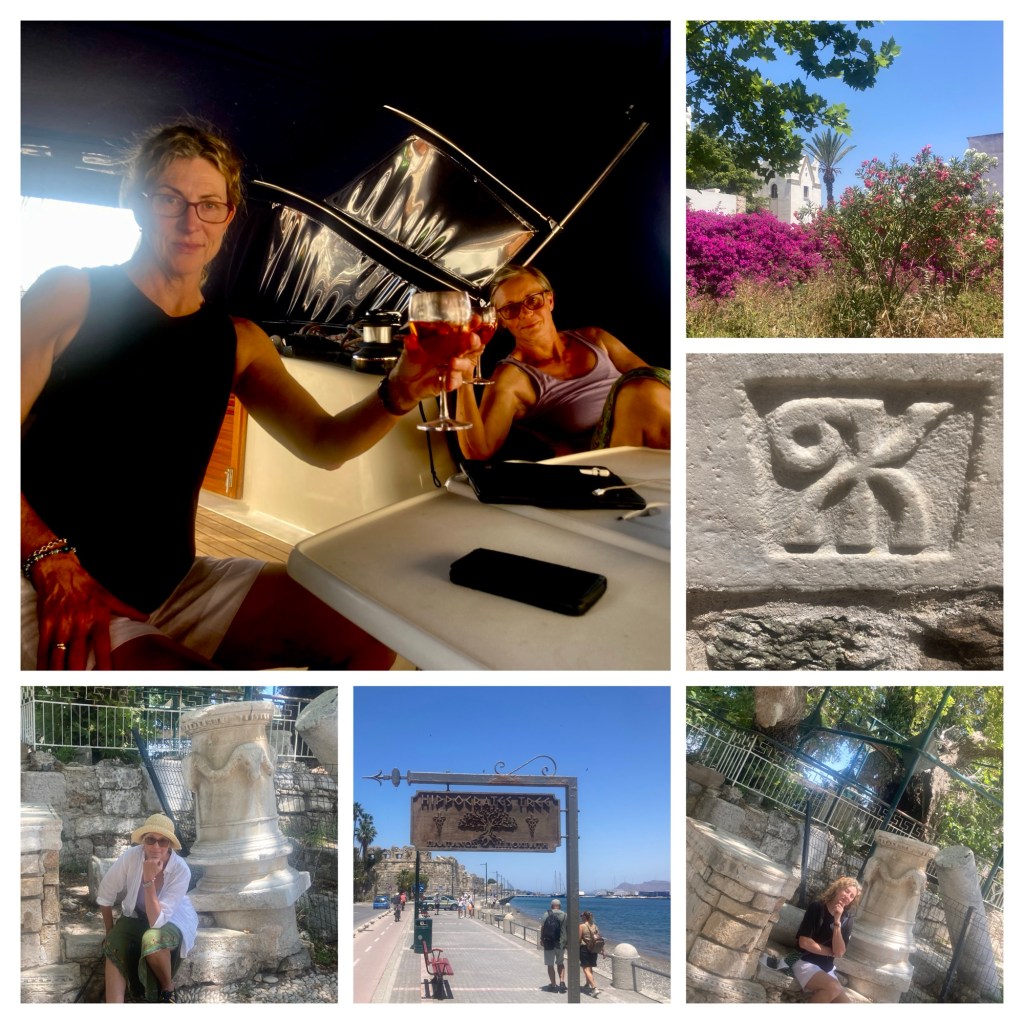
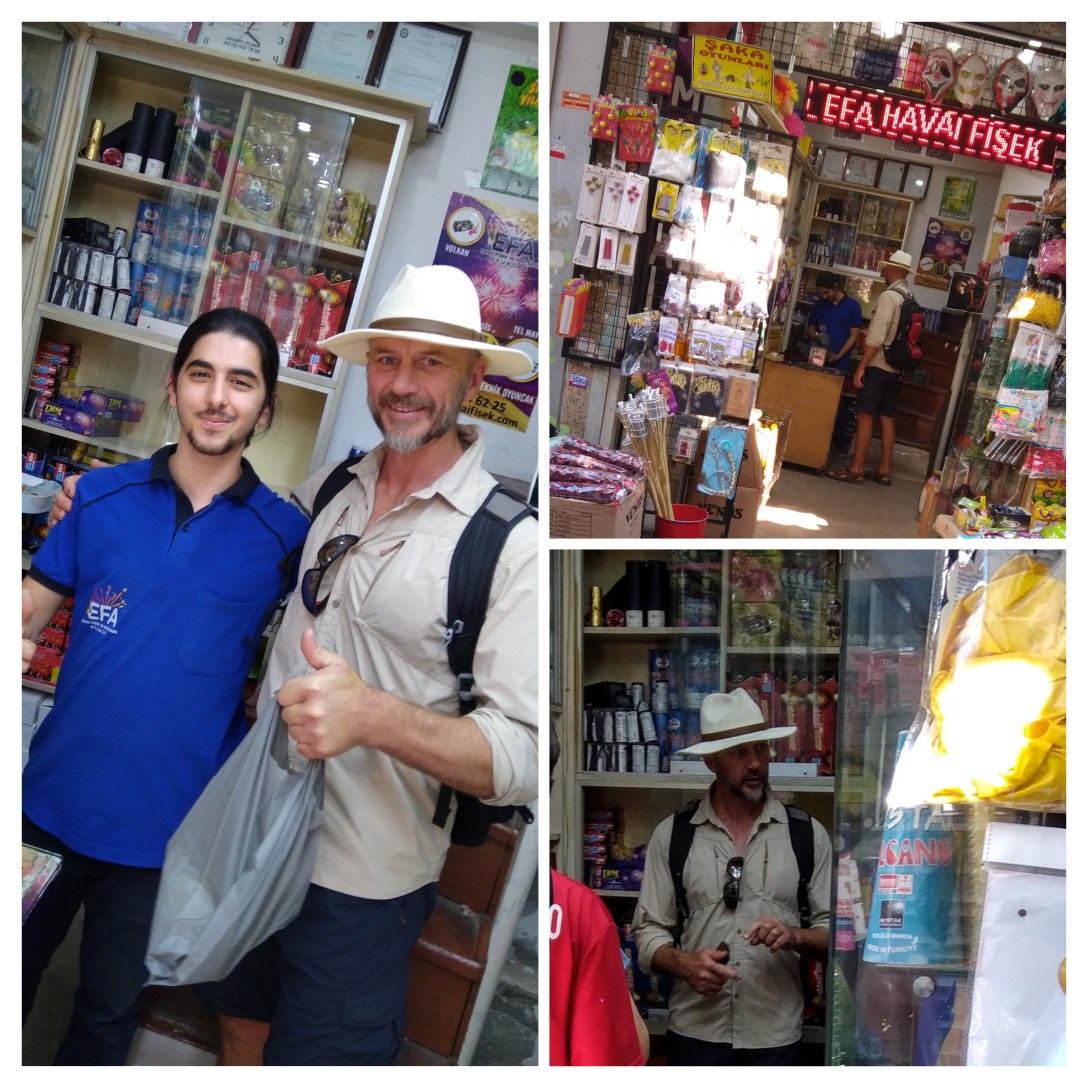
Wanting to make a good impression we decided to meet Leslie at Kos. We’ve been there before and it’s hard not to let your mind wander to knights on ye-olde sailing ships as you enter the fortified harbour and tie back onto the castle wall. It also makes a great backdrop for our morning coffee. The castle fortifications were initially built by the Knights of St John around 1315. It’s a very impressive castle to wander through, but this time we were thwarted as it was closed for renos. There are however loads to see in Kos so we made do. Ian set about finding a shop that would sell him some fireworks and Leslie and I engaged in a less frivolous exploration.
Kos is known for its most famous inhabitant, Hippocrates, as in “the Father of Medicine”. From the little I read he was a firm believer in letting the “patient heal thyself”. Hippocrates, however, is not the only famous person from Kos’s history. Philotas was a poet and scholar known particularly for his “Disorderly Words” which was a kind of dictionary on rare words. Sesquipedalian is a more modern example which springs to mind. It means using unnecessarily long winded and complex language. I always chuckle at that. He also wrote two books which are contained in the Collection of Paradoxical Stories. The story goes that he was so bound up in his academic studies of paradoxes that he forgot to eat and sleep and popped off his perch. It seems that every island we visit has a famous inhabitant. Pythagoras lived on an island just to the north. Amazing to walk through their hometowns and wonder how they fostered such brilliant minds.
Kalymnos
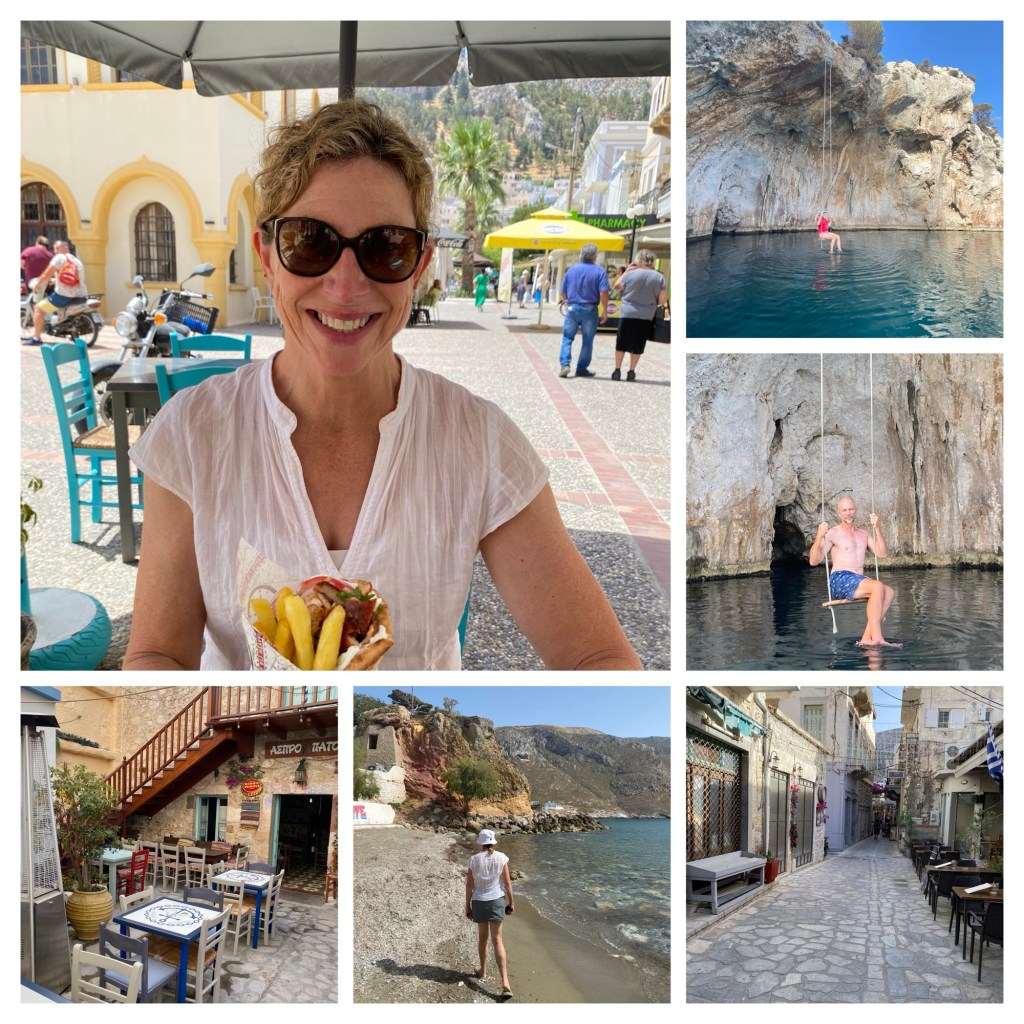
Lesley and I had a wonderful time exploring Kos, but it was soon time to move on to Kalymnos. As an island Kalymnos ranks as the “wealthiest” member of the Dodecanese and one of the wealthiest in the Greek islands. Surprisingly the island is historically unremarkable.
Earthquakes are a frequent occurrence, and while we didn’t feel one this time, on an earlier visit a quake hit while Ian was in the supermarket. I was wandering in the alleys outside and had no idea it had happened until Ian told me about it and I saw mess in the market. The isles were in chaos with products fallen from the shelves. It is best known as an international rock climbing hotspot. I guess that tells you something of the landscape.
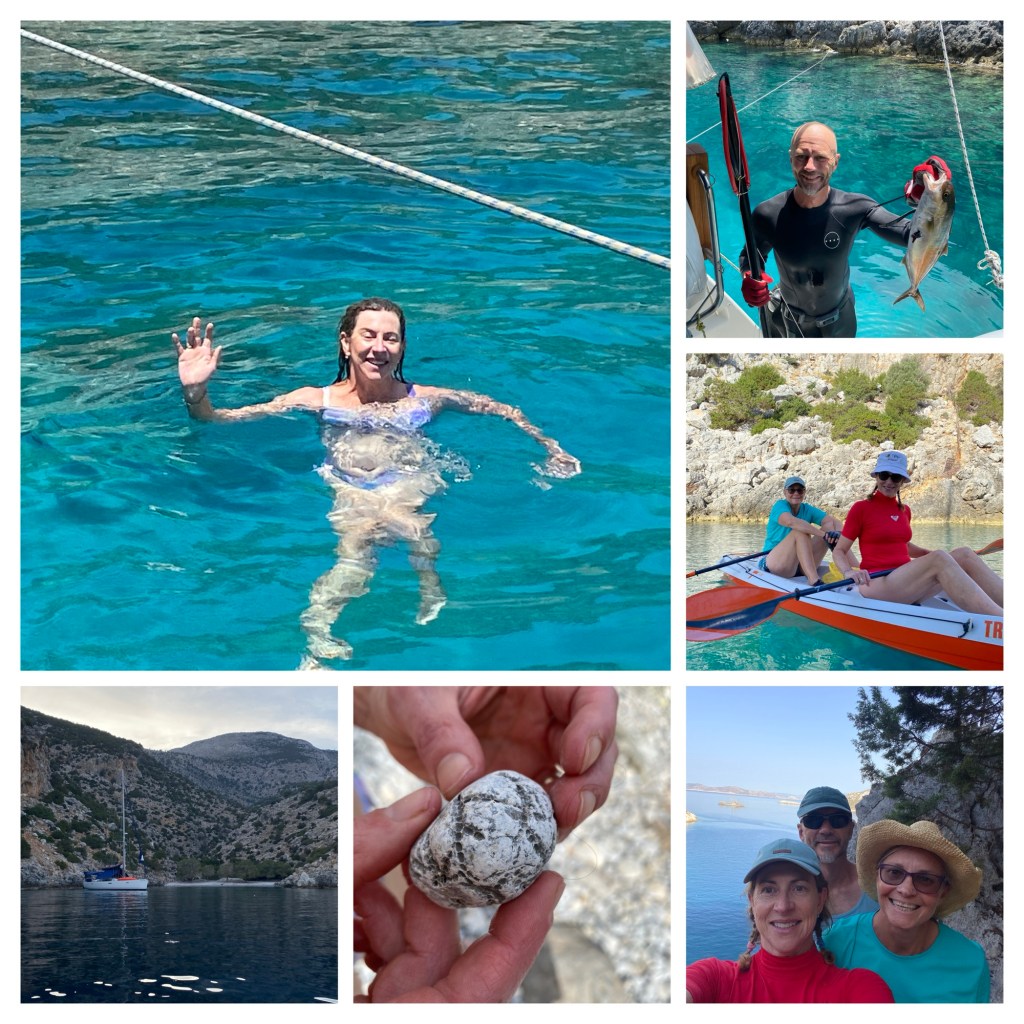
When we arrived with Leslie, we managed to snag a lovely spot in a secluded anchorage with room for just one, maybe two boats. To do this we had to reverse between two cliffs while lowering the anchor then run stern lines to convenient rocks. We then had the secluded (25m) beach between these cliffs to ourselves except for the odd taxi boat bringing in climbers looking for adventure in the surrounding cliffs. We tootled around in the dinghy to Vathy the nearby village and had a lovely dinner with the best baked cheese I’ve ever had.
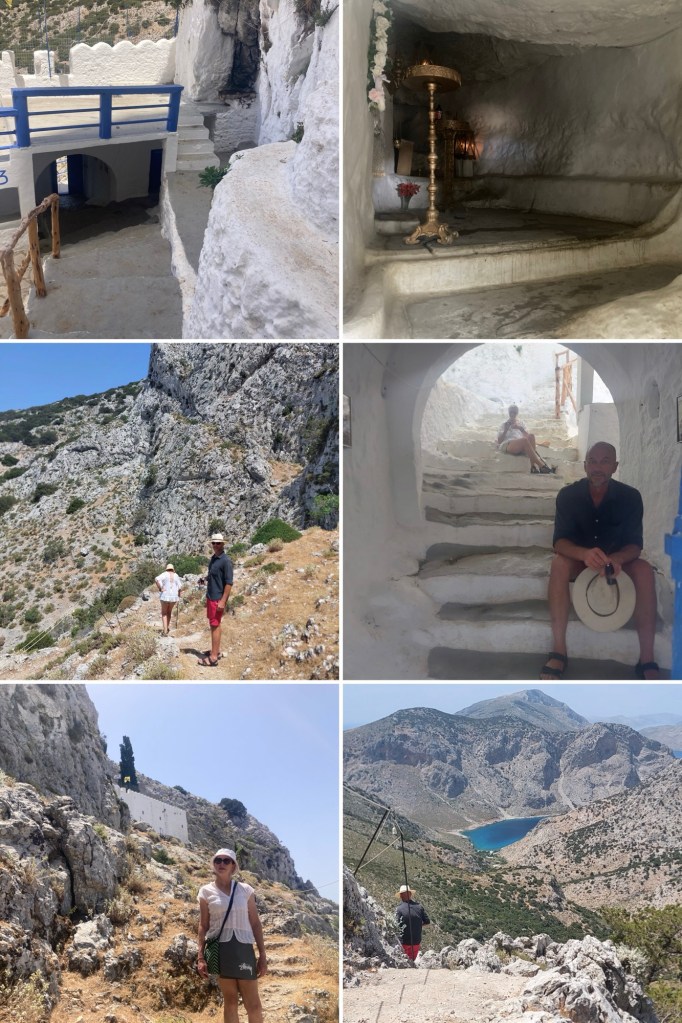
It was a great place to visit but there wasn’t any real option to explore inland. So we took Longo around the corner to spend a bit of time moored to the Kalymnos old town wall. This busy little town had plenty of cafes, bars and, more importantly, a hire car so we could adventure inland. We took Lesley to see the remote mountain church of Panagia Kyra Psili which houses another Acheiropoietia (means an icon “made without hands”). The church was built by a Calymmian (person from Kalymnos) on his return both to the island and his faith. It’s built into the side of a mountain. To get to there you need to drive up to the summit of the mountain via a winding steep one lane road. It has been fabled since antiquity that this journey can only be undertaken in a hire car. The road was more suited to a 4WD than our overloaded Fiat. On reaching the top we left the car to recover from overheating and clear the smell of boiling coolant. From there we walked about a kilometre or so to the church. Lesley was a champ and did this walk in thongs, of the flip flop variety, not her nickers. However for all I know Lesley may have been wearing the other kind; we’re good friends but not that kind of friends. The hot walk was made worthwhile once we made it to the shrine to the Virgin Mary. It was high in the mountains at the base of a rugged cliff overlooking Vathy. The view was spectacular!
We also found another out of the way shrine located up a small path only accessible by boat. This shrine was dedicated to St George. It was such an odd place for a shrine but apparently the saint appeared to the members of a family as they were coming home from a fishing trip.
Far too quickly it was time for Lesley to leave us. This proved a little tricky as her flight was leaving from Kos which was 3 hours motoring to the south. We then had to get moving in the other direction to catch the next favourable winds. We planned to drop Leslie at a small town on the north of Kos island but there was no spare space in the port for Longo. So, we stopped offshore, launched the dinghy and Ian zoomed Leslie off to find a taxi. I stayed onboard cutting laps and generally keeping Longo safe. This was first time I had been left onboard alone with the boat underway. Call me a solo sailor! I can report that despite the two ferries and several other boats coming and going I managed not to sink Longo or hit anyone. A win for me! And Lesley made her flight despite the lackadaisical* taxi service. (*Another great word, which I’ve either been saying wrong for years or doesn’t look like it should be spoken. There’s just too many a’s and i’s in there”.)
Leros
After an uneventful sail northward we anchored outside the town of Lakki on the island of Leros. This is a great little anchorage provided you pay pretty close attention to the notes in the charts. There’s a ferry of the “fook that’s a big one” variety that visits in the middle of the night. The captain is known to offer little regard to any boat foolish enough to park within his anchor zone. There are stories of people being woken by a massive ship’s anchor being dropped right alongside as the ship towers above.
It was here that we linked up with our buddy boat, SV Chill and also our good friends, Ian, Janine and Lucy (the golden retriever) on SV Deejay. The island is beautiful with lots to see and since we’d been here before, I took on the role of tour guide. Perhaps they should have asked the last group I took adventuring on this island before agreeing to my guidance. Here’s what I’ve learned over the two tours of Leros: duck when entering ye’ olde churches (or risk splitting your head – wow that hurt!), Google is very flexible with what it calls a road and just because it says a car can go up a hill, doesn’t mean the car will go up the hill, online opening times are advisory, and not all ruins are worthy of a visit. Most noteworthy however is the Aussie butcher in Lakki for the win. Oh my god, this man’s meat is so good, Ian even proposed to him!

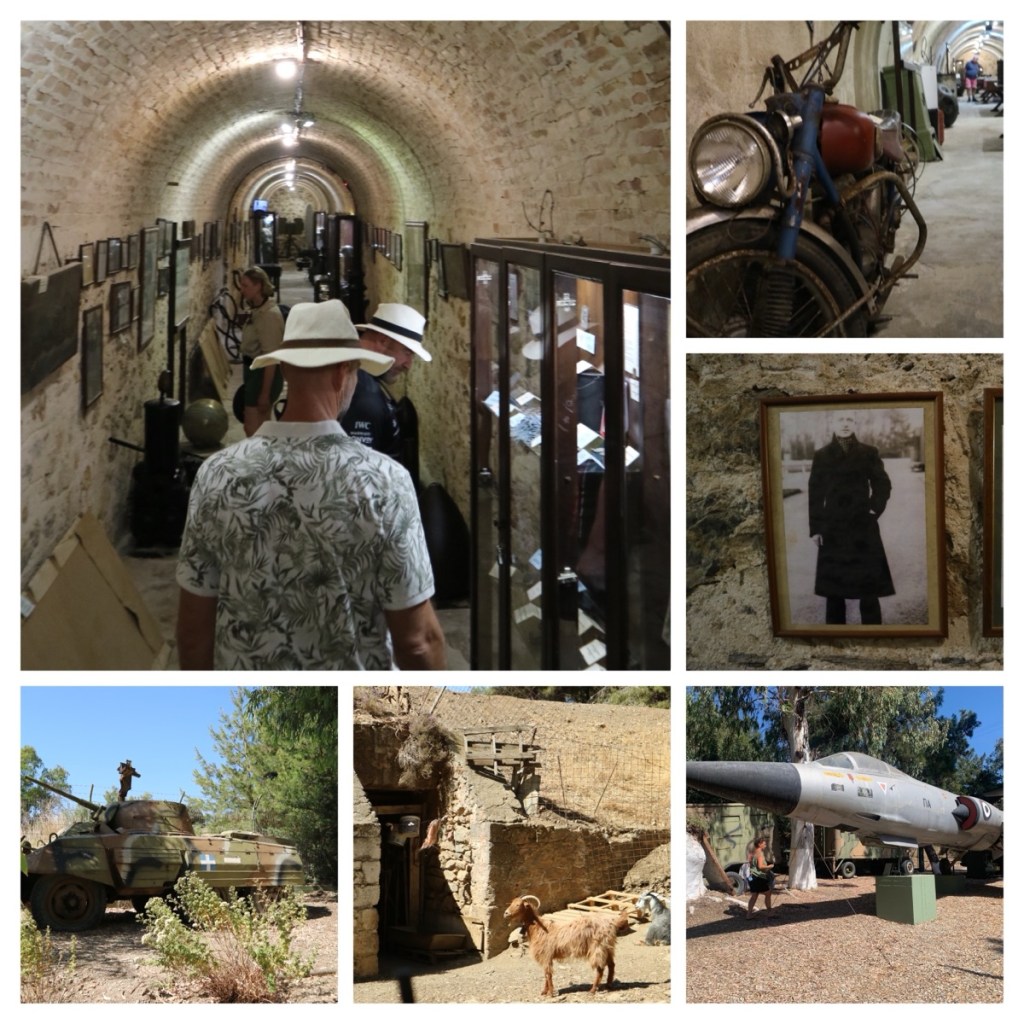
Historically once you get past the usual leapfrogging of ancient invaders things become more tangible in the early twentieth century. During the Libyan War (1912) the Italians occupied the island. In the 1930’s the Italian Fascists built the town of Portlago (now known as Lakki). It is one of the best examples of Italian Rationalist architecture. They chose the western side of the island as the bay (in which we were anchored) is big and deep, with a narrow entrance and well protected by the surrounding hills. It made a perfect Navy port and seaplane base. Mussolini also had a mansion in the town.
when Italy picked the wrong side at the beginning of WWII, the Allies bombed Leros remorselessly. As a result of the excellent anchorage provided to warships by the many natural coves, the island was the second most bombed during World War Two (after Crete). In 1934, the Italians turned coat and the British arrived. That’s when the German’s began their continuous aerial bombardment. The Germans finally taking the island during Operation Taifun. The forces involved were paratroopers and the elite Brandenburg division. The island remained under German occupation until the end of the war. The Battle of Leros inspired the book and movie “The Guns of Navarone”. I can’t help wonder how the local Greeks felt about all this? On our first visit to the island we happened upon the annual celebration of one or another of the battles, which appeared to be well supported. There is a wonderful museum located in the tunnels near Lakki, so I guess they’re not too bitter.
Patmos
Saying hooroo to our buddies we headed to our next destination, Patmos. This was a new island for us and one I definitely didn’t want to miss. Ian and I hired a moped. I’m not allowed my own moped and I’m just fine with that. Scooting around the small roads on a ridiculously small bike is one of my favourite things to do. I get to sit on the back and sight-see without having to worrying about what’s coming the other way.
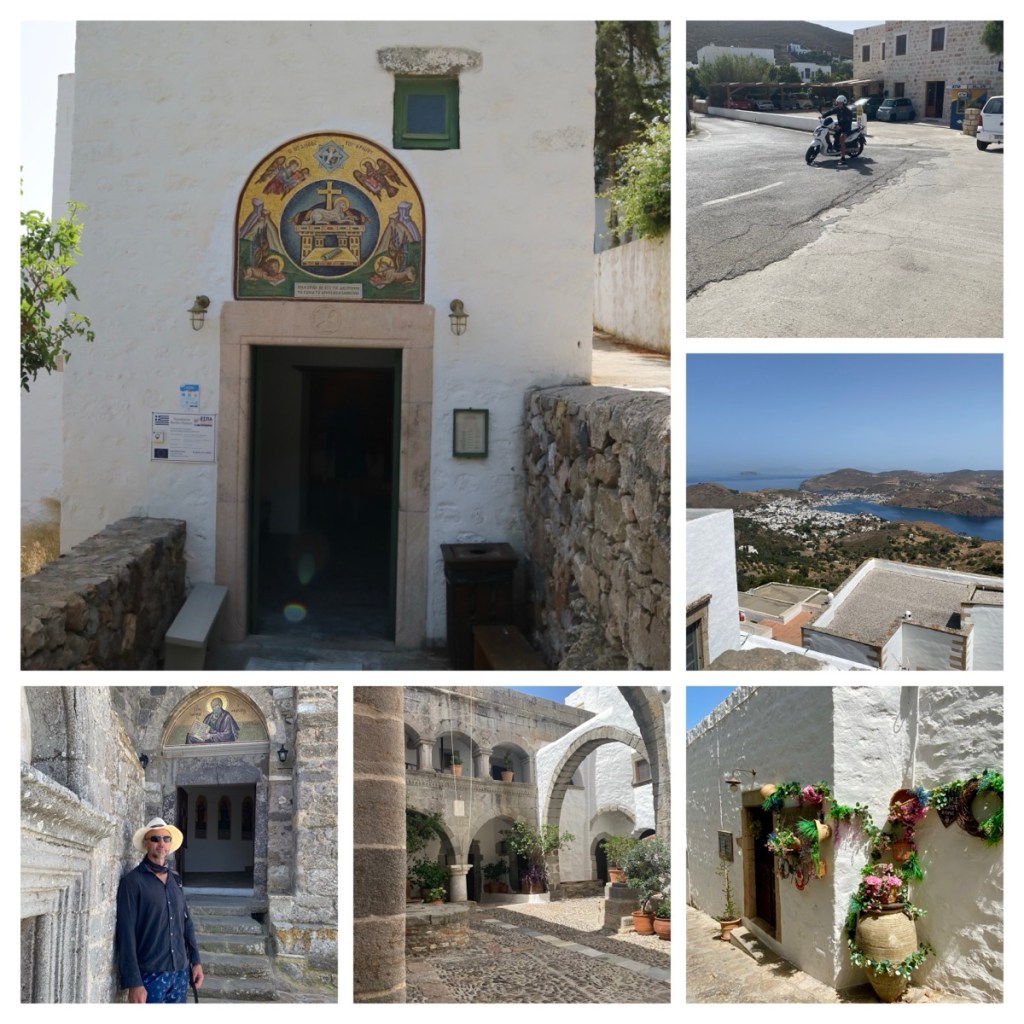
Patmos represents one of the best examples of living history, that we’ve seen. I’m sure there are other sites that rival this but right now I can’t think of a single one where the buildings and surrounds are still being used by the same organisations. The most sacred and historically important site is the Cave of the Apocalypse. Sounds impressive but, to my mind, it was visually underwhelming. This is where St. John of Patmos was exiled and received visions that he recorded in the Book of Revelation. Like many I assumed this St John was John the Apostle, who hung out with the big man himself. However, this is by no means certain as the author names himself as simply “John” in the text, so his precise identity remains a point of academic debate. Nonetheless, the cave and its surrounding building was worth a visit. To stand on the spot where such a formative event of our modern lives occurred is incredibly special.
Further along the same road you come to the town of Patmos. Hands down one of my favourite historical sites is the Monastery of Saint John the Theologian. This is the same Saint John, just by a different name. (they call him John, big bad John) This Greek Orthodox monastery was founded in 1088 when the island was given to the monks by a Byzantine Emperor. The same religious ceremonies that date back to the early Christian period are still practiced by the same monastic order to this day. This is living history!!! The lovely man at the gate was so proud of this fact that his smiling face beamed with joy at the telling, despite it being something he must say over and over again.
There is a wonderful museum housed within the monastery. Among other things on display are some of the 330 manuscripts from the monastery’s library, paintings (including the one of St Nicholas I used in my blog about Gemlier Adasi), and the most amazing textiles with examples of early embroidery and weaving. It becomes apparent in this wonderful museum that these monks had some serious political clout. With many of documents on display being trade treaties and proof of protection from the Ottomans, Russian Tsars , Knights Hospitaller and many many more. The monastery also houses a number of religious relics including the Skull of Saint Thomas. We saw several other skulls adorned with gold. Unfortunately, photography within the museum is forbotten, though I managed a few of the monastery surroundings.
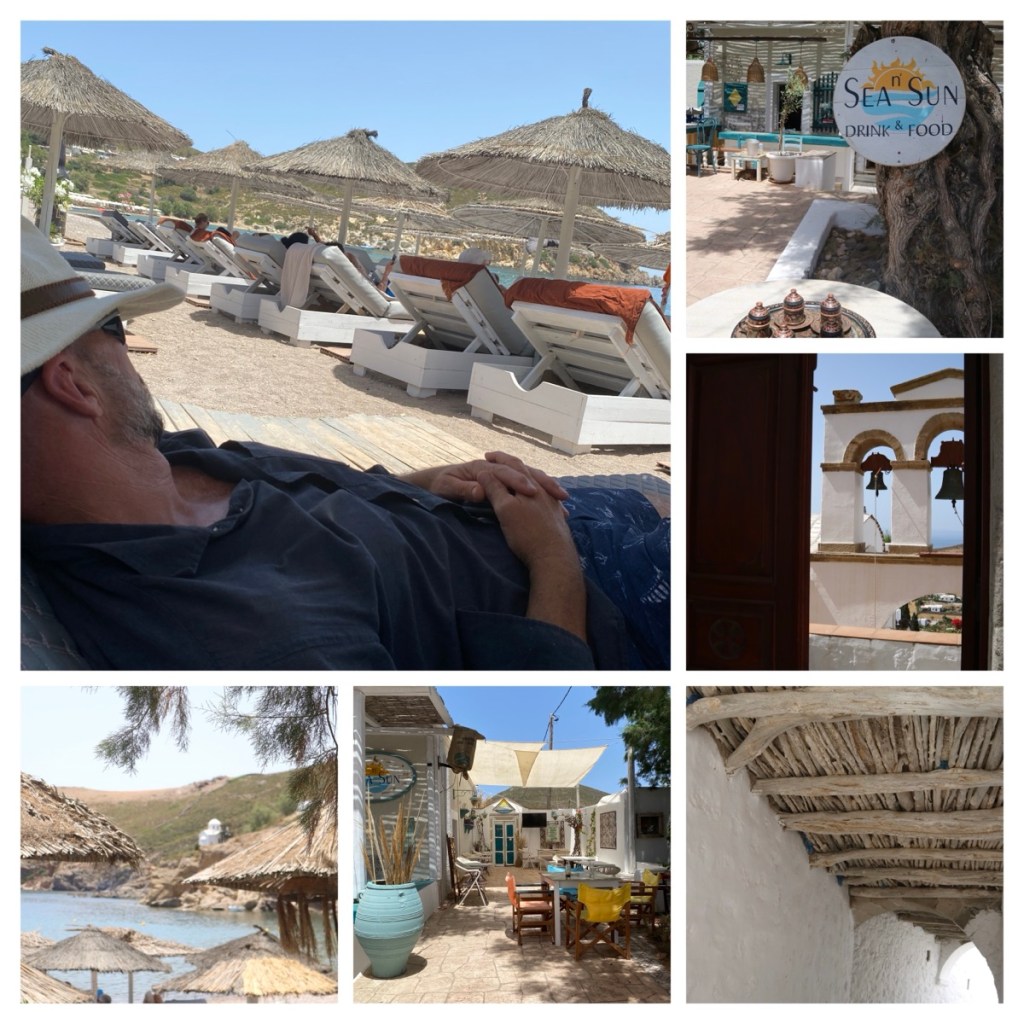
We finished off our tour of the island with a lovely lunch that Ian’s keen nose for BBQ found at a groovy little seaside restaurant. It had the added bonus of deckchairs suitable for a sneaky little nap on the beach opposite. A day or so later our buddy boat SV Chill arrived and we spent a lovely couple of days just mooching while we waited for a good weather window to move on.
Farewell to the Aegean
The winds soon turned and the forecast was for a Meltemi. I’ve mentioned these northly winds before. They’re strong, dry, and gusty north winds that blow in through the Aegean Sea, especially in summer. A good Meltemi will last a couple of days, a bad Meltemi will last for over a week. It looked like we were in for bad Meltemi to come in a few days. Where we were offered good protection, but we were keen to start our journey across the Aegean Sea towards mainland Greece so it was time to let loose the mooring ball and see how far we could get.
We were originally aiming for the island of Tinos which has a good solid port wall and anchorages on its Southern side. Town walls and marinas are good options during strong winds however as a general rule we prefer to be at anchor even in strong or gnarly weather. This allows Longo to swing with the wind, so it is always coming over the bow of the boat. It is after all how the boat was designed to work. The biggest risks are that our anchor could drag or another boat’s anchor drags and they drift onto us. I will risk the jinx by saying that we have never dragged due to strong windows with our current anchor. It’s oversized for our boat; call us Billy not silly! We take care with where we set the anchor and watch the boats around us closely to minimise the risk of being hit should someone else drag. We also look at the surrounding hills to see if they will provide shelter or serve to accelerate and channel the wind. Lastly, we have a great app on my phone that allows us to monitor our location per the anchor.
We have had our anchor (old one) drag and then had to reset it in strong winds. We’ve done this a few times so we know the drill and that we can manage. When I say “we” I mean “me” as its my job to go forward and run the windlass (anchor dropping and picking up device). I’ll admit it is at these times that I really feel I earn my keep on the boat; especially if there’s storms. It’s something we’ve had to do when an unexpected squall hit our anchorage and running is what saved our boat (again, old anchor). Would we have had to do that if we’d been in a marina on the same coastline? Who knows? we just know that it was safer for us and the eight other boats to up anchor and run with the wind that it was to remain close to land.
Ian and I decided to try out an anchorage on the island of Syros. Friends had told us this was a great bolt hole bay with a large hill on the Northern side.
Syros
We stayed on Syros for about a week. The first couple of days were light winds, so we used the time to improve our position in the bay before the wind started getting serious. Once the anchor had dug in, we caught a bus over to Ermoupoli, the capital of the island, the Cyclades, and the South Aegean.
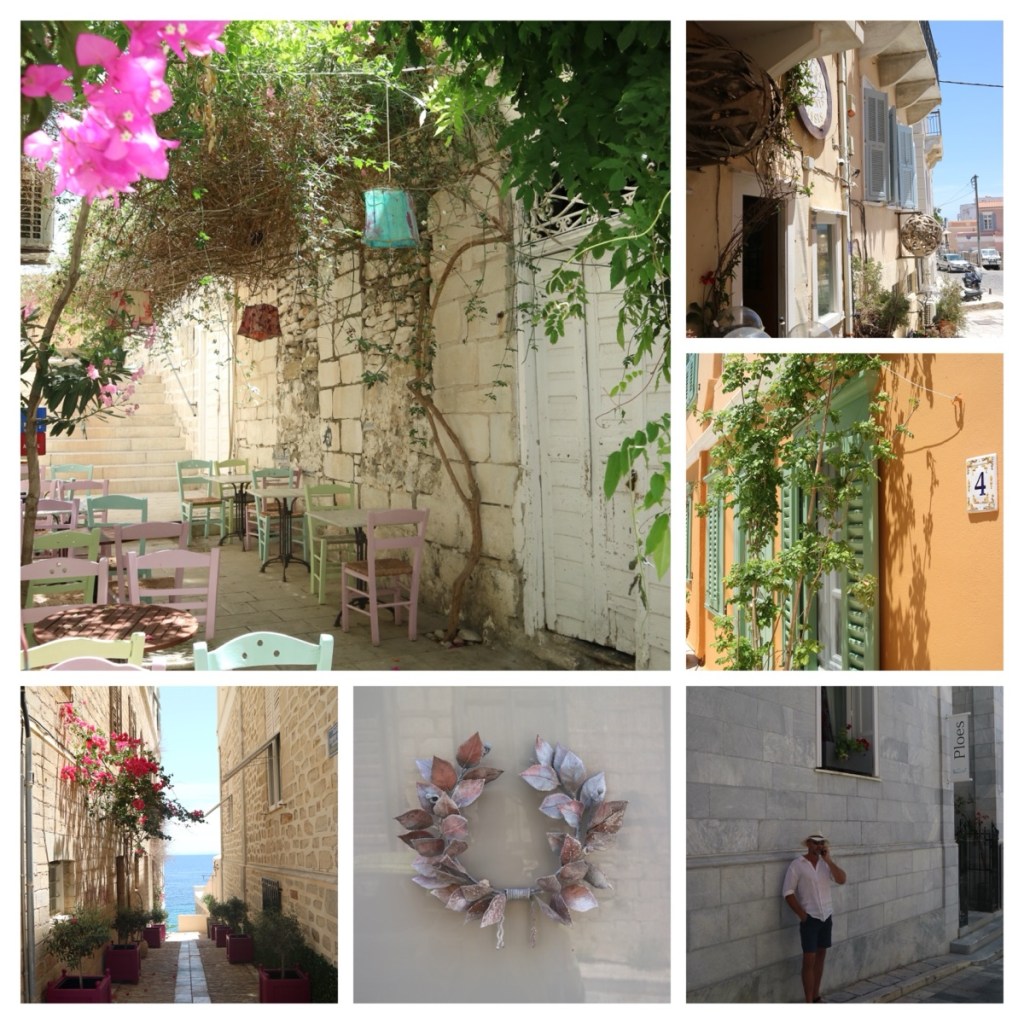
Having moved further East, into the Cyclades, I thought perhaps the usual list of invaders and occupiers might change a little. It didn’t, except that there is mention of the Phoenicians having held the island for a while. Notably island was under Venetian rule from 1204 to 1522 when the corsair Barbarossa took possession of the island. However, the Ottomans gave the Cyclades substantial privileges, such as the reduction of taxes and religious freedom. The religious freedom was based on an agreement between France and the Holy See, and the Ottomans.
Quick sidebar, Barbarossa the Ottoman corsair and naval officer was born on Lesbos. Among his claims to fame Suleiman the Great appointed him a grand admiral; he led an embassy to France, conquered Tunis, achieved a decisive victory over the Holy League at Preveza, and conducted joint campaigns with the French. As befitting a pirate of such renown he had a kickass name: Captain Redbeard. He was successful enough that he retired to Constantinople and like all men of action promptly died, I suspect of boredom!
Today there is an equal number of Catholic and Greek Othordox Churches on the island and some entirely Catholic villages. Making it one of the most significant Catholic places in Greece. Interestingly Syros is one of a few places where Greek Orthodox and Catholics share a common date for Easter.
During our week or so on the island we spent most of it mooching around Foinkas the little village near our anchorage. Among other things it has one of the best bakeries we’ve come across and it had great coffee. It was so good even Ian was willing to line up for a delicious morsel of pastry and a cappuccino. We also became regulars at a bar along the waterfront. We figured we were locals once we were being offered coffee liqueur shots on the house and being told by our lovely waitress, Diana, that we couldn’t handle a burger each. Diana was right about the burger we ended up sharing the one we were permitted to order and regretted asking for additional chips. When not feeding our bellies we watched the locals learn to windsurf and the little duckling boats (dingy sailboats) go about their thing. I guess that gives you an idea about how protected this anchorage was. Outside the bay was howling at 40 to 50 knots and inside it was protected enough for eight-year old’s to practice their stuff in boats not much more than a bath tub.

On our last day on the island we had a front of house seat for the final of the Cyclades annual yacht race. This was incredibly impressive and left us not a little bit chagrined about hiding from the weather as we watched boats half the size as ours running full sails, heeled well over with the crew riding on the rails as they came screaming into the bay. Oh well we call ourselves cruisers not sailors, for a reason.
Farewell Cyclades
The next day we upped anchor and headed out. We expected a causal cruise but the weatherman had left the work experience kid in charge. To our surprise we found ourselves no longer acting as scallywags but as full blown racing sailors. Longo loved every minute. She has new pants (racing sails) made in Turkey. Once they powered up, she put her head into the wind, heeled over and was off! As one of Ian’s American friends would say ‘Oooowee, we was whippen them ponies and haulen the mail!’ Well Ian and Longo were, I was holding on. Thankfully it was a clear day and while the oncoming swell was uncomfortable it was manageable. Our only change of plans was to run under the next islands to our East rather than cutting between two of them, as we thought that the narrow strait between the island might have a funnelling affect on the winds. It was a wild ride.
SV Chill followed a few days later and discovered that the weatherman hadn’t returned and the work experience kid had gone back to school. They faced even stronger winds and swell but managed it superbly arriving at our next anchorage safe and sound if a little weary.
Herein we end our adventures in the Aegean (almost) as we entered the Saronic Gulf with Athens on our right and Poros on our left. I think that I’ve probably outlasted my welcome in your day and I will return again soon with the last instalment of our Greek adventures. In the meantime, fair winds and a dearth of sea monsters for your daily travels.


























 Sailing Longo Maï