
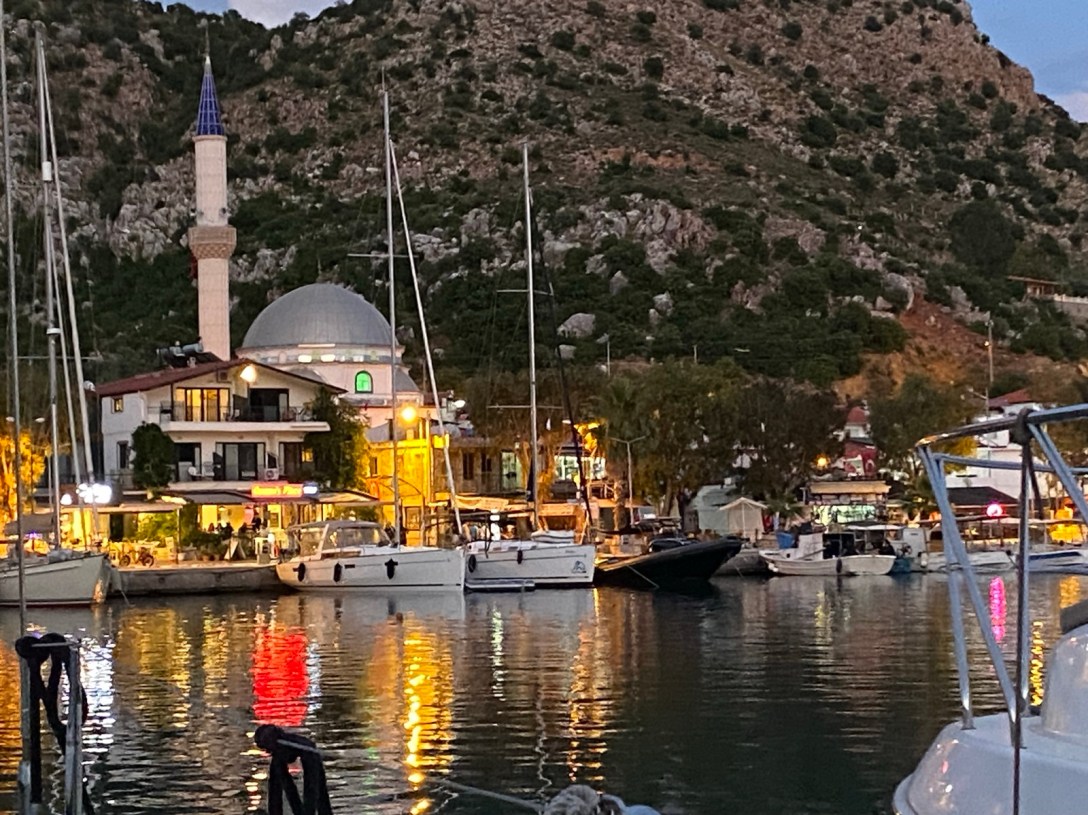
Hello, welcome, come aboard. Oh, how the wind blows! The last month has been both joyful and frustrating. Since dropping Ned off, so that he can continue his journey to Copenhagen and then Vietnam, we have been plagued by the pernickety wind gods but at least we’ve had beautiful surrounds.
We headed back to Fethiye so that Ali and Ray on SV Chill could attend to some important upgrades to their dinghy and arch. Having work done on your boat in a non-English-speaking country, or more correctly in a country where you don’t speak the language, can be challenging. Ian uses a mixture of Google translate, technical drawings and interpretative dance. It works most of the time and when it doesn’t it’s very entertaining. Thankfully, SV Chill had an English-speaking agent helping with the negotiations, so Ian and Ray didn’t need to bust a move. Still as with all technical work there were complications and delays, but the outcome is spectacular and well worth the wait. They now have Red Rocket, a Highfields dinghy with a 20 HP outboard. Let the dinghy races begin! They also have an arch that supports solar panels and can stow Red Rocket safely for sailing.
In between this important work we hung out in Göcek National Park and Fethiye. We made the trip up to Käyakoy (see our blog of 30 May 23). I love this ghost town for its modern history, as sad as it is, and we were keen to share this mournful place with our mates on SV Chill. We eased the load by tagging on a trip to the stunning beach at Oludeniz. Where we had ice cream as we strolled along the foreshore watching paragliders attempt to land on the beach. These paragliders piqued our interest and we attempted to drive up the mountain to see these nutters take off. We made it about two-thirds of the way when we called it quits. There were buses full of tourists, Mama and Papa’s on their mopeds, and numerous late 70’s Russian sedans bravely or naively making this trip, these Turks are made of stronger metal than we were. I refused to get out of the car when we stopped to take in the view, as my fear of falling off* the mountain had taken over. So, only the photo, that Ian took.
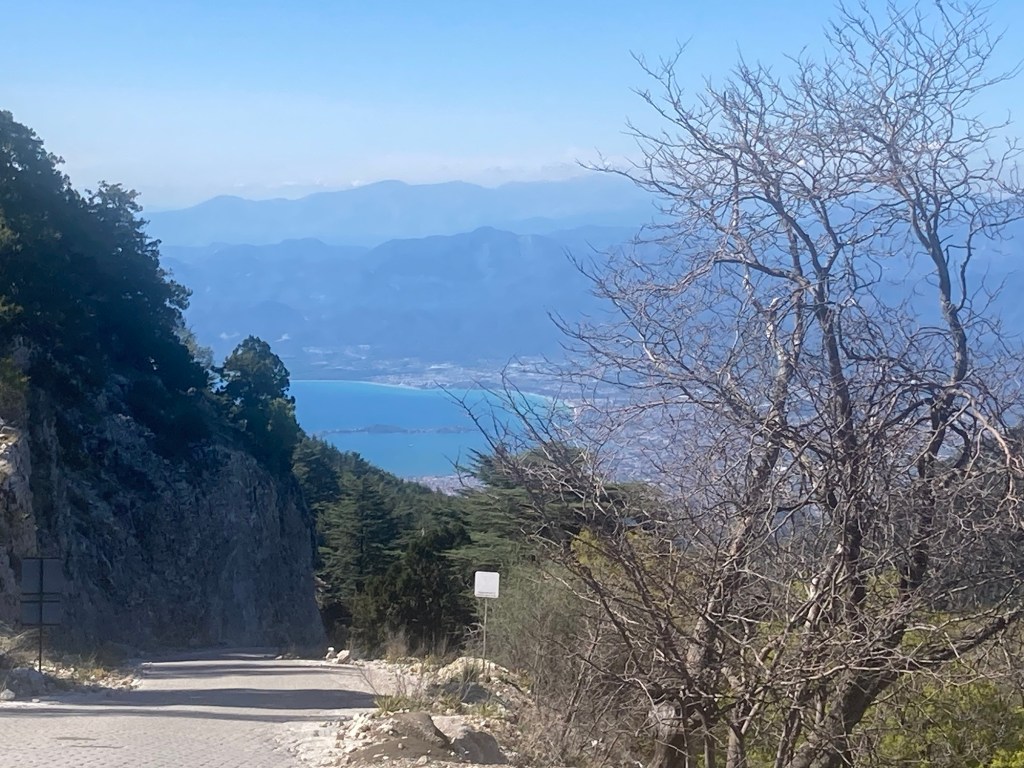
*I’m not frightened of falling down the mountain but up off it. This irrational fear has something to do with not being closer to the centre of the earth and therefore gravity has less of a hold on me. And as I had no rock in my pocket weighing me down, I could not bring myself to get out of the sturdiness of the car. (Ron and Ned stopping laughing)
Dalyan and Kaunos
Once all was well and spiffy with SV Chill, and Red Rocket was stowed as safe as a safe thing, we decided to sail to Ekincik. It was from here that we took a river cruise up Dalyan Strait, with stops at Kaunos Anti Kenti and the Kaunos Tombs of Kings which overlook the pretty village, Dalyan. This was high on my list of places I wanted to see.
Kaunos was once a seaport but now lies seven kilometres inland due to earthquakes that caused the ports to silt up. Consequently, the town and much of the surrounding area was deserted after a breakout of malaria decimated the local population.
I’m glad we stopped but it wasn’t as noteworthy as I expected. Which made me ponder whether I am becoming jaded with all this history? I tried to discover an oddity or unusual snippet about this region’s past and came up somewhat wanting. Though legend has it that Kaunos was named after a man who ran away from home to escape his sister’s romantic advances! The legend doesn’t say whether he ran away because her desires were morally corrupt or if he just wasn’t feelin’ the love? This restored my faith sufficiently for me to continue with my visits to ruins in search of the quirky, magical, and downright loopy factoids that keep me entertained and out of Ian’s hair. (Mind you it’s not hard to keep anything out of Ian’s hair)

Dalyan is a lovely little village, and the King’s Tombs are impressive. These tombs are not dissimilar to the Lycian tombs in Fethiye and were built between 5-2 centuries BCE. There are more than 150 rock-cut tombs, twenty of them have temple-type façades which suggest they were the Kaunosian Kings’ tomb and these feature Hellenic Columns and such. Many are smaller, simpler, and designed only to hold cremation urns and/or bones. The grandest tomb is only partly completed, and it’s believed that this was due to the lack of gin and tonics at the time. The carvers started from the top and were working down, which gives it the appearance of an image stalled on a computer.
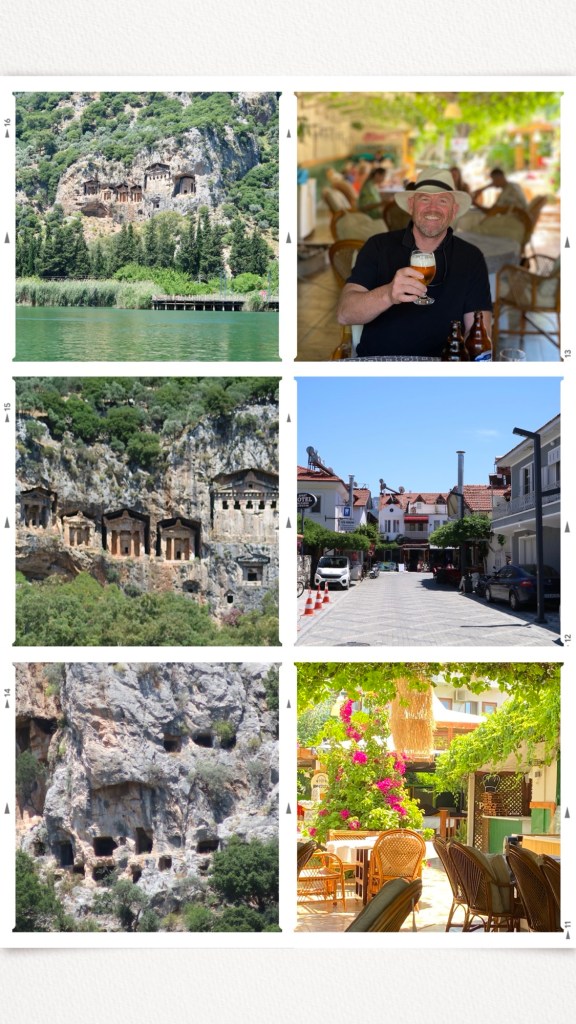
The handsome, relaxed gent top right, is Ray. Ray is recently retired, can you tell? We had a lovely lunch in Datça.
The highlight of the day for me was the trip along the Dalyan Strait on the quaint river boat, “not unlike the boat in the African Queen” but really nothing at all like it. Dalyan means “fishing weir” in Turkish. Bass, Mullet, and Sea Bream swim upstream through the strait to Köyceğiz Lake to breed. Along the strait there are permanent fish nets called dalyans with fishing shanties alongside. Due to the profusion of fish the area is also a turtle-urtle (scientific name for the common turtle) breeding ground. According to the information provided on the boat there are three kinds of turtle-urtles: “the caretta-caretta which is a pradator, the chelonia mydas is a wegetarian, and the other one is the river nile turtle”. I was keen to see a turtle-urtle and was beginning to despair when in the last few minutes leaving the strait I caught a glimpse of a big ol’boy coming up for air; not sure if he was a pradator, wegetarian or river nile type though.

Weathering the Weather
While in Ekincik, the weather forecast predicted some stronger north-westerly winds for the coming days. Interpreting the weather forecasts can be further complicated as they don’t always adequately reflect the effects of local land features. Though not so important when sailing it’s crucial when choosing an anchorage during high winds. When I try to read the forecasts, I feel I should be donning my floaty skirt and bangles like a fortune teller before trying to read someone else’s tarot cards. Whereas Ian has years of experience in reading the weather and an understanding of the isolated effects of local terrain, so I have normally left this mystery to Ian.
We have plenty of tools to help with these decisions: three weather Apps, with nine weather models (some twice), displayed in a variety of ways. Is this too many? Yes, we generally use one called Windy (.com not .app) and rely mostly on one model (ECMWF). It seems to us to be the most consistent and conservative, it almost always shows the highest predicted wind strengths, and means we are preparing for the worse rather than hoping for the best. In the beginning we looked at all the models and deliberated and worried, but this only caused me anxiety. Then dealing with my anxiety causes Ian consternation, so for a long time I’ve only used the other Apps and models sparingly as validation tools. Ian also looks at google earth to get a feel for the surrounding land masses when we are picking anchorages.
We also consult our electronic charts for anchorage info such as depth and obstacles and the Bibles of Anchorages, Navily and No Foreign Lands, for up-to-date information on what human comforts are nearby. Trust me there is nothing worse that being stuck on the boat in an anchorage without the confidence to go ashore or somewhere to go even if you can get ashore. How do we know? Five days riding out high winds stuck on the boat beneath a mine site on the back end of a Greek Island. Not something either of us want to do again.
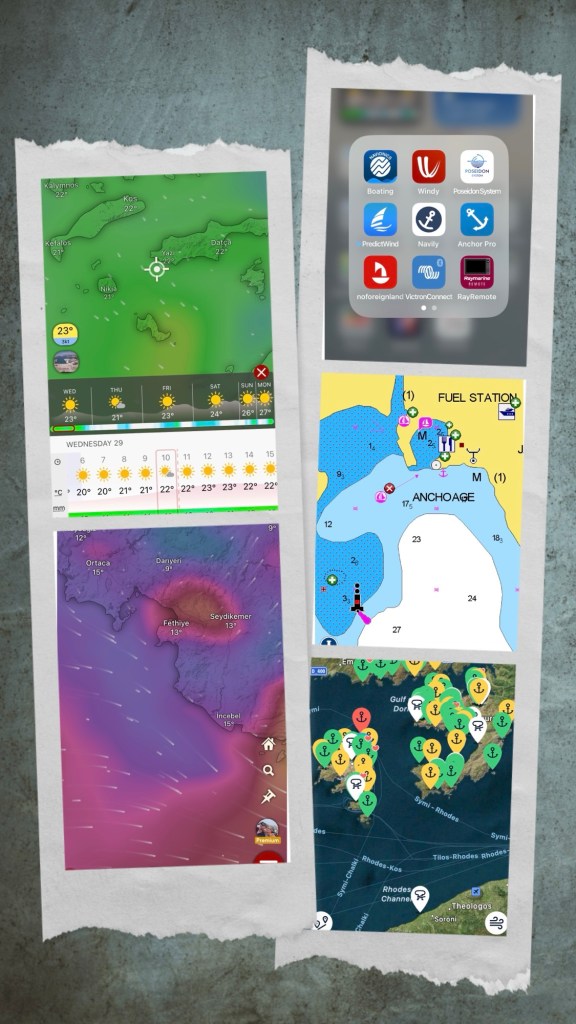
2. On Windy these pretty pinks and purples are a sure sign that we will be anchored somewhere save preferably with a nice big mountain between us and the very strong winds they represent.
3. These are some not all of my boating Apps.
4. This is Navionics on my phone. It replicates our navigation on the charter plotter on the boat. It’s the modern sailors charts and maps. Rightly or wrongly we don’t have physical maps on board … at the moment. We can both use them and when we go for long off shore trip, like crossing the Atlantic, we will consider having them on board as a redundancy. At the moment our connectivity does not warrant physical maps.
5. Finally this picture is from Navily and gives you an idea on just how many anchorages, ports and marinas we have to choose. So much to see, and so much time to do it in.
So before leaving Ekincik, the crews of SV Longo and SV Chill convened a war counsel to determine a safe place to hole up until the pernicious wind gods blew out their idjits. Idjits are not related to idiots but that icky jittery feel you sometimes get when stupendously bored. I do sometimes wonder if the wind gods are idjits idiots.
Lately, I’ve been trying to help out more with trip planning and anchorage choice, so I took a seat at the big kid’s table, and I didn’t even don my skirt and bangles.
Serce Limani (Sparrow’s Bay)
Our chosen bolt hole is called Serce Limani or Sparrow’s Bay. It has a narrow entrance that opens out into a nice T shaped cove surrounded by hills. We decided to take up a mooring ball outside of Captain Nemo’s, a rustic restaurant. It’s been a while since used a mooring ball and a first for SV Chill, but the staff of the restaurant gave us a hand, and it all went without a hitch. When the winds came in, we listened to it howl over the tops of the hills snug in the knowledge that we were safe. I helped pick this spot, so I was feeling a bit pleased with myself.
The cost of the mooring was a meal at the restaurant and as it was still early in the season, Captain Nemo was happy for us to stay a few nights even though we only ate there once. The food was simple, the beer was good, and the anchorage very safe.
Before the big winds hit, Ian, Ali and I decided to take a hike over to the next anchorage which is one of Ian and my favourites coves in Tϋrkiye. The cover photo of our blog pages shows Longo sitting pretty tied back to the shore of this cove.
We were halfway up the hill on our walk when Ali, said from behind me in her very calm English accent “there’s a snake”. My exclamations of alarm and wild gesticulations must have been comical compared to her calm utterance. When she pointed over to the other side of the ravine to a cluster of dried weeds that was madly shaking, I calmed a little, perhaps it was leaving. A moment later not one but two snakes locked in mortal combat reared up out of the grass, my nerves kicked into overdrive notwithstanding the distance and deep ravine between us and the snakes. The display was impressive and terrifying. I wasn’t taking my eyes of the snakes to grab my phone, but Ian tried to get video. Unfortunately, it looks those photos of the Loch Ness or Big Foot, so you’ll just have to take our word for it – they were huge snakes, with ten-foot fangs and ready to stop their fight and join forces to attack us. Meanwhile the three of us stood transfixed for what seemed like hours but was likely a minute or so, I suspect the others were watching the spectacle, I was panicking.
I had read somewhere that Turkey had only a couple of types of snakes and that they were mostly timid or harmless. As a consequence, I’d started to feel safe and allowed my natural Aussie born and bred fear of all things bitey to weaken. Finally, those instincts came rushing back with a vengeance and I announced “nope! Just nope. I’m done, time to leave”. Unsurprisingly neither Ali or even Ian questioned my decision, and we trooped back down the hill to the dinghy. Later, Ali and I both did some research and separately came up with the fact that there are LOTS of snakes in Turkey (well duh!) and that these feisty ones were most like Ottoman Vipers and yes, they are venomous. They might not kill you as fast as some of our Aussie snakes but your chances of coming out of an encounter breathing when you live on a boat moored in an isolated anchorage is not good.
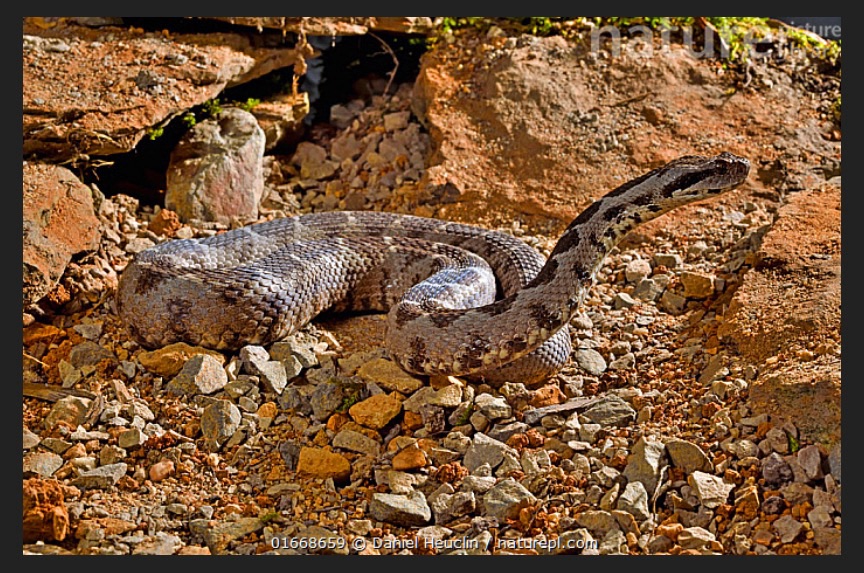
Finally, our pulses and the weather slowed enough for us set out on our next adventure.
Bozburun
Our next port of call was the town of Bozburun, another quaint village with a couple of nice safe anchorages protected from the North-West by large hills. Ian insisted we, he and I, had been here on our first trip along the Turkish coast but I had no recollection of the town and no photos to help jog my memory. It wasn’t until we dinghied into town and were walking through a kid’s playground that I said “that’s right! I had a melt down on that stone fence over there. You were trying to sort out fuel, a pump out and water at the harbour”. Ian held his own counsel on this remembrance as he’s a wise man with years of experience.
Last time we visited Bozburun, we were tired beyond belief. We had just sailed from France to Turkey in too short a time, suffering our first Meltemi stuck on the boat for five days, had a mainsail car break leaving us with only our foresail to work with and then only just scrapping through the Turkish check in (with only two days left on our European Schengen time). We were looking forward to a few nights in the marine but the agent confessed they had forgotten to book it as promised and so we had to bugger off as there was space available. There’s an exceptionally long post about this trip somewhere. Bozburun was only our second anchorage in Tϋrkiye.
My meltdown while sitting on that stone fence was because of the dreaded Turkish black water pump out regulations. These regulations require boats to hold their black water (i.e. what goes down the loo) in a tank “for safe keeping”, I mean disposal. This tank is pumped out every couple of weeks at a marina. The principle of these regulations is noble, it’s supposed to protect the beautiful clear turquoise waters we all enjoy sailing. The reality is vastly different. Our observation is that these regs only to apply to foreign boats and not the local tourist boats or big gϋlets. Not unreasonably we are required to pay for these pump outs. The cost varies, our most recent one being 1,000TL (about AUD50.00). The cost of this service is determined by the volume in your tank.
We’ve had successful pump outs where they pump out the entire contents of holding tank, tell us how much they’ve pumped, we get our blue card updated, the official record of the pump out, we pay and go on our merry way. We’ve had partially successful pump outs, where they try to pump out or pump out some of the contents but not all and tell us how much etc etc. Or before doing the pump out they ask us how much they are going to pump out because we all know how many litres we flush, right? We’ve learned that if we say anything less than 50 litres it’s cheaper. Finally, there are the virtual pump outs, where you take a guess at how much you’ve been carrying around for the last how-ever many days, pay the arbitrarily determined fee, receive your all-important blue card tick, and go on your merry way without every having seen a pump out machine.
No matter which kind of pump out you’ve had the next time you’re out on the big blue wobbly, you do what the locals do and release the Kraken*. The Coast Guard are the enforcers and will fine you, sometimes thousands of dollars if they catch you or if you don’t have evidence (the blue card tick and receipts) of pump outs every 14 days. This time allocation is regardless of your tank capacity or how many onboard. *The kraken is what we affectionately call the contents of our holding tanks.
Before continuing I have to say just how proud I am of myself for getting through that without once using the word “poo” once! Shit, I’m good!!
So, the first time we were in Bozburun, I was stressing as we had just been told we couldn’t get a pump out. It hadn’t even been five days and we weren’t due, but in my tired, overwhelmed state it was just too much for me. I will go a long way to keep within the rules. I have given up trying to defend myself against Ian’s claim that I have “good girl syndrome” because he’s right. I’m the overly conservative yin to his mischievous yang. Ian isn’t one to break important rules, but he is more than willing to “adopt local customs”; when in Rome and all that.
This was the memory I had when I saw that little stone fence in Bozburun. Having identified the cause of the blackhole in my memory and relishing how relaxed I’d become; I was now free to fill the space with wonderful memories of a sleepy village loved by the locals.

Sticking to our promise to go slow this year, we hung around for several days just living. Ray and Ali had some bibs and bobs that they needed to do on SV Chill so they took up a berth along the town quay, while we hung out in the anchorage. We met some two and four legged locals. There’s a wonderful restaurant called Osman’s Place, the chef speaks brilliant English and is always happy to have a chat about the region, his time on boats and to help wherever he can. The restaurant even has shower facilities available to us salty seadogs. There was also the quaint laundry service that lowered our washing from a second-floor window using a long rope. There’s even a decent cup of coffee at one of the many cafes and the local market was small but had everything we needed.
When the strong northerly wind came through, we treated ourselves to that guilty pleasure known as schadenfreude as we watched a couple of late arriving charter boats try to anchor and then opt for taking a berth in port. At one point they, one a smallish monohull, and the other a larger cat, were vying for the same berth; the cat won. The mono found a spot but only after he laid his anchor in an interesting right hand turn which had us wondering who he might have overlayed. For the record, We’re not total assholes. When we can we help, we’ll pop the dinghy down and Ian will don the Bundy rescue hat then zoom off to help guide a boat that has trouble. Like most sailors we know we’ll help with docking, tying lines and such, we’ll take lines ashore, offer advice or give a boat a bump to help get it in place. On this occasion there was nothing we could do to help and besides, it was gusty so having the dinghy in the water would not have been safe for us or the other boats. The boats were not in that much danger other than from the actions of their captains. They were both charter boats so hopefully they had comprehensive insurance.
I guess a time will come when our wrongdoings and misdemeanours are weighed against our honourable deeds, and our schadenfreude on this day will be just another grain of sand on the scales. I hear Lucifer holds all the best eternal parties “down below” anyway.
With that I bid you farewell until next time. May your seas be calm, your winds fair and there be a dearth of sea monster for your journey ahead and no mammoth snakes with ten-foot fangs duelling it out in your path.

 Sailing Longo Maï