

Hello, welcome, come aboard. Today’s blog rounds out our adventures in Istanbul. It truly was a once in a lifetime adventure and somewhere I never envisaged myself visiting. We are now just beginning our adventures in Greece, which includes a visit from Ron, Marissa and our little Charlie Love. In the meantime, here is Part III of our adventures in Istanbul. I will also write about our adventures in the Marmara Sea including our visit to Gallipoli soon but first meet Taksim Square and Fener-Balat.
Taksim Square and Galata Tower: Ian had some very important boat job that required him to head down to a suburb that wouldn’t rank on the top 100 places to visit in Istanbul. Thankfully Janine and Craig of SV Inelsamo invited me to tag along on their visit to Taksim Square. So I ditched Ian’s adventure to nowhere and went off to explore with our friends. Janine and Craig had visited Taksim Square before and were the very best tour guides. We ferried across the Bosphorus, then hopped on the Füniküler* that takes you to the top of the hill. *Fun-nik-ul-er; now there’s a word, it clatters over your tongue like a mouth full of lego.
Taksim Square is on the European side of Istanbul and I wasreliably told that it was less touristy than where all the big icons are in old Town. It was still touristy, just less so. A little like comparing the Sunshine Coast with the Gold Coast. For non-Australians apologies for the local reference, please transpose two of your own holiday locations where one is sheer bloody madness and the other is just madness.
Taksim means “division” in Arabic. In times gone by all the water sources for the European side of Istanbul converged here before being funneled of to other parts of the city. Nowadays this impressive square is the heart of the local Istanbul life. The square is lovely but I think Janine and I really started to enjoy ourselves as we walked along İstiklal Caddesi (Independence Avenue), a long pedestrian shopping street, that begins at the Square and leads down the hill towards the Galata Tower and on to delightful laneways that end at the Golden Horn.

Independence Avenue is much like any big city mall. We recognised many shops, name brands and takeaway joints. The significent difference, from the malls in Australia, were the stately vintage buildings. It was still a public holiday so there was a chilled vibe to the pedestrians, local and tourists alike. Janine and I shopped while Craig patiently wandered ahead. It was such a lovely “normal” day. Shopping with friends, trying on clothes, stopping for a bite to eat. Normal from our old life, one of those normal things that you miss only when you return to it after a while.
Along the way we stopped to view the Galata Tower. The original tower was built during Byzantine period (527-565 CE). This poor building has had a somewhat traumatic existence! It was destroyed by fire and folk alike, rebuilt, repurposed, and forgotten by just about every occupier of Byzantium-Constantinople-Istanbul. It’s been a fortified watchtower, fire watch tower, prison, religious sanctuary and more recently a museum. In doing my research into the Tower’s history I came across this quirky little tid-bit, which is just too good not to share.

Hezârfen Ahmed Çelebi, (1609 – 1640) was an Ottoman scientist, inventor, chemist, astronomer, physician, Andalusi musician, and poet from Constantinople. According to one source* Hezârfen means “a thousand sciences” and the title was bestowed upon Ahmed as an acknowledgement of his wisdom. All this at the ripe old age of twenty-three. (Don’t you hate under-achievers!) Ahmed is credited, by at least one contemporary source, as having achieved sustained unpowered flight. He achieved this by strapping on a pair of wings and jumping off the Galata Tower. Remarkably he is said to have landed about 4 kilometres away, on the Asian side of the city. Making this the world’s first intercontinental flight, and the fourth sustained unpowered flight ever recorded. It’s said his inspiration came from the birds and Leonardo Da Vinci’s of course. *hezarfen-ahmet-celebi-the-first-man-to-fly
However being known for your wisdom in 1600 Constantinople was not… well… very wise. It seems that Sultan IV Murat decided our erstwhile genius was “somebody to be afraid of. Someone, who could get whatever he wants and therefore was somebody illicit”. Not wanting such greatest to overshadow him the Sultan gave Ahmed a bag of gold before sending into exile in Algeria where Ahmed died at the age of thirty-one.
Not to be outdone, Ahmed’s brother, Lagari Hasan Çelebi may have survived a flight on a seven winged rocket powered by gunpowder from Sarayburnu, the point below Topkapı Palace in Istanbul (1633). Lagari was obviously wiser than his brother as before launching his craft he joked with the Sultan Ahmet IV “Oh my Sultan! Be blessed, I am going to talk to Jesus!”. When Lagari landed in the sea he swam ashore and quipped “Oh my Sultan! Jesus sends his regards to you!”. For his efforts the Sultan gave him a bag of silver and the rank of Sipahi in the Ottoman army.
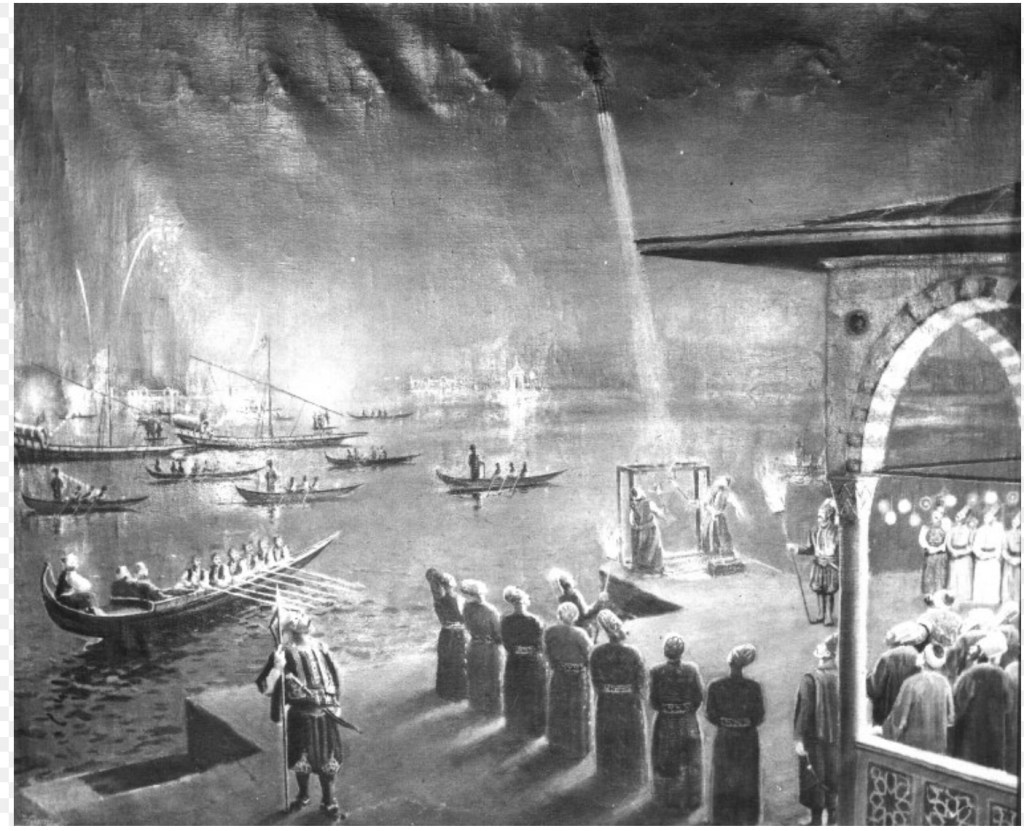
I love a good conspiracy, and wonder if little brother, Lagari had a hand in his brother’s exile. There is after all no competition greater than that between siblings.
Unsurpringly Wikipedia suggests the authenticity of Evliya Çelebi, the Ottoman traveller who documented these events, may not have been reliable. To further erode the validity of an otherwise crackin’ good story in November 2009 Myth Busters tried to recreate Lagara’s flight. However, Evilyas account did not contain sufficient technical detail or the experiment to confirm or debunk claims. Myth Busters concluded that it would have been “extremely difficult” for a 17th-century figure, unequipped with modern steel alloys and welding, to land safely or even achieve thrust at all.
Eyüp and Fener-Balat Suburbs were our last grand adventure in Istanbul and it was one of my favorites for two reasons: it was somewhat unplanned and it was all about the ‘burbs. I’m being a tad cheeky saying this adventure was unplanned. Craig and Janine had a Plan A, Plan B and I think Plan C. These were based on the ferry timetables and our group desire for trekking. Plan B was taking the ferry up the Golden Horn (insert giggle here). There were some interesting sites along the Golden Horn, some beautiful and some downright curious. We left our ferry at the last stop in the municipality known as Eyüpsultanmet or Eyüp.
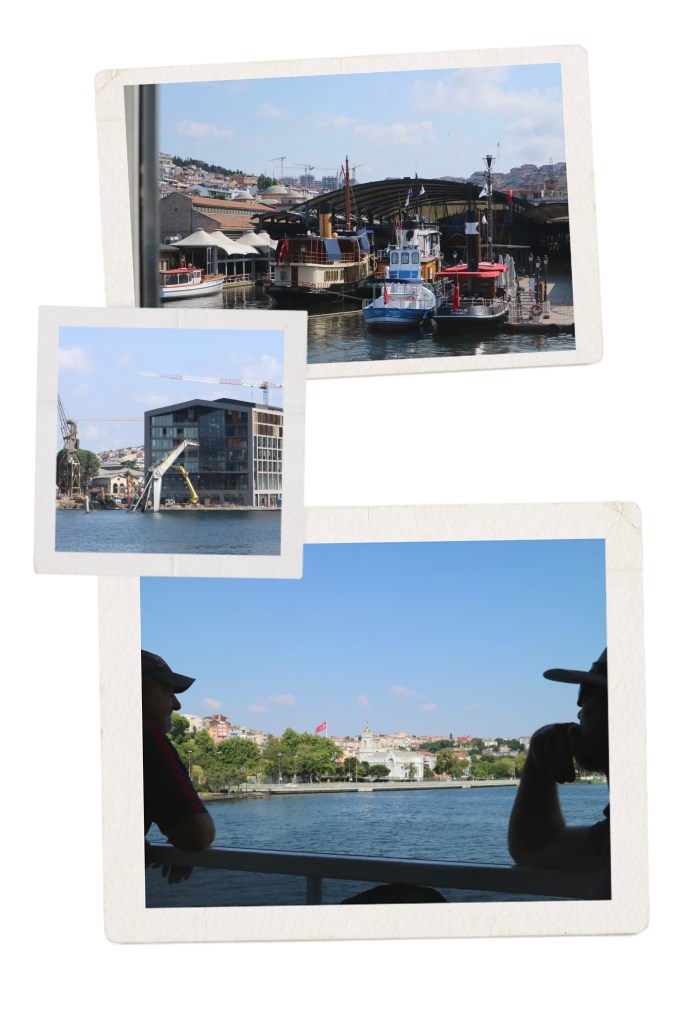
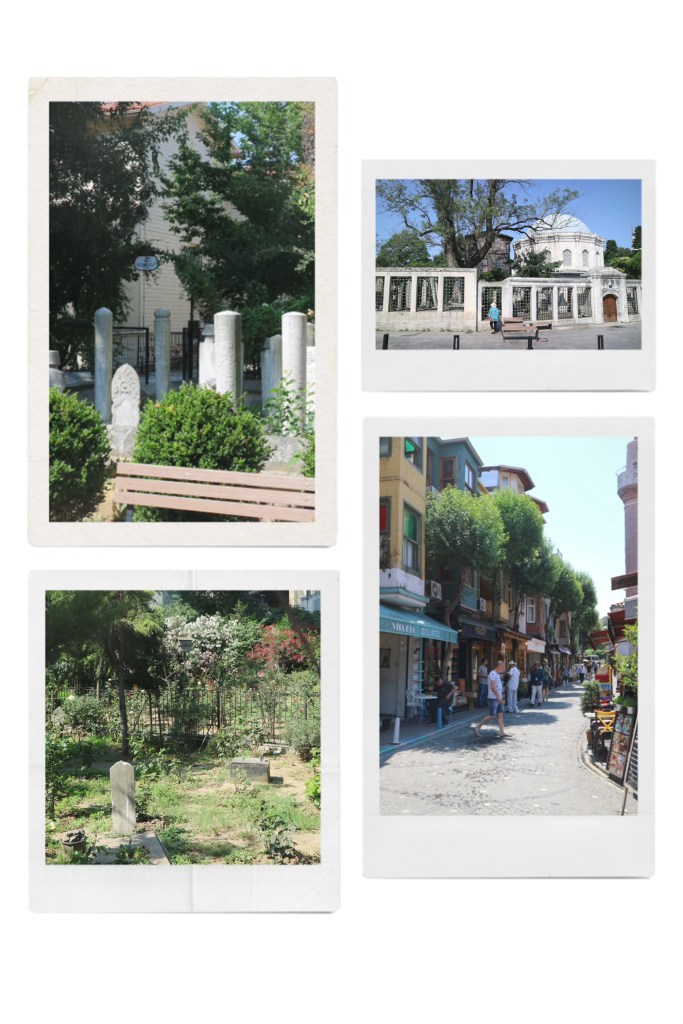
Like the rest of the Istanbul habitation in the area dates back to the Byzantine era. There was a monastery (founded circa 480 CE), saints performing miracles (circa 518-565 CE and more in the 1200s ), some equally important civil wars, some seiges, a coup, attacks by crusaders, state meetings and visits by quite a few historical notables. So like the rest of Istanbul a place with a past and a character all of its own. The municipality has numerous churches and many more Mosques. The Eyüp Muslim cemetery is one of the oldest cemetries in Istanbul and which was very popular with sultans and other important dignitaries as the tomb of Ebu Eyyûb el-Ensarî (or in modern Turkish Eyüp Sultan). Ebu was close companion (sahaba) of Prophet Muhammad, he died during a raid against Constantinople and wanted to be buried as close as possible to the city walls.
The Eyüp we saw was a mix of old and new. More old than new with a definite working class feel to it. There was a lovely green park along the Golden Horn but it was overshadowed by major roads and shady backstreets. Not “drug lords, pimps and muggers” kind of shady. Though perhaps overnight? Who knows? Still the neighborhood had its charms at least in the daylight.
We continued on our way and found ourselves in Fener-Balat. These were once the Jewish and the Greek quarters of Istanbul. In the mid 1500s Sultan Bayezid II offered citizenship to Jews and European Muslims fleeing the Inquisition in Spain and Africa, and the 1492 Alhambra Decree (forced expulsion of the Jewish population from Spain). Many of these refugees settled in Fener-Balat. However, Fener-Balat today is overwhelmingly Muslim, with most minority populations having left the district or were forced to leave as a result of the Armenian genocide and the Greek-Turkish “population exchange”.
These suburbs are an odd mix. The joyful sherbert hued buildings and the river create a pretty facade behind which lurks a dusty rabbit warren of mid-1800 and 1900 apartment buildings in varying states of disrepair. We came across the weekly pazari (fresh food market) in one back street. Going by the chatter that followed us through the market the locals were not accustomed to having tourist wander so far back in the suburb. They were friendly and curious though reserved. Other parts of the suburb are geared up for tourists with funky cafes, groovy shops and crazy curiosities.

1. The impressive red building is the Church of the Virgin Mary of the Mongols
2. I may have threatened Ian with the purchase of the sunflower ‘kini top and/or adoption the kitten. Ian was more concerned about the kitten than the top!
Throughout these suburbs there are remnants of the ancient Walls of Constantinople . These walls are some of the most substantial and long lasting defensive additions to Constantinople. The first walls were built by the Emperor Constantine. They are said to be “the last great fortification system of antiquity and one of the most complex and elaborate system ever built.” (wiki). Countless improvements, repairs and additions have been undertaken throughout history. While many of the ruins that remain date back to the Ottoman period, it is the double line of the Theodosian Walls built in the 1400s that are considered the penultimate defensive structures. At the height of their use these walls were impregnable. They withstood sieges by the Avar-Sassanian coalition, Arabs, Rus’, and Bulgars, among others. The introduction of gunpowder siege cannons being the only credible threat to the fortifications. The siege cannon used was 8m long and fired a 700kg projectile 2.5km, but it could achieve a maximum rate of fire of 3 rounds per day. Even this level of cannon technology was insufficient to capture the city on its own. Through a combined effort the walls were finally breached and Constantinople fell under the sheer weight of numbers of the Ottoman forces on 29 May 1453. (This willingness to accept incalculable deaths in order to achieve a goal is a recurring theme in Ottoman and Turkish history.)
The walls were largely maintained until the 1800s when the city outgrew its medieval boundaries, and sections were dismantled and repurposed. Despite lack of maintenance and wanton “recycling”, many parts of the walls are still standing today. In the 80’s a large-scale restoration program begun and the remnants are now mostly protected.
The segments of wall that we came across during our walk were well tended. They were “repaired” not “restored” using wooden frames to support crumbling parts of the structure. In other parts of Istanbul the walls are incorporated into more modern buildings. We saw numerous examples of modern houses being built on top of the ancient walls or have repurposed these walls as retaining walls.

It was a great day of adventuring, with lots of stops to eat, drink and be merry on the way. It ended with Ian attempting to drag us back to see his fireworks dealer. However, the heat and crowds of the Bazaar bested us and we headed back to our floating homes.
Not long after this we moved on to the satellite town of Yalova where we encountered the dreaded pterodactyl but that’s a story for our next post.
Fair winds and a dearth of sea monsters on your travels through life.

 Sailing Longo Maï