
Hello, welcome, come aboard. Part II of our adventures in Istanbul. Unlike most of our adventures, where we just charge in like a bull at the gate, we decided to begin our stay in Istanbul by doing a guided tour. We knew there is was much to see and many friends had given us advice. However, we thought that supplementing this with a walking tour with a local, designed to orientate new visitors, would enhance our exploration of this rich exotic city. We were guided through the old town precinct, viewing all the important sites: The Hagia Sofia, Sultan Ahmet Camii (also known as the Blue Mosque), the Basilica Cistern etc without stopping to enter them or to really take in their outwardly beauty. Instead, we made notes about the best times to visit those that interested us, which ones to miss and other tips that would make our explorations easier. We will do this again and thoroughly recommend it to anyone travelling to “big” locations.
In the afternoon we boarded a ferry for a tour of the Bosphorus Straits and Golden Horn. It’s possible sail along the Bospherous (motoring only) all the way into the Black Sea. The likelihood of a “next time” in Istanbul with Longo is very slim, and doing this trip would add another sea to our list, but we decided that the trip through one of the worlds busiest waterways was something we would put on the “maybe next time” list. We’re learning that while we have all the time in the world, there will always be choices to be made between this or that adventure.
Having found the lay of land, we planned our assault on Istanbul, we took time to first explore Kadiköy (see Part I). Then the following day we set off early to hit to the big attractions. The history of most of these is well known and well documented so I won’t bore you with the usual historical data, instead here are some quirky and lesser known facts and our personal observations.
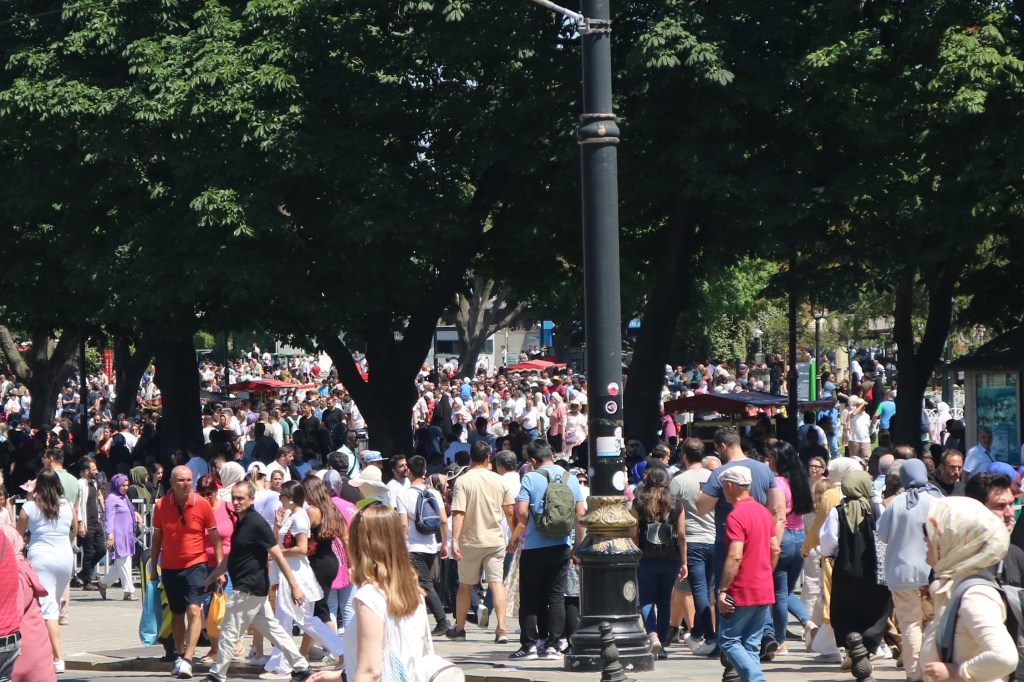
To add a little spice to our experience we found ourselves in a city of pilgrimage during Eid al-Adha. A time when many Muslims, Turkish and tourists alike, travel to Istanbul to worship at the Hagia Sophia and Blue Mosque. Erdogan, the recently re-elected Turkish President, extended the holiday period so many locals had extra time on their hands and it seemed they all decided Istanbul was the place to be. At times this increase in population was daunting, intrusive and downright over powering but our guide had set us up well for success.
Hagia Sophia: A church turned into a mosque turned into a museum returned to a mosque. The name means “Holy Wisdom” and it was completed in 537 AD. Amazingly, the architect knew the area was prone to earthquakes and designed this mammoth stone domed building to withstand them. It has survived many earthquakes the largest coming in at over 7 on the Richter scale. Having survived these earthquakes undamaged, in the 9 CE vikings left their mark on the building in the form of carved graffiti on columns in the southern gallery. Unfortunately this no longer open to visitors but I love the impropriety of these bored men. The graffiti reads “Halfdan was here” and “Ari made these runes.” These men were likely members of the Varangian Guard in Constantinople.

I had great hopes for the beauty and spiritual vibe of the Hagia Sophia. After all it has Islamic and Christian history. Thousands have payed within these hallowed walls. “God’s” presence should be strong here. It is certainly beautiful, especially the enormous low hanging candelabras. The lights have a golden glow that lends the cavernous space an intimate air. I imagine the building could be peaceful and in quiet times imbue a feeling of spiritual calmness. There were many visitors (Muslim and Christian) who obviously felt this way. I envy their faith, which must lay the foundation for their experience because I never felt any of this. This lack of emotion had little to do with the Hagia Sophia being a mosque rather than a church. I am an agnostic. I don’t care what flavour the Devine comes in and how folk choose to worship (so long as it’s not an excuse for base emotions such as hate, envy and superiority). Many religious buildings fill me with awe and wonder. They are expressions of devotion which I feel in my own way. I just didn’t get any profound sense of well being from the Hagia Sophia, it was “just” a pretty but busy building.

Sultanahmet Camii: (The Blue Mosque) (1609-1616) Sultanahmet’s Mosque is popularly known as the Blue Mosque due to its stunning tile mosaics. The blue mosaics are beautiful however I was taken by the striking red boarder designs. I found this mosque held all the soothing hush that I have come to love from religious buildings, perhaps because we entered just after Dhuhr (midday prayers) and the crowds were smaller.
The architect Sedefkar Mehmet Ağa, an Albanian was brought to Constantinople as part of the “child levy” or “blood tax”. Thıs was a form conscription practised by the Ottomans. In addition to the beautiful tiles, the Mosque was the 2nd Mosque to have six minarets. Ka’aba in Mecca being the first, and the holiest, in Islam. The story goes that Sedefkar misheard the Sultan’s request for “altin minareler” (gold minarets) as “alti minare” (six minarets). Folks were not fooled by this and were a tad miffed by the Sultan’s presumption that he could have a mosque that rivalled Ka’aba. To prevent a coup or revolution the Sultan had another minaret built at Ka’aba. There are now a number of other mosques with six minarets in the world. One of the most recent is being built by the current president of Türkiye on the Eastern shore of Istanbul. This new mosque was mentioned by a number of locals we spoke to; all of whom seemed to be embarrassed and apologetic for the avarice of ther current leader or as Ian’s fireworks dealer called him “our new Sultan”.
The Blue Mosque is a glorious expression of devotion or for the cynics out there a magnificent example of avarice (the people paid through taxes to ensure the Sultan’s devotion to Allah was displayed for all the world to see). Whichever way you look at it’s creation the Mosque certainly provokes awe and wonder. Even the sound of a few merry kidlets cavorting around those still at prayer was joyous. I left content and happy with the world.
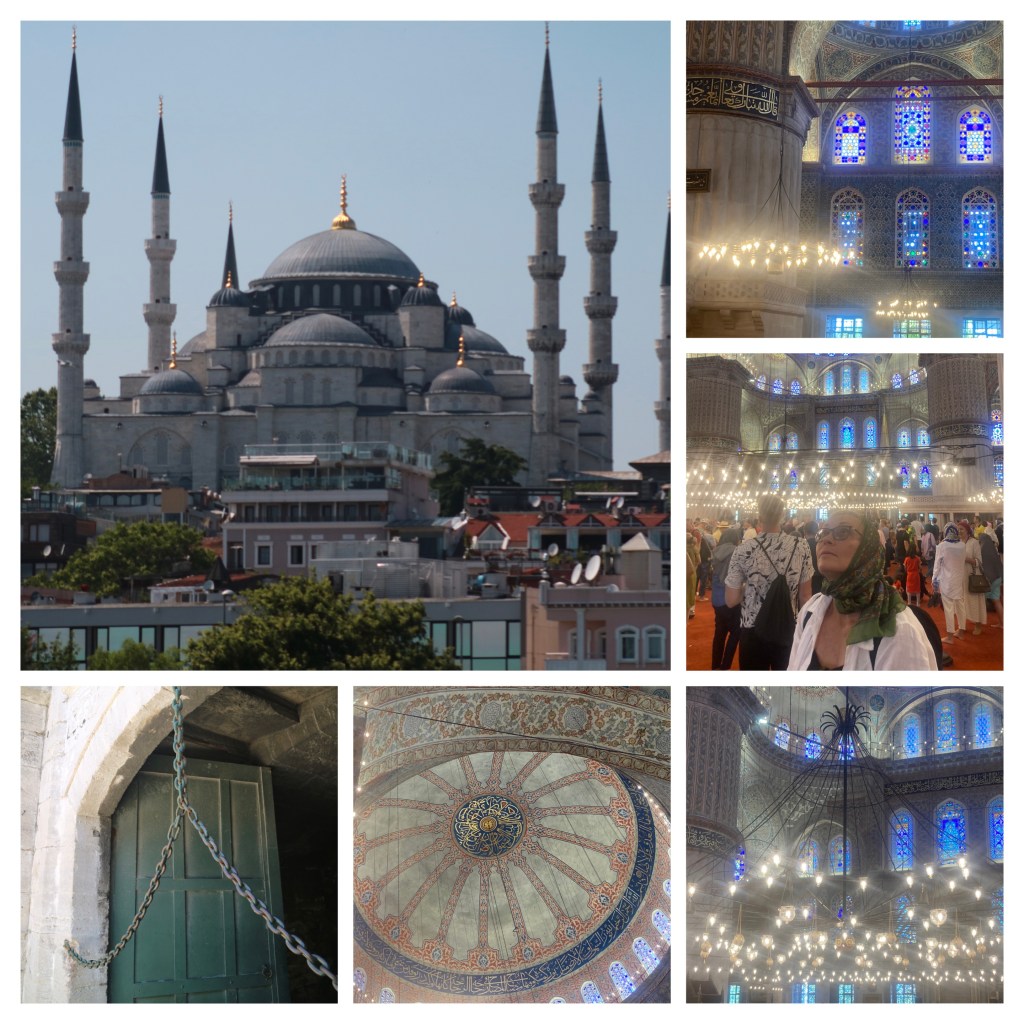
A local explained to us that the chain across the door to the mosque precinct is there to remind us that we must all bow down to the Will of Allah.
Theodosius Cistern: This might be controversial but we didn’t go to the Basicillia Cistern. We’ve heard it is a magnificent architectural construction and worthy of a visit. However the lines were long and the temperature scorching. Besides, we had local intel that we could view the equally magnificent, smaller and older, Theodosius Cistern without standing in huge, round the block, cues and spend more time in an more intimate environment. We were also promised an impressive light show in the cistern.
Emperor Theodosius ordered the cistern be built in 428 CE and it was completed in 443 CE. The Biscillica Cistern had to be reconstructed in 476 CE after it was damaged by fire. The Theodosius cistern is much smaller, with only 32 marble columns compared to the 336 of its more famous younger brother, Basilica. There were number of cisterns built as the city of Constantinople had to have sufficient water to withstand a lengthy siege. The cisterns also had fish in them to indicate if the city’s water supply had been poisoned. We loved the cistern and were terribly impressed by the architecture.

I have a touch of Fomo (fear of missing out) regarding the Basilica Cistern but it is impossible to see everything all the time. I have also added Topkapi and Dolmbaçhe (the Sultan’s Palaces) to the list of ‘next time’ we are in Istanbul.
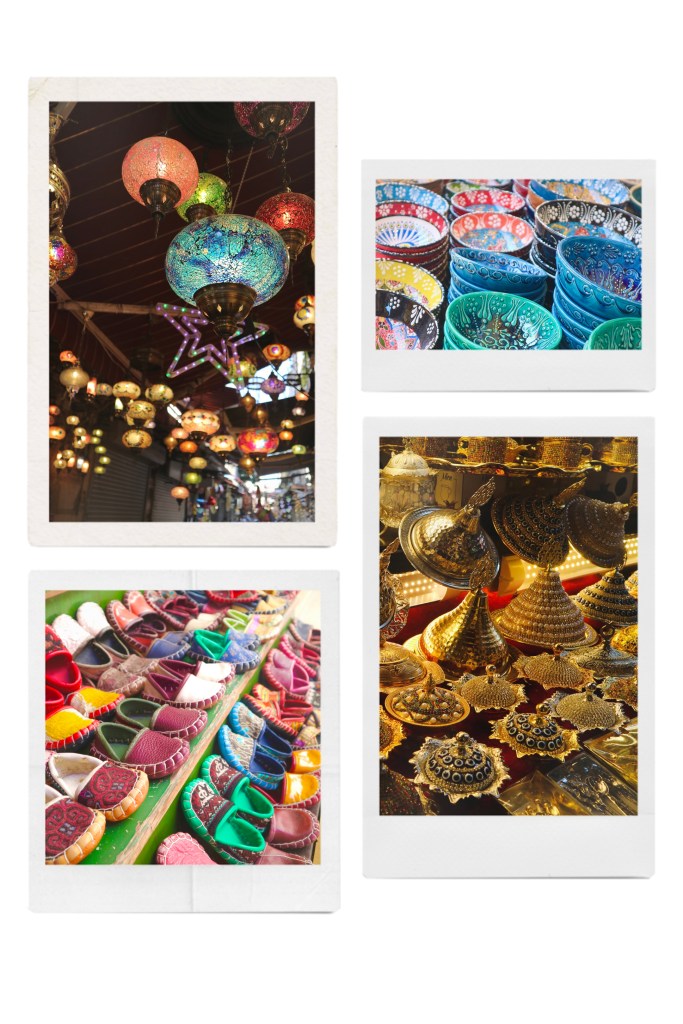
The Grand Bazaar and the Spice Bazaar: We have been lucky enough to visit many “old town” bazaars during our travels in Türkiye. They are mostly touristy and gimmicky. The touters have their patter down and will offer prices based on how much they think they can squeeze out of you. They take your nationality, dress and apparent interest into account when making these calculations. The pazaris (fresh food markets) that we frequent regularly to provision are more authentic and a joy to visit. We weren’t too fussed about mingling with the public holiday hordes in the heat to look at trinkets and fake handbags. So when we were warned that the Istanbul Bazaars were exemplars of the tourist ideal, we decided to give it a miss.
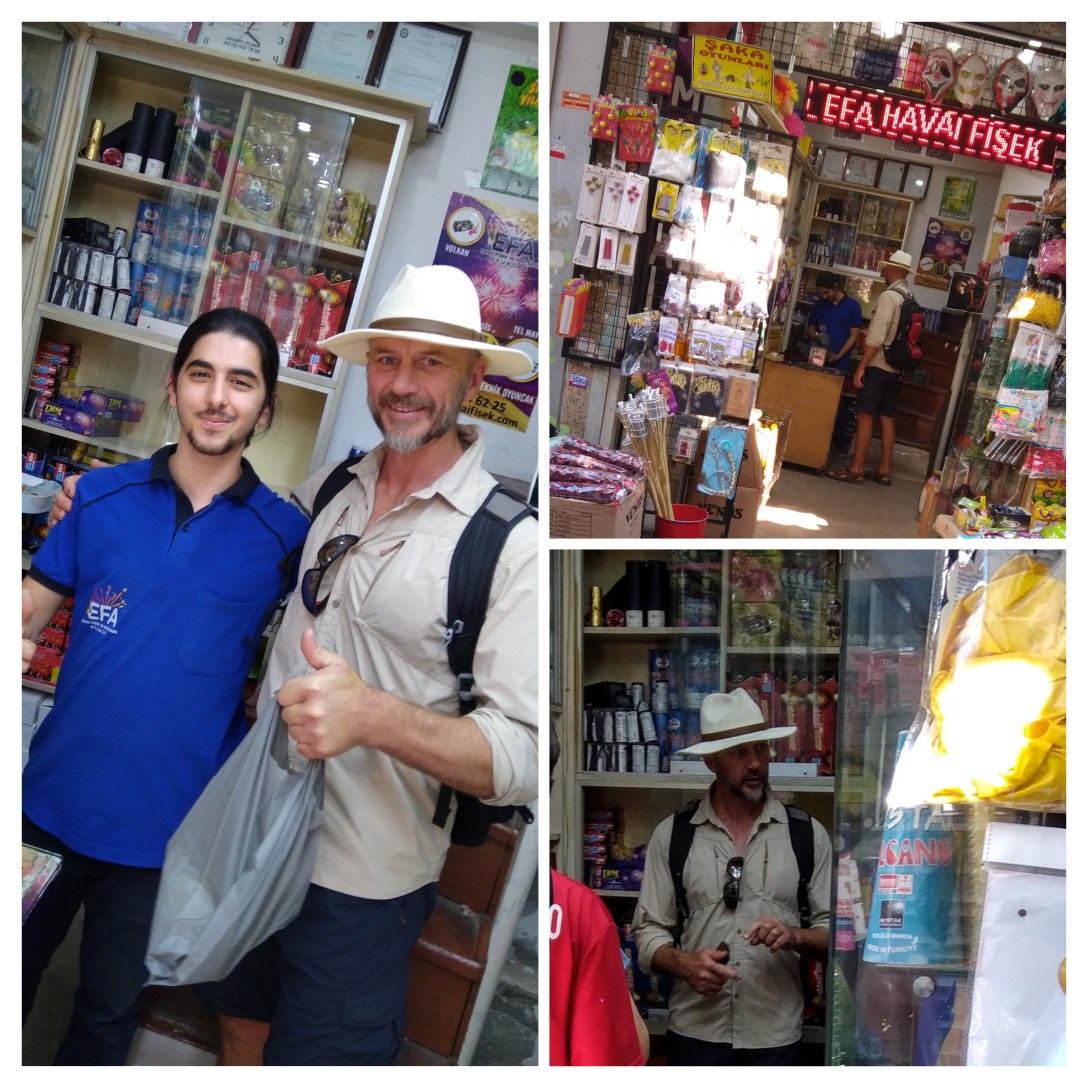
Instead we decide to search out a fireworks merchant that Ian had located on Google. Fireworks are Ian’s catnip. There is no distance, inconvenience nor danger that will keep him from that big bang. When we lived in the States, Ian, who of course likes his explosions to be grand, decided it was necessary to find an 80mm mortar tube to ensure we had the full 4ᵗʰ July experience. So ventured into the underbelly of a Californian town used for reality TV series “Bad Cops”.* It’s OK he had one of his ‘vato’ Mexican mates to act as a local guide; so he’s not completely crazy! The transaction ran smoothly despite initially initial suspicions of being undercover Po Po. A 6’1” guy tall guy with an Australian accent doing an excited dance is unlikely to be Po Po. *California has “safe and sane” or as Ian calls it “safe and lame” laws that downgrade their sparklers to a dull fizz and prohibit anything with more bang than a cap gun.
Following Google or Iphone Maps in some of the older towns or city can be hit and miss. The magic air-ways (GPS signal) doesn’t always penetrate the bowels of the backstreets and laneways. Shops and even buildings appear to come and go, much like the fabled Brigadoon. Then there is the tricky business of translation. We’ve had plenty of experiences when modern technology has been a boon, but just as many when we’ve been left wondering if we’ve entered a pocket of faerie land. So imagine our surprise when despite Ian’s protestations that the shop was not in the old town, Maps led us on an unwavering course into the heart of the Grand Bazaar! It looked like we were going to have the full Istanbul experience!
We’d been given pointers for haggling in the Bazaar. Much as you would expect not showing too much interest is high on that list. Ian is usually very good at this. The exception is when he walks into a shop chock full of fireworks; then he turns into a kid in a candy store and the salesmen rub their hands together with gleeful anticipation.
The quest for fireworks did allow us to stumble upon a great haggling tactic, which we used on our second trip to the store. It goes a little like this: Ian enters the store with wonder in his eyes doing his childlike happy dance. Then asks for ALL the fireworks. When the salesman tells him the price I scold him and walk off in a huff to stand outside the store arms crossed, foot tapping. He then says ‘look my wife is very upset ! Now what about 50% off’. Inevitability the guy says no but Ian persists ‘No? Can’t you see how much trouble I’m in? What about 40% off? I might be allowed to sleep inside tonight if I don’t spend all my money.’ I wouldn’t say it works every time, but 50% of the time it works every time!

Since we were already there. We took the time to explore the bazaar. It was hot and dusty. The kind of heat that makes spicy smells sizzle and burst, when even the dust kicked up from the path is peppery. Colours shimmer in the haze and the air is moistened with the sweat of the people. Surprisingly the noise is not overbearing but it is constant. The hawkers are polite. The crowds of tourists less so, pushing and jostling for position and service. There are fleet footed cats dodging mopeds and sleepy dogs taking up their patch of earth between stalls. I loved it!
That first day was a big day so we didn’t dawdle. Time didn’t matter so much on our next trip across the Bosphorus, we wandered the streets and Ian conscious or subconsciously lead us back to his fireworks supplier because well, you can never have too may fireworks. There will be more stories of Ian’s obsession with fireworks in blogs to come.
Archeological Museum: To escape the heat we spent a few hours (probably too many if you ask Ian) in the Istanbul Archaeological Museum. Fascinating stuff, with a great exhibit on Troy and there were many beautiful shiny things. Of note was the subtle reference to the quantity of Turkish archeological history that has been “relocated” to Western European countries. Many exhibit have pictures of this or that artefact with a note beneath identifying were this precious item can be found (the UK and Germany being the most prolific). The Turks have a right to their history however time and time again we have seen historically significant ruins in this country left to crumble or reused in as recycled materials materials in newer buildings. Our observation is that the best preserved sites are those that have been discovered and protected by foreigners. It’s childish but “finders keepers” comes to mind. However many of the “finders” have decieved, trespassed and misrepresented themselves in order to liberate these treasures. Perhaps I’m reading too much into these little signs but I’m not a big fan of blaming current generations for their ancestors misdeeds. Admittedly its probably time to return these treasures to their rightful owners.

2. And as for the toes … you’ll notice that the second toe is bigger than the big toe. This is a “Greek Foot” or a “Fire Foot”. The ancient Greeks supposedly love this look because it meets the golden ratio aesthetic. More recently it’s been proven that a large number of Greeks – 62% of men and 32% of women – share this trait with Ian.
I had originally thought I’d manage to tell you about Istanbul in two parts but alas lan’s fireworks shenanigans took up too many words. Hence there will be one more instalment to our Istanbul adventures and then I’ll move on to a new topic. Promise!
Fair winds and a dearth of Sea Monsters until we next meet.

 Sailing Longo Maï